Experts Weigh Pros and Cons of Regulating, Taxing Prediction Markets as Lawsuits Continue
Former Cuomo aide says New York should start taxing Kalshi and other prediction market operators.

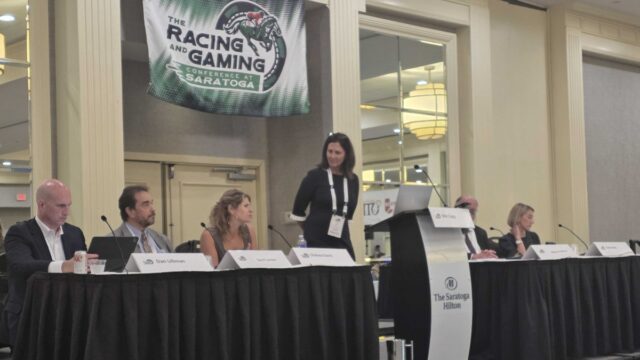
SARATOGA SPRINGS, NY – The story of the year in gambling has been the legal fight between federally regulated prediction markets that offer contracts on sporting events and states that claim the exchanges are illegal sportsbooks.
New York is a current focus of the ongoing battle as the state seeks $36 billion in a lawsuit against Kalshi. So it made perfect sense that last week’s Racing and Gaming Conference at Saratoga held a panel discussion on the topic. That session took place 24 hours before Commodity Futures Trading Commission Chairman Michael Selig used the regulatory body’s “emergency authority” to protect Kalshi from legal repercussions in the Empire State.
A Taxing Question
Katie Neer, a lawyer with Albany-based lobbying firm Dickinson & Avella PLLC, noted that several states have either filed legislation or passed laws that would regulate or tax prediction market operators. She added, though, that she gets why New York has not gone that route so far.
Neer served for nearly three years as the state’s assistant secretary for general government and financial services under then-Gov. Andrew Cuomo. During her tenure, she helped shape policies and lead operations for six state agencies, including the New York State Gaming Commission.
“Perhaps the reason why (New York officials) haven’t taxed the PMs is they don’t want to legitimize that activity while there’s a massive legal play pending,” she explained. “I would get over that. I’d start to capture some tax revenue.”
Before the state filed its lawsuit against Kalshi late last month, the operator proposed a 6% tax on its trades, claiming it would generate about $10 billion in revenue over five years. However, Chelsea Davis, the deputy secretary for gaming, cannabis, and alcohol for New York Gov. Kathy Hochul, said the offer may not have been compelling, since state-licensed sportsbooks pay a 51% tax on their revenue.
Further, the state should not take money from illegal activities, she added.
I’m not going to sit here and say that raising revenue for the state isn’t important. I’m the state’s weed, booze, and gambling lady,” she explained. “I think our role in this regulation is balancing all of that with the public good.”
Davis used the state’s legalization of marijuana as an example of proper regulation. The public supported legalizing recreational use, but they’re not as sold on the idea of prediction markets, especially given some of the contracts they offer for trading on their sites.
“Some of the best with the worst societal consequences, with the least integrity monitoring, is causing a larger backlash,” she said. “It’s causing some bigger questions to be asked about our entire regulatory sphere of gaming. That’s putting a lot more at risk to have this perspective of ‘OK, it’s happening anyway, let’s just tax it.’ It’s putting a lot of our other regulated gaming revenue at risk.”
Regulation Needed to Protect Integrity, Trades
While litigation over prediction markets is underway across the country, the CFTC has continued to propose rules to regulate trading on the platforms. Dan Ullman, a partner with global law firm Orrick, said the federal agency “is sort of hedging its bets” on how the issue will be addressed by the courts, as well as “stress testing” sports contracts to ensure there’s market integrity and fair trading.
“My prediction is that the (U.S.) Supreme Court will decide this,” he added.
Neer added the need for regulation also stems from the vast majority of trading on platforms like Kalshi and Polymarket involving full-time “super forecasters” who make and can move markets.
“That’s not an entertainment-based opinion with a $2 bet, right?” she asked. “So, what about the 20 to 30% of people who are putting their money on that trade? I think they deserve to have some level of consumer protection.”
Can Prediction Markets Help Racing?
Since horse racing is a major part of the conference’s agenda, it was fitting for the sport to come up during the prediction market session – even if it did take nearly 30 minutes to get to it.
While prediction markets have contracts on most other sports, they have, for the most part, stayed away from racing, which is covered under federal law for interstate wagering. Polymarket briefly offered contracts on this year’s Kentucky Derby but retracted them after a demand from Churchill Downs.
Even if prediction markets can’t offer contracts on the winner of a certain race, William Gotimer, a Saratoga Springs-based lawyer, said those operators could fill a niche through tangential opportunities, such as who will win an Eclipse Award or which jockey will have the most wins during a meet.
He explained his reasoning to Gambling Insider after the session concluded.
“Horse racing sometimes suffers from the fact that it’s a little more complicated to bet on than a simple win or loss,” he said. “Sports betting is easy: Do you want Alabama or do you want Indiana? …
“I think people would like to be able to follow, would like to be able to have a financial interest in it, but not necessarily have to get down to the nitty-gritty of betting each and every race. Much like people in either a NASCAR or F1 support a particular team, I think they would like to, on an annual basis or six-month basis, follow a particular jockey or trainer.”


Gambling Insider delivers the latest industry news, in-depth features, and operator reviews that you can trust. Our team combines rigorous editorial standards with decades of specialized expertise to ensure accuracy and fairness. We are committed to delivering clear, impartial, and dependable coverage across the global gambling sector.