Polymarket User Nets 1108% Return After Maduro Capture Leads to Insider Trading Questions
The news that U.S. President Donald Trump ordered forces into Venezuela to apprehend President Nicolás Maduro dominated headlines over the weekend, triggering sharp geopolitical reactions and immediate fallout across prediction markets.


There was a mixed reaction to the capture. Many welcomed the end of Maduro’s reign, which has been marred by allegations of corruption and human rights abuses. Others questioned the legitimacy of the move by the U.S. to overthrow a foreign leader.
Whatever the case may be, one Polymarket user profited handsomely from Maduro’s exit. The timing of those trades has sparked renewed questions about insider trading on prediction market platforms.
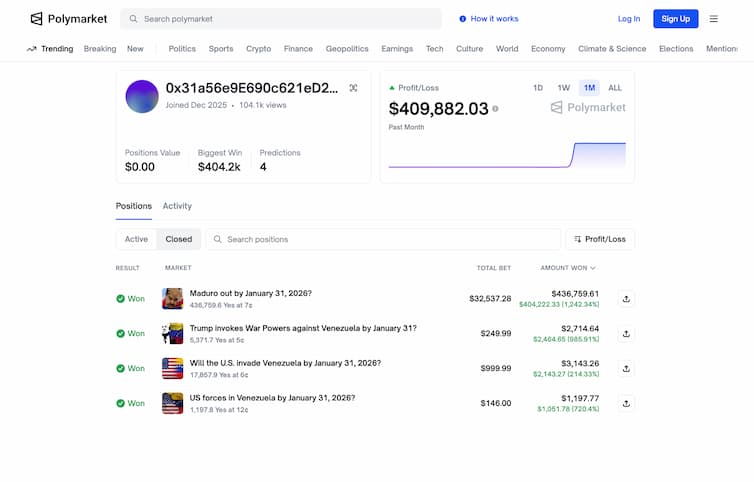
Across social media, users have questioned whether this person had access to insider information to take advantage of the mission. They bet that the U.S. would invade and go to war with Venezuela and that Maduro would be out of office by January 31.
The anonymous account staked a total of $33,933.26 across multiple positions tied to the Venezuela developments. These bets resulted in a profit of $409,882.03, which is an 1108% return.
On-chain data linked to the account shows that the user executed several of the largest trades shortly before the announcement, according to transaction records on the Polygon blockchain.
The Polymarket account was only created in December. It hasn’t made any other predictions.
Persistent questions about insider trading
This isn’t the first time that prediction markets have been subject to allegations of insider trading.
In early December, an account speculated to belong to an Alphabet insider correctly predicted Google’s most searched people of 2025. They won 22 of their 23 bets, resulting in a profit of roughly $1.2 million.
The same account won $150,000 after successfully predicting the day on which Google would release Gemini 3.0.
Then there was the case of Coinbase CEO Brian Armstrong deliberately mentioning five specific words at the end of his Q3 2025 earnings call. Before signing off, he said he was “a little distracted” by the prediction market about what Coinbase would mention in the Q3 earnings call.
He proceeded to say, “I just want to add here the words bitcoin, ethereum, blockchain, staking, and Web3 to make sure we get those in before the end of the call.”
Armstrong subsequently claimed he was “just having a little bit of fun.” Still, his remarks raised the question of market manipulation by an insider. People who were on the wrong end of the trade were unsurprisingly unhappy with his stunt.
Social media users raised similar questions earlier this year after unusual price movements in prediction markets. One example is Taylor Swift’s engagement before it became public news.
Furthermore, another Venezuela-related event was the subject of unusual betting patterns on prediction markets. In October, a series of successful bets was placed on Venezuelan opposition leader-in-exile María Corina Machado winning the Nobel Peace Prize. The users placed the bets just 12 hours before the announcement was made public.
A Major Issue
If someone wins money from using insider knowledge on prediction market sites, there’s a real user on the other end who’s losing out. These markets are a zero-sum game, so it’s everyday people on the other side who were at an information disadvantage.
For now, the regulation of prediction market platforms remains in the hands of the Commodity Futures Trading Commission (CFTC).
The agency primarily oversees market structure, rather than focusing on day-to-day integrity, as state gambling regulators do for sportsbooks. There’s no requirement in place for prediction platforms to share suspicious data with state regulators or an external integrity body to monitor activity.
In contrast, the use of insider information in the U.S. sports betting sector is under strict monitoring. Operators watch betting activity to spot any unusual spikes in volume. If they flag unusual activity, operators pass it on to the relevant authorities for further investigation.
The level of oversight is how former NBA player Jontay Porter received a lifetime ban from the league. Investigators found that he tipped a ring of bettors that he would leave games early by faking an injury when playing for the Toronto Raptors.
The group allegedly made over $1 million before investigators revealed the scheme. The defendants in the case are now awaiting their sentencing.
As prediction markets continue to expand, cases like the Maduro markets are likely to intensify calls for stricter oversight and clearer rules around insider trading and information asymmetry


Gambling Insider delivers the latest industry news, in-depth features, and operator reviews that you can trust. Our team combines rigorous editorial standards with decades of specialized expertise to ensure accuracy and fairness. We are committed to delivering clear, impartial, and dependable coverage across the global gambling sector.