Trump Jr., White House Step Into Prediction Market’s Fight vs. States
The White House and Donald Trump Jr. both emerged in state-level prediction market battles, adding a political dimension to an already contentious regulatory fight.

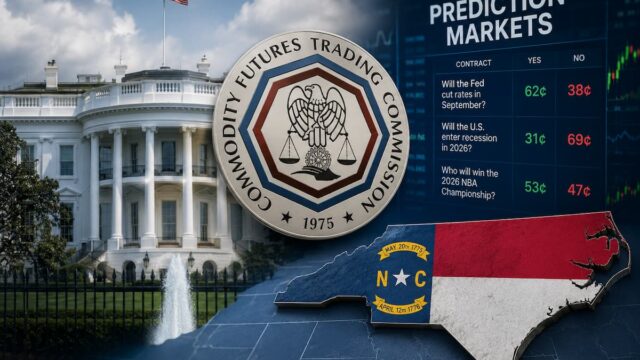
The Trump administration’s support for prediction markets appears to have extended beyond public statements and federal regulatory policy, with new reporting showing that Donald Trump Jr. and White House officials engaged directly with state officials over the growing industry.
According to a New York Times investigation, Donald Trump Jr. made a closed-door pitch for prediction markets to Republican state attorneys general earlier this year. The White House separately communicated its position on state regulation to North Carolina lawmakers as they considered legislation affecting the platforms.
The developments add another layer to President Donald Trump’s public support for prediction markets. In May, Trump called prediction markets a “new form of Financial Market.” He said it was “critically important” to maintain the Commodity Futures Trading Commission’s (CFTC) exclusive authority over the sector.
Trump Jr. Makes Prediction Market Case to Republican AGs
In early March, Trump Jr. appeared at a three-day retreat for Republican state AGs in New Orleans.
Participating in a question-and-answer session alongside Montana Attorney General Austin Knudsen, Trump Jr. made his case for prediction markets. Knudsen’s presence was notable because Montana was among the earliest states to challenge Kalshi’s sports event contracts. State regulators issued cease-and-desist letters before Kalshi sued Knudsen in federal court.
Trump Jr. argued that state officials were being influenced by a “vested interest”: traditional gambling companies seeking to protect their “monopolies” by opposing prediction markets, according to four people familiar with the remarks cited by the Times.
He also characterized prediction markets as sophisticated financial products already subject to federal oversight rather than state regulation.
The comments are notable given Trump Jr.’s financial ties to the industry. He joined Kalshi as a strategic adviser in January 2025 and received a reported $300,000 in company shares as part of his compensation. He is also an adviser to Polymarket, while his investment firm, 1789 Capital, holds a stake in the company.
A spokesman for Trump Jr. told the N.Y. Times that he “does not interface with the federal government on behalf of any company he invests in or advises.”
Kalshi posted a response to the Times story, stating the publication “asked a series of questions, then ignored almost every answer that didn’t align with the narrative that was being pushed. So we’re sharing the answers below.”
Regarding Trump Jr’s presence at the GOP AG’s retreat in New Orleans, Kalshi responded, “He’s a fan of the industry and has his own views. He provides advice on marketing strategy, but he does not advise on regulatory matters.”
White House Weighed in With North Carolina Lawmakers
The White House also reportedly engaged with North Carolina legislators as the state shaped its prediction market policy.
Earlier this year, Democratic Rep. Pricey Harrison and two other lawmakers introduced House Bill 1171, which would have added prediction markets under the state’s gambling statutes. The bill would have explicitly prohibited residents from gambling on prediction markets.
The bill did not advance past its initial committee.
The eventual budget took almost the opposite approach. The legislation imposed a 6% tax on prediction markets as part of the state budget. At the same time, lawmakers recognized that CFTC-registered platforms may legally operate in the state without obtaining a state license.
The Times reported that former North Carolina legislator and current Kalshi lobbyist Jim Harrell helped shape the provision in discussions with Republican House leadership. According to the report, Kalshi’s feedback also helped secure a lower tax rate than lawmakers initially considered. For context, sports betting revenue is taxed at 23% (up from 18% under the new budget).
In its response, Kalshi has this to say about Harrell: “This is literally what lobbyists do – represent client interests and help inform legislators regarding potential legislation. Prediction markets and sportsbooks have very different revenue structures, so the state enacted a percentage that contributes roughly the same in tax revenue to the state as sportsbooks.”
The White House Office of Intergovernmental Affairs provided lawmakers with information about “the federal government’s position on state regulation of prediction markets,” a spokesman for North Carolina House Speaker Destin Hall told the Times.
The White House’s involvement does not establish that the administration drafted or negotiated the provision. However, it shows the administration communicating its prediction market policy directly to state lawmakers as they considered legislation affecting the industry.
North Carolina’s approach has since spilled into the national legal fight. Kalshi cited the law to the Ninth Circuit in its case against Nevada officials. The operator argued that state taxation can coexist with exclusive federal regulation. Nevada responded that Kalshi’s embrace of the state tax instead undermines its argument against state authority.
CFTC Lawsuits Show Partisan Divide Among States
The new reporting also puts a spotlight on the partisan pattern in the CFTC’s state litigation.
The agency has sued nine states over their efforts to regulate prediction markets, and Democratic governors lead all nine. However, Kentucky complicates that partisan breakdown. Republican AG Russell Coleman initiated the state’s enforcement action against Kalshi and Polymarket and was subsequently named as a defendant in the CFTC’s lawsuit.
Other Republican-led state officials, including those in Nevada, Ohio, Montana and Tennessee, have also moved against prediction markets. In those Republican-led disputes, the CFTC’s strongest intervention has generally been through friend-of-the-court briefs.
The CFTC has denied that politics influenced its strategy. It said the distinction reflects which states have taken the most aggressive action.
“The C.F.T.C. didn’t pick these states — they picked themselves,” CFTC spokesman Zach Fulton told the Times.


Gambling Insider delivers the latest industry news, in-depth features, and operator reviews that you can trust. Our team combines rigorous editorial standards with decades of specialized expertise to ensure accuracy and fairness. We are committed to delivering clear, impartial, and dependable coverage across the global gambling sector.