DraftKings 2026 Guidance Disappoints, Stock Crashes 15%
DraftKings (DKNG) shareholders can't catch a break – Q4 earnings were a beat, but the stock still fell in after-hours trading. Here's the latest

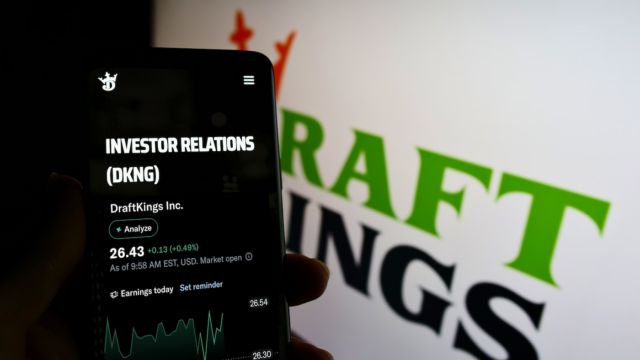
Legacy sportsbook and iGaming giant DraftKings delivered Q4 and full-year 2025 results that were in line with analyst consensus estimates. Still, it wasn’t enough to stop the shares sliding after-hours as the Boston-based company’s 2026 guidance fell below expectations.
Fiscal year guidance came in at $6.5 billion to $6.9 billion, below the forecast $7.29 billion. The 2026 adjusted EBITDA guidance range was $700 million to $900 million, beating the $450-550 million previously stated by management. The Q4 EPS forecast of 0.41 cents was missed with a reported 0.36 cents.
At the close, the shares were down 4.3%, and fell another 14.6% in the post-market to trade at $21.51.
DraftKings’ 2026 guidance confirms that the company’s business remains under threat. That’s despite its defensive move into prediction markets to forestall disruptors such as Kalshi and Polymarket.
The stock hit its fiscal full-year guidance of $5.9 to 6.1 billion in revenue, printing $6 billion (27% year-on-year growth) and $619.9 million in adjusted EBITDA.
Q4 2025 revenue was $1.989 billion, at the top end of the forecast of $1.96-1.99 billion, for year-on-year growth of 43% for the same period in 2024. Adjusted EBITDA for the period was also in line with forecasts and company guidance, at $343 million.
Seasonal factors have positively contributed to performance. The NFL peak season, which generates the highest volumes and favorable hold rates, and the college football playoff and conference championships have helped to drive revenue growth to record levels.

CEO Robins: ‘massive, incremental opportunity in DraftKings Predictions’
Following a downward revision to guidance during the Q3 earnings call, analyst expectations have seen some volatility recently, primarily due to “customer-friendly” sports outcomes — in other words, favorable results for bettors — that impacted margins in late 2025.
Management has previously noted a $300 million headwind from sports results. On the call, expect analysts to be looking for “structural hold” improvements. In other words, indications that DraftKings is getting better at winning regardless of game outcomes through parlay products.
As far as new markets go, commentary on Missouri’s Dec.1 launch will be of interest, as will signs of progress in large remaining states to legalize, such as California or Texas. There may also be word regarding DraftKings’ plans in Alberta, which is set to be the next Canadian province to launch iGaming later this year.
The earnings call is for 8:30am ET Friday.
DraftKings Predictions performance data was not shared in the readout. As the product only went live on Dec. 19, there would not be much to glean. Still, expect analysts to interrogate the team nonetheless.
That being said, breaking news last Friday that the company was expanding its prediction efforts into the NFL and NBA player markets will encourage those looking for an aggressive fightback against Kalshi and others.
We closed 2025 on a high note. Fourth quarter revenue increased 43% year-over-year and we achieved records for revenue and Adjusted EBITDA. Our core business is strong as we enter 2026,” said Jason Robins, DraftKings’ CEO and co-founder in a statement accompanying the quarterly report.
He added: “We also see a massive, incremental opportunity in DraftKings Predictions. We plan to deploy growth capital to build the best customer experience in Predictions, and acquire millions of customers. We have the playbook to execute and win.”
Monthly Unique Players growth freezes up
Robins reported average monthly unique players (MUP) remained unchanged at 4.8 million year on year in Q4. Analysts had forecast growth to 5.4 million.
Taking into account the exclusion of the Jackpocket online lottery, sports and casino players improved 5%.
Average Revenue per MUP (“ARPMUP”) was $139 in Q4 2025, a 43% increase compared to the same period in 2024. The report stated that the increase was “primarily due to higher net revenue margin across both Sportsbook and iGaming”.
A critical revenue driver is same-game parlays, although even in this segment, the prediction markets are breathing down DraftKings’ neck.
By estimates, Same Game Parlays (SGPs) account for 85% of online sportsbook profits. As far as the hold-rate premium goes, parlays add 200-400 bps (2-4%) on top of the hold rate.
Margins of 20% compared to around 5% for straight bets are why parlays make such a high contribution to profits. As the legs involved in a parlay rise, the chances of winning fall at an exponential rate. As a consequence, the house cut (or Vig) increases.
Although parlays offer enhanced payouts, the application of pricing complexity to maximize house profits is another factor that makes these bets such a winner for DraftKings. It is for these reasons that sportsbooks are willing to spend heavily promoting them to their players. Parlays account for approximately 67-70% of online sportsbook revenues.
Jackpocket, which DraftKings acquired in 2024 for $750 million, is another handy revenue generator. The third-party app for buying state lottery tickets was previously estimated to deliver $260-340 million in revenue in 2026, but that estimate has been revised higher.
Extrapolating from Q4, Jackpocket’s EBITDA contribution could reach $150 million, which we estimate could have a 10-15% impact on valuation. Margin could be as high as 44%.
Jackpocket should help cash flow to turn positive for DraftKings after years of spending to grab market share in the super competitive US iGaming environment.
DraftKings Stock Price Trending Lower for the Past Nine Months
The last year has been a “tale of two halves” for DraftKings investors. After hitting 52-week highs in early 2025 driven by profitability milestones, the stock has spent the last 9 months in a steady downtrend. That erased those gains due to guidance cuts and sports results headwinds.
Between February and March 2025, the stock peaked at an all-time high of $53.61, catalyzed by the company’s first full year of positive EBITDA in 2024, the end of the costly ‘cash burn’ period to acquire customers, and the onset of an era of margin expansion.
April, however, marked the start of the pullback. Worries about sports betting tax hikes, particularly in Illinois, prediction markets, and broader market rotation out of growth stocks raised concerns.
Then came the Q3 shock in November when DraftKings reported a surprise loss of $0.26 per share (vs. expected profit) and missed revenue estimates. As mentioned, “customer-friendly” outcomes created a serious headwind. This forced a guidance cut, shattering investor confidence in the predictability of their margins.
Entering 2026, the stock failed to recover. Selling pressure intensified in January as fears grew that the Q3 “hold rate” (percentage of total money wagered that a sportsbook expects to keep as profit) issues were not a one-off but a deep-seated problem affecting Q4 as well.
The stock has now fallen below the crucial $25 level—a critical technical floor — this break of support could signal a return to 2023 lows.


Gambling Insider delivers the latest industry news, in-depth features, and operator reviews that you can trust. Our team combines rigorous editorial standards with decades of specialized expertise to ensure accuracy and fairness. We are committed to delivering clear, impartial, and dependable coverage across the global gambling sector.