Jay Cohen’s ‘Odds Man Out’ Details Rise and Fall of World Sports Exchange, the Template for Modern Day Sportsbooks
The co-founder of an Antigua-based sportsbook laments in his autobiography what he believes was a miscarriage of justice, spearheaded by pro sports leagues, that led to his prosecution.

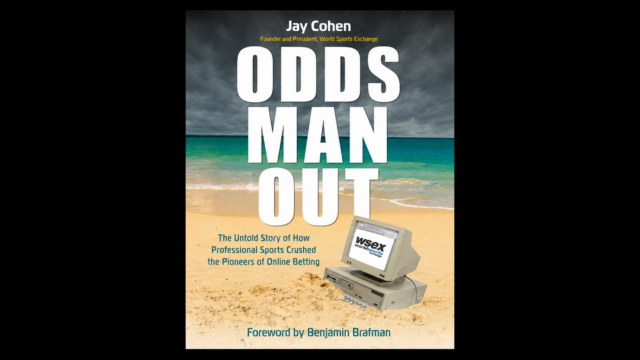
Odds Man Out is a one-sided airing of grievances.
And Jay Cohen has a lot of them.
The just-released memoir exists because Cohen still feels the sting of slight and the aftermath of incarceration 26 years after what he considers a one-sided and rigged judicial process made him the first offshore sportsbook owner convicted under the 1961 Federal Wire Act.
With Caribbean sportsbooks still serving American customers – despite increasing pressure from the United States legal system – and emerging forms of online gambling like prediction markets in the news, Cohen’s tale feels historical and topical. Ultimately, it’s about a guy with a big idea, and a big belief he was on the right side of the law, only to learn that power disagreed. And won.
Jay Cohen and the Germ Of World Sports Exchange
The story has twists. A Long Island kid who earned a nuclear engineering degree from Cal-Berkeley, but found his first calling as a stock trader on the Pacific Stock Exchange and then as the owner of a pioneering online sportsbook in the late 1990s, Cohen eventually also became a convicted felon, serving 21 months in a federal facility.
But the story, as Cohen painstakingly describes in Odds Man Out, is not that simple.
After being indicted federally in 1998, he chose to return to the U.S. from Antigua, where his sportsbook, World Sports Exchange, was headquartered to defend his business in court. He came back assured by lawyers, his belief, and perceived federal precedent that his business was within legal bounds. He chose to do this despite what he saw as a massed effort between a law firm representing professional sports leagues that foisted integrity concerns in previously trying to shut him down and a conflict of interest with the Department of Justice that later successfully prosecuted him.
All along, he bitterly contends, the presiding and prejudiced judge, Thomas Griesa, thumbed the scales by preventing the admission of evidence that would have allowed the jury a more nuanced view of the case.
‘We Thought We Were Doing Everything Right’
Cohen and his friend and late business partner, Steve Schillinger, in a nascent Internet era, in essence created numerous aspects of the online sportsbook experience – including in-game and point-and-click wagering – that are now commonplace.
But even as industry luminaries such as Roxy Roxborough lend their reputations to validating a visionary lesser-known and, arguably, tainted for the mainstream public by his conviction, there is a theme in the book that while WSEX was first, it wasn’t first at the right time. At least according to Attorney General Janet Reno’s Justice Department.
Cohen didn’t see it that way then, and still doesn’t.
“We thought it was the right time,” Cohen told Gambling Insider. “We didn’t say, ‘Hey, we’re early here.’ We thought we were doing everything right and everything was working well, and people liked what we were doing.
“We just got chopped down by the powers that be. Now today, the same people who made such a stink about it, in particular the sports leagues, all their moral reservations seem to have gone out the window.
“Whatever happened to all your hangups about this? I mean, they’re just gone, completely gone, like they never existed.”
Cohen set up WSEX in Antigua in 1995 after being assured by his lawyers that catering to bettors in the U.S., 23 years before the fall of the Professional and Amateur Sports Protection Act, was legal because of existing federal and international law. Business boomed.
The company was the subject of favorable mainstream media coverage in HBO Real Sports, the Wall Street Journal and 60 Minutes, and even took out advertisements in major publications. Cohen’s rationale appeared to have been validated.
Until it wasn’t.
O.J. Simpson, Tiger Woods Spurred Business
Much of the 384-page work details Cohen’s indictment, trial, and the eventual collapse of WSEX in 2013. But Cohen’s evolution makes for a timely arc from the low-broadband age to the modern day, when upstart gambling companies – re: prediction markets, sweepstakes casinos, etc. – are in the midst of their own legal reconciliation, if not reckoning.
Just as controversial sports events contracts sprung from the thought bubbles and egos of contemporary tech and stock entrepreneurs, so did the genesis of WSEX from the floor of the Pacific Stock Exchange, as Cohen and Schillinger fostered an interest in venturing beyond stocks and derivatives.
An opportunity presented itself at the intersection of morbid curiosity and pop culture in 1995.
“It all started with Steve making markets on the O.J. Simpson trial in real time. And that was exciting,” Cohen said.
“But I don’t like to say what we were doing was gambling because there’s a famous quote in one of the sports betting books: gambling is wagering at unfavorable odds. When you’re the house, you’re wagering at favorable odds.
“That’s also what we did as option market makers, as derivatives traders. We always had the odds in our favor, but it certainly required a lot of volume to make the odds shake out.”
Cohen and Schillinger soon left the Pacific Stock Exchange and relocated to Antigua to found WSEX as a traditional sportsbook with innovative exchange elements. Schillinger began posting futures markets, specifically Major League Baseball, and then, Cohen said, “we brought the market-style wagering into live betting where people could bet the game up to the last second. We also had traditional wagering, where people would just bet the game the historical way.”
“It took educating some people to understand the live betting and the future-style betting. Once they learned it, they loved it,” he recalls. “But some of the old timers were a little reluctant to start with that.”
The glory days of Tiger Woods weren’t bad for business, either, Cohen said.
“Tiger Woods was hot, and Tiger Woods would start around $15 or $20 [to win $100]. And you’d have all these other players that were starting at one or $2 and maybe a couple of $5 or $10,” Cohen said. “Steve would keep the golf running for four days. [Bettors] would be actively trading in and out of the golf players, watching every bogey and birdie.
“It was very exciting back then.”
That’s not nearly the case today. Having renounced his American citizenship after serving his time, Cohen, 58, now lives in Eastern Europe with his wife and young son, his first child. Work, he said, is hard to come by despite his educational and entrepreneurial background. He has no connection to the modern sports betting industry, as he struggles to watch what he was punished for creating.
“We were just some guys who started a business and were trying to make money,” Cohen said. “Today, so many businesses, these companies and people, they’re experts in rounds of financing. They’re experts in hiring connected people.
“We were just some guys and started and thought that we did it right.”
Jay Cohen Q&A: Gambling Industry ‘Drove Me Out of Business, Took My Ideas’


Gambling Insider delivers the latest industry news, in-depth features, and operator reviews that you can trust. Our team combines rigorous editorial standards with decades of specialized expertise to ensure accuracy and fairness. We are committed to delivering clear, impartial, and dependable coverage across the global gambling sector.