Beshear Vetoes Bill Updating Kentucky Sports Betting, Gaming Laws
Democratic leader objects to language removing gubernatorial review, approval of gaming regulations

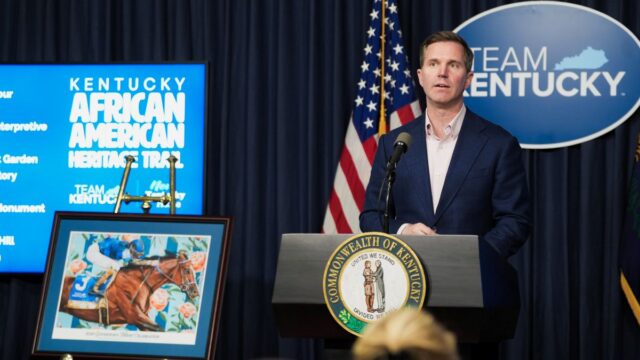
Kentucky Gov. Andy Beshear on Monday afternoon vetoed a wide-ranging bill that would update numerous gambling and horse racing laws that the state’s legislature passed a couple weeks ago.
However, in his veto note on House Bill 904, Beshear mentioned none of those changes in why he sent the bill back to lawmakers. Instead, he focused on a provision that would allow Kentucky Horse Racing and Gaming Corp. and the Kentucky Lottery Corp. to file both routine and emergency regulations without a governor’s review and approval.
Authorizing an agency to file an emergency regulation in this manner would prevent the Governor from carrying out his constitutional duties and allow boards and agencies to impose rules on Kentuckians without executive oversight, including boards whose decisions impact public safety,” he wrote.
So, the veto has nothing to do with sports betting, fantasy sports, prediction markets, racing or charitable gaming. It’s about a fight over the governor’s powers, which has defined the Democratic executive’s two terms in office, dating back to the COVID-19 pandemic.
Monday was the final day for Beshear to act on legislation sent to him by March 31. Beshear’s office sent a press release shortly before 4 pm ET Monday, highlighting several bills the governor either signed into law, let become law without his signature, or vetoed.
That release did not mention HB 904, and the published veto statement showed that the House clerk received it at 4:27 pm ET.
The Kentucky General Assembly returns Tuesday for the final two days of its session, focusing on veto overrides.
Veto Override Likely
The Republicans hold 80% supermajorities in both chambers over Democrats, and only simple majorities in both the House (80 of 100 seats) and Senate (32 of 38 seats) are needed to overturn. That should happen based on the votes in both chambers to send HB 904 to Beshear on March 31.
The Senate’s 24-13 vote featured 23 yes votes from Republicans. It likely would have received more support from Democrats, but concerns about the prediction market language and its possible impact on broadcasting the Kentucky Derby led several Democrats to vote no.
House members concurred with the Senate’s changes with a 64-19 vote, with 10 Democrats among the supporters.
What’s In Kentucky House Bill 904
A 150-page bill sponsored by state Reps. Michael Meredith (R-Oakland) and Matthew Koch (R-Paris), HB 904 was one of the more complex pieces of legislation before the Kentucky General Assembly in this session, as it touched upon many aspects of regulated gaming.
Key provisions in the bill include:
- Sports betting: raises minimum age to play from 18 to 21; prohibits licensed operators from offering “under” prop bets on college athletes from Kentucky-based schools; bars Kentucky-licensed sportsbooks from operating prediction markets in state; requires operators to forward self-exclusion forms they receive to the Kentucky Horse Racing and Gaming Corp.; and bars individuals who owe $500 or more in back child support from placing wagers.
- Daily fantasy sports: creates a regulatory framework.
- Horse racing: mandates the state’s tracks update their pari-mutuel wagering systems; requires tracks to disable all wagering on a race no later than the opening of the starting gate; establishes fixed-odds wagering at in-state tracks; and prohibits tracks from partnering with prediction markets.
- Charitable gaming: establishes an age limit of 21 for e-pulltabs, establishes guidelines for the location of machines and monitoring of games; and increases prize limit from $599 to $1,499.
Beyond the changes to gambling laws, the measure also includes changes to breeding regulations that many in Kentucky’s horse racing industry sought, and the five lines of text Beshear found objectionable regarding the KHRGC and the lottery corporation.
What’s Behind Beshear’s Veto
The General Assembly established the KHRGC two years ago as the successor organization to the Kentucky Horse Racing Commission. That measure also removed charitable gaming’s oversight from the state’s Public Protection Cabinet to the newly formed entity and required KHRGC commissioners, appointed by the governor, to be confirmed by the Senate.
The governor and Republican legislative leaders have been at odds since Beshear took office in December 2019. The crux of their battle has been the powers of the legislative and executive branches. State lawmakers wanted oversight of Beshear’s COVID-19 pandemic regulations. Ultimately, the Kentucky Supreme Court rules the General Assembly served as the policy making branch, and the governor could enact rules and regulations, but only on a limited emergency basis that would require legislative approval to be continued.
There have also been other battles between the two sides over the years, including a fight over the power of filling a vacant U.S. Senate seat. Beshear, considered by some as a possible Democratic presidential candidate in 2028, is in his second and final term in office. His current term ends in late 2027.
Key Charitable Gaming Leader Wants Measure Passed
Beshear’s veto did not necessarily surprise some supporters of HB 904. Last week, Mike Mulrooney, founder of Louisville-based nonprofit Shirley’s Way, urged his group’s supporters contact key lawmakers to protect the bill’s charitable gaming language ahead of their return to Frankfort.
Mulrooney created Shirley’s Way in 2013 in honor of his mother and her fight against cancer. The nonprofit helps cancer patients with everyday needs, including covering expenses. In recent years, the charitable organization has expanded to support children’s causes and partner with other nonprofits. It operates the slot-like e-pulltab machines in several locations in and around the Louisville area.
In a statement to Gambling Insider, Mulrooney said charitable gaming “has become a needed lifeline” for organizations across the state.
Grants and donations have slowed down over the years, and finding volunteers for an event is tough. That’s why charitable gaming is so important,” he said.
According to the Kentucky Department of Charitable Gaming, the amount wagered with licensed organizations grew from nearly $490 million in 2019 to $1.37 billion in 2024. After paying out winnings, adjusted gross revenues have grown from $76.6 million to $151.6 million over that period. Net revenues, the amount remaining after covering expenses, have grown from $47.4 million to $94.9 million.
State law requires charities to keep at least 40% of their adjusted gross revenue. The state average in both years exceeded 61%.
Over that same timeframe, though, charitable gaming’s market share of Kentucky’s legalized gaming handle (i.e., the amount wagered) has gone from 20% in 2019 to 10.3%, largely due to the arrival of sports betting and the historical horse racing’s statewide growth at tracks and gaming halls owned by Churchill Downs and other operators.


Gambling Insider delivers the latest industry news, in-depth features, and operator reviews that you can trust. Our team combines rigorous editorial standards with decades of specialized expertise to ensure accuracy and fairness. We are committed to delivering clear, impartial, and dependable coverage across the global gambling sector.