Horse Racing at a Crossroads with Computer-Assisted Wagering
New York making changes, but will it bring recreational bettors back to the tracks?

Millions of people will tune in Saturday evening to watch the Belmont Stakes at Saratoga Race Course in Upstate New York. As the final leg of horse racing’s Triple Crown, and a rematch between Kentucky Derby winner Golden Tempo and runner-up Renegade, it’s one of the biggest races of the year.
However, there’s something else happening at the track that’s also worth watching. Earlier this year, the New York Racing Association (NYRA) implemented new rules with the intent to curb the impact computer-assisted wagering (CAW) has on the parimutuel odds.
CAW allows VIPs who bet huge sums on racing to make large volumes of wagers at one time. They also have access to data models and algorithms that help them identify prime betting opportunities in the parimutuel pools. These are tools that are not available to railbirds or casual bettors, and the number of both is declining due to the ability of CAW to significantly alter the odds just before the race starts.
“You can’t have these fluctuating odds and ridiculous payouts,” Barstool Sports founder Dave Portnoy posted on X last fall. “Gamblers have to win at least 2x as many times to get the same payouts I got 2 years ago. It’s hard enough to win without being told you now need to win double.”
NYRA Places More Limits
On Feb. 6, NYRA announced that it would prohibit CAW accounts from placing batches of wagers in all wagering pools, including exotic bets like exactas and trifectas, once the timer reaches one minute to post. This policy follows one that the operator of Saratoga, the soon-to-reopen Belmont Park, and the soon-to-close Aqueduct Racetrack, where Resorts World just opened New York City’s first full-fledged casino, put in place five years ago that cut off those accounts from high-volume wagering in the win pool at two minutes to post.
Wagering is still allowed once the timer reaches a minute before post time. However, any bettor, including one using CAW, can only make up to six bets per second.
NYRA still blocks CAW accounts from placing win-only bets with two minutes or less to post. It also prohibits those bettors from playing the tracks’ late pick-5 and pick-6.
It’s still early, but those preliminary numbers show the changes are making an impact. For example, from Feb. 11 to May 25, CAW’s share of the overall handle at Aqueduct was around 13%. In previous years, that figure hovered around 22%.
In addition, the influence CAW has on exacta prices has been reduced by more than 50%.
Jack Jeziorski, the president of NYRA Content Management, told Gambling Insider Friday that the CAW portion of the handle “has been down significantly” for the first two days of the Belmont Racing Festival at Saratoga.
“And we would expect that through the next three days of the festival,” he added.
Handle Down, Hopes Up
The new guidelines came into effect midway through Aqueduct’s winter meet, and according to the Daily Racing Form, the handle for that three-month meet was $194.6 million, off nearly 24% from the $255.6 million wagered during the same meet in 2025.
Limiting CAW access played a role, contributing about 5% of the 23.9% dropoff, according to the DRF. Aqueduct also had 35 fewer races this winter compared to last, due to inclement weather and a decrease in entries. Several of the canceled race days were on weekends, when there’s more wagering, and rescheduled for the middle of the week.
Aqueduct’s spring meet handle, according to data from Equibase, was $82.2 million, a 19.3% decline from the 2025 spring meet total of $101.9 million. However, the 2025 meet ran 16 days, one longer than this year’s.
Based on average daily handle, $5.5 million this year compared to $6.4 million last year, the decline was 14%.
We’re starting to see some indications that the retail market is responding to a better wagering experience,” Jeziorski said.
He added that NYRA will review the guidelines, with the possibility of making adjustments to attract more recreational bettors.
Source of Liquidity
It remains to be seen whether other tracks will follow in NYRA’s footsteps. However, it might be a harder task for some smaller tracks that don’t carry the same cache as Saratoga and Belmont Park.
Experts believe CAW accounts for approximately 30% of the U.S. racing handle. That means those high-volume bettors wagered $3.3 billion of the $11.04 billion tracks reported in 2025 to The Jockey Club.
For some, CAW betting helps them stay afloat, even if it comes at a cost.
“They provide a hell of a lot of liquidity, especially for small tracks,” Dr. Marshall Gramm told Gambling Insider.
Gramm chairs the economics department at Rhodes College in Memphis. He also owns horses and has qualified repeatedly for the National Horseplayers Championship, an annual handicapping contest held by the National Thoroughbred Racing Association. The professor has also written more than a dozen academic papers related to the sport.
Bigger Races Affected by Computers
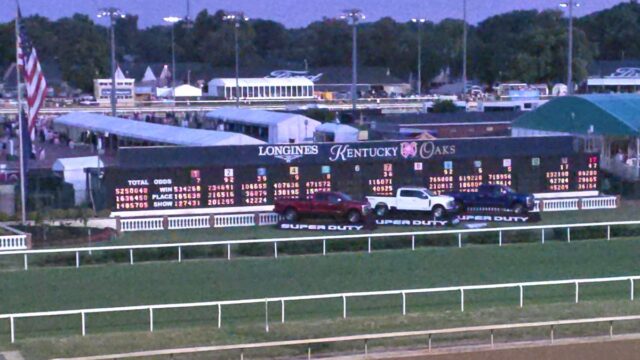
Besides liquidity, CAW can also influence some of the bigger races in the sport. Take, for example, the Churchill Downs Stakes, one of the races on the Louisville track’s Kentucky Derby Day card. The winner of that race, T O Elvis, entered the starting gate with odds of 12-1. By the time the 4-year-old colt crossed the finish line as the winner, a large quantity of bets from CAW accounts at the last minute reduced his odds to 5-1.
The total amount bet into the Churchill Downs Stakes’ win pool was about $4.5 million, Gramm said, or roughly 80% of what was bet on horses to win last year’s Breeders’ Cup Classic.
“The fact that can happen in one of the 15 highest volume races of the year is very, very, very telling,” he said.
He added he’s not anti-CAW like others in racing. Anyone can bet up until the race starts at most tracks, not just the high-volume bettors.
I sort of really admire what they’re able to do,” he said. “Unfortunately, it’s the way they’re taking advantage of the outdated parimutuel system, which I’m more worried about.”
Vegas Redux?
In Gramm’s mind, an ideal solution would be to move away from parimutuel wagering, especially for bets to win, and create a prediction market format.
A prediction market or exchange in racing is probably a long shot at this time, and even Gramm understands that. Support for fixed-odds wagering in racing is growing. Even Kentucky lawmakers passed a bill this year to allow it, but Churchill Downs has no plans to offer it anytime soon.
Now, having a 5-1 winner still can make for a nice day at the track. That said, it is a letdown if you were expecting to get more than double that, especially if you’re a newcomer to racing. And on a day like Derby Day, there’s more than a few of those milling about Churchill Downs.
He compared the current state of racing to where Las Vegas was years ago. Over the years, casinos on the Strip have increased the hold on their slot machines, changed the odds on blackjack from 3-2 to 6-5 and added a triple-zero to the roulette wheel.
The casinos saw revenues increase initially, but at the expense of customers who eventually decided it was no longer worth going to America’s Playground.
“I think horse racing is in this same boat, where they’ve made the game much more difficult and less appealing to casual players,” Gramm said. “So those players become less sticky, and especially in this modern environment where there’s so many other betting options… We’re just driving away potential new horse players.”


Gambling Insider delivers the latest industry news, in-depth features, and operator reviews that you can trust. Our team combines rigorous editorial standards with decades of specialized expertise to ensure accuracy and fairness. We are committed to delivering clear, impartial, and dependable coverage across the global gambling sector.