Prediction Markets Gain Traction Ahead of 2026 FIFA World Cup, Survey Finds
Nearly one in five respondents said they plan to use prediction markets during the tournament, while Millennial interest nearly matched licensed betting apps.

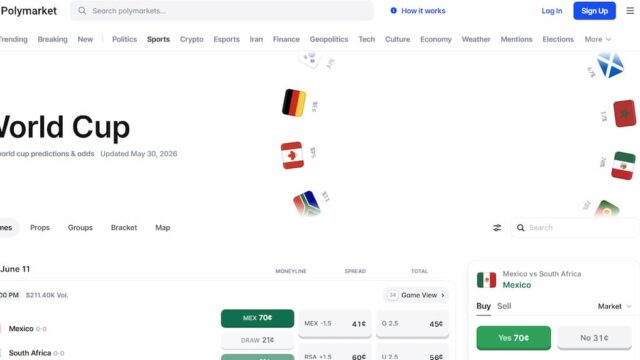
Prediction markets are emerging as a mainstream betting channel, especially among younger bettors ahead of the 2026 FIFA World Cup, according to a new survey from fraud prevention and compliance company SEON.
Among 588 U.S. adults surveyed, 19% said they plan to use prediction markets during the tournament. That trailed traditional sportsbooks (29%), but exceeded social casinos (17%), crypto-based betting platforms (8%), and offshore betting sites (8%).
The findings suggest prediction markets are attracting growing interest as the World Cup approaches.
“Prediction markets let consumers put money behind what they think they know,” George Pace, Lead Product Marketing Manager for Betting and Gaming at SEON, told Gambling Insider.
“That’s always been the appeal, but the World Cup amplifies it. The tournament generates a continuous news cycle over weeks, with hundreds of outcomes to take a position on, from group stage results to individual player performances.
For many fans, especially younger ones, watching isn’t enough anymore. They want to participate, and prediction markets are a low-barrier way to do it in real time.”
Overall, 56% of respondents said they planned to watch the tournament. About 43% said they were at least somewhat likely to bet on the matches.
Millennials Show Particularly Strong Interest
The survey found particularly strong interest in prediction markets among Millennials.
Among Millennial respondents, 36% said they planned to use prediction markets during the tournament. That nearly matches the 38% who selected licensed sportsbooks.
According to SEON, the results reflect broader shifts in how younger consumers engage with sports wagering.
Only 24% of Millennials say they don’t bet at all, the lowest of any cohort surveyed,” Pace said. “Gen Z is close behind at 28%, compared to 70% of Baby Boomers and 56% of Gen X. Younger consumers already manage most of their financial lives through apps. Betting is following the same pattern, accelerated by the expansion of legal sports betting across the U.S. and a general shift in how gambling is perceived.”
Security Concerns Persist Ahead of Tournament
Despite the strong interest in betting, many respondents expressed concerns about platform security. Nearly half (45%) said they were not confident that betting platforms could protect their personal and financial information during a major event such as the World Cup.
The survey also found many consumers engage in behaviors that can create fraud and compliance challenges for operators.
According to SEON, 22% admitted to signing up for multiple betting accounts to access promotions. Meanwhile, 20% said they had clicked a betting link from social media or a messaging app, and 17% reported using a friend or family member’s betting account.
Account sharing risks were highlighted by the NCAA’s recent case involving Texas Tech quarterback Brendan Sorsby. Sorsby was ruled ineligible after placing wagers through accounts registered to other individuals while playing at Indiana University.
The SEON survey also found that World Cup-related scams are already appearing online. One in four respondents (24%) said they had seen social media scams related to World Cup betting. Meanwhile, 20% reported encountering fake ticket websites, and 18% reported seeing fake betting apps or websites.
Operators Face Growing Fraud Challenges
Pace said operators face an increasingly complex balancing act during major sporting events as consumers move across multiple wagering platforms in search of promotions, odds, and betting opportunities.
“Consumers are shopping around for better odds, better promotions, and more markets. Fraudsters are doing the same thing,” Pace said.
Operators have to deliver a fast, frictionless experience while running strong security underneath it; this is during a period when transaction volumes spike and the pressure to get players in quickly is at its highest.”
According to Pace, the growing mix of sportsbooks, prediction markets, social casinos, and other products is creating new fraud-prevention challenges compared to previous major sporting events.
“The biggest change from previous major events is that the ecosystem is wider,” he said.
Consumers are moving between licensed sportsbooks, prediction markets, social casinos, and other products, sometimes in the same session. A bad actor who gets flagged on one platform can move to another with different onboarding standards and start again.”
He added that operators must increasingly distinguish between legitimate new customers and bad actors attempting to exploit major-event traffic surges.
For operators, the challenge is no longer just transaction volume. It’s that new users flooding in during a World Cup may be genuinely new to the platform, or they may be fraudsters taking advantage of the fact that everyone looks new during a surge.”


Gambling Insider delivers the latest industry news, in-depth features, and operator reviews that you can trust. Our team combines rigorous editorial standards with decades of specialized expertise to ensure accuracy and fairness. We are committed to delivering clear, impartial, and dependable coverage across the global gambling sector.