Crypto Casino Investigation: How Big (or Small) is the Industry?
Gambling Insider investigates what's behind the controversy surrounding the radically different claimed sizes of the crypto casino industry. To help us, we ran the numbers at the blockchain analytics platform Dune.


Crypto casinos should be transparent, right, because the transaction data is on a public blockchain? Not so fast. If you try to find out how much money crypto casinos are taking in, you will soon discover that things are not as straightforward as you would expect.
Gambling Insider looked at two headline figures for the size of the crypto casino industry. The first number comes from Yield Sec, which estimates the industry’s gross gaming revenue (GGR) at $81.4 billion in 2024, according to the Financial Times. GGR is the difference between what a gambling company takes in bets and pays out in winnings.
Ismail Vali, the founder of Yield Sec, is confident that $81.4 billion is a realistic reckoning. “We did that work for the FT a couple of years ago… and we stand by it,” Vali told Gambling Insider, who we interviewed to learn how Yield Sec arrived at its much-cited number.
A visit to the crypto casino analytics website Tanzanite reveals a radically different GGR estimate of around $10 billion — an 8x gap.
We had our suspicions that the nature of their respective client bases might explain the delta between the two figures.
Yield Sec’s mission is to help governments, businesses and consumers fight back against illegal financial activities, including illegal gambling, as it states on its website: “Consumer safety is what society requires for gambling to be present and sustainable. Its removal by illegal operators is not a ‘grey market’, a ‘black market’, ‘loss’ or ‘leakage’. It is theft.”
Tanzanite, on the other hand, provides data and consultancy services to the very same companies it reports on, companies Yield Sec unequivocally describes as illegal gambling companies.
Most crypto casino companies are regulated but in offshore jurisdictions such as Curaçao and Anjouan (at the cheaper end of the range) and Malta and the Isle of Man (more expensive jurisdictions).
Does Yield Sec have an interest in pumping up the size of “the problem”, as it would see it? Tanzanite implies as much. In a blog post entitled ‘The $81 Billion Myth Debunked’, Tanzanite pushed back against Yield Sec’s estimate:
“Our assessment indicates a realistic cryptocurrency gambling GGR in 2024 of around $10-11 billion, not $81.4 billion. Suggesting Yield Sec’s reported figure is inconsistent with industry data and blockchain analysis.”
Gambling Insider studied 12 casinos that generated somewhere between $5.7 billion and $11.4 billion in GGR in 2025, a range that spans the lower of the two rival industry estimates for the entire global market in 2024.
$10 Billion or $81.4 Billion? We Try to Find Out Who is Right
We decided to conduct our own data intelligence research to verify Tanzanite’s data, and we followed that up by reaching out to Yield Sec to learn more about the assumptions and methods used to arrive at its $81.4 billion estimate.
We made Tanzanite our starting point because its numbers are based on publicly available data and a transparent methodology. This is not to say that Yield Sec is being non-transparent or underhanded; after all, it has a data intelligence business to run and proprietary secret sauce to protect. However, we wanted to establish an ironclad floor ($5.7 billion), and this was the best way to do it.
For the crypto-uninitiated, let’s quickly walk through what the blockchain is and then get into the weeds of our methodology for validating Tanzanite’s findings.
Every payment made in a cryptocurrency such as Bitcoin or Ether is recorded on a blockchain — a public ledger that anyone can inspect, and that is copied across millions of computers worldwide.
Unlike a bank’s books, this ledger has no doors. Every transaction is visible to anybody, forever. What the ledger does not show is names. Money moves between “addresses” — long strings of letters and numbers that work like account numbers without the name of an account holder printed on them.
That combination — visible money, invisible owners — is what makes crypto gambling hard to measure and, paradoxically, what makes it measurable at all. If you can work out which addresses belong to a casino, you can watch its money arrive in real time. This is what we did.

Finding the Casinos’ Accounts
When a customer deposits money at a crypto casino, the site typically gives them a personal deposit address — think of it as a numbered locker assigned to them.
The casino then periodically empties those lockers into a small number of central accounts it controls, known as “hot wallets” (wallets kept connected to the internet for day-to-day payments, as opposed to “cold” wallets kept offline in storage for security). Count everything flowing into the hot wallets, and you capture, with a short delay, everything customers deposited.
Casinos periodically empty customers’ personal deposit addresses into their hot wallet in a process known as a sweep. Counting arrivals at the hot wallet captures total deposits without double-counting.
The identity of these hot wallets is not officially published — casinos do not advertise their account numbers.
But two independent sources label them. Etherscan, the most widely used public directory of Ethereum activity, attaches name tags such as “Stake.com” or “Rollbit: Hot Wallet” to addresses whose ownership has become common knowledge. One of the Stake addresses we used was separately confirmed by the FBI, which named it in a 2023 press release as the wallet from which North Korean hackers drained $41 million.
The second source is Arkham Intelligence, a commercial blockchain analysis platform whose free tier labels the entities behind addresses; its live feeds let us watch deposits arrive at Stake, BC.Game and Gamdom second by second and read off the current account numbers — including, crucially, on Tron, the network where no public directory tags any major casino.
Counting the Flows
We identified 29 labeled hot wallets belonging to 12 casinos — seven major (Stake, Rollbit, Roobet, BC.Game, Gamdom, Duelbits, Shuffle) and five deliberately chosen smaller “tail” sites (TG.Casino, Lucky Block, MegaDice, WSM Casino, BlockBet).
We then used Dune, a free public tool that turns blockchain ledgers into searchable databases, to aggregate all payments to those wallets across three networks — Ethereum, BNB Chain, and Tron — from January 2025 to mid-July 2026.
Bear in mind that there is more than one blockchain. These are separate ledgers, and casinos accept deposits on several at once. Most of the money arrives as stablecoins — tokens such as USDT, engineered to always be worth one US dollar — which let gamblers avoid the price swings of Bitcoin. Tron matters most: Its transfer fees are pennies, making it the workhorse of stablecoin gambling.
We excluded transfers between the casinos’ own wallets, so internal housekeeping is not double-counted, and ignored payments under $1 and over $50 million.
The free tool stores each blockchain in a separate table, so the work is published as two public Dune pages — one covering Ethereum and BNB Chain, the other covering Tron — with each page listing every wallet it tracks and its month-by-month totals. Between them they hold the complete casino set, so any reader, or rival analyst for that matter, can open either page and rerun the numbers.
For the data analysts among you: the two saved queries — one for Ethereum and BNB Chain, the other for Tron — open on a recent window so they run in seconds on Dune’s free tier, inside its two-minute execution limit. The full 2025–26 history the article quotes lives in the CSV file [download the crypto casino deposits master csv file here].
To rebuild it in Dune, extend the date range and run in roughly six-month windows to stay under that limit — and on the Ethereum/BNB query, switch the blockchain filter between ‘ethereum’ and ‘bnb’ and run each in turn, since the two chains won’t finish together over a long span.
Here’s What We Found
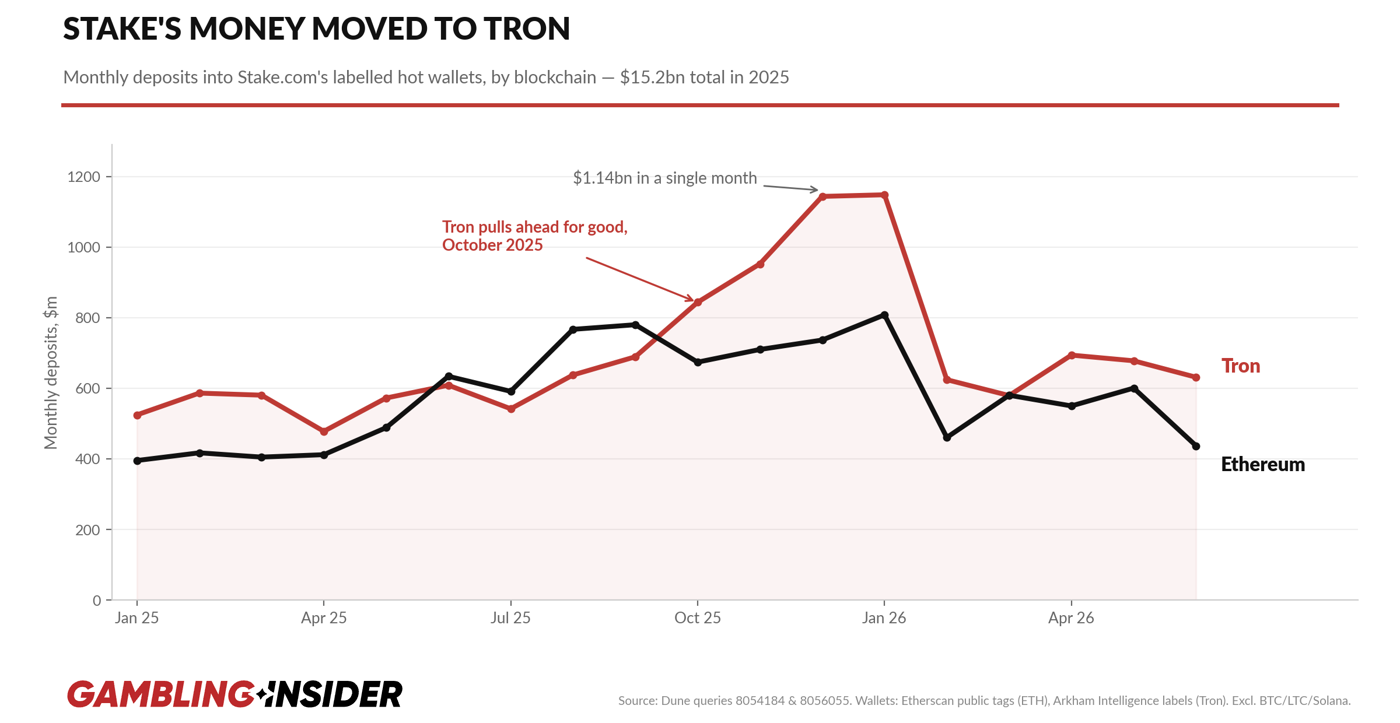
In 2025, the 12 casinos we studied received $22.7 billion in deposits on the three networks. Stake alone accounted for $15.2 billion of it — $7.0 billion on Ethereum and $8.2 billion on Tron, where its business grew so fast that monthly inflows more than doubled over the year, from $542 million in July to $1.14 billion in December.
Tron, where the casino wallets are publicly unlabelled and so slip past anyone working from public tags alone, turned out to carry more of Stake’s money than Ethereum itself. It also revealed the industry’s clear number two: Roobet, which took in $4.2 billion across the year, nearly a quarter of it on Tron, a channel that would have been invisible without wallet-level tracking.
The five tail casinos tell the other half of the story. Combined, they took $151 million in 2025, less than one percent of Stake alone. That number matters because the case for the largest industry estimates rests on the assumption that there are “tens of thousands” of small casinos beyond the majors.
If a typical tail operator handles tens of millions a year, not billions, the arithmetic of the long tail cannot rescue an $80 billion dollar total.
To turn deposits into revenue, the industry’s convention is the ratio of GGR to deposits. GGR runs at roughly 37 cents per dollar deposited, the ratio published by Tanzanite in its blog we referenced above in which it questions Yield Sec’s data. Tanzanite draws the 0.37 ratio from just four chains (Ethereum, Solana, Tron, Binance Smart Chain).
Stake’s deposit figure is not explicitly stated in the Tanzanite blog; it’s implied: $4.7 billion (Stake’s self-reported GGR) divided by $12.7 billion (the implied deposit total from the four chains Tanzanite referenced) = 0.37. The real rate across every deposit a gambler makes, including, for example, the Bitcoin payments this method never sees, is therefore probably a little lower.
Taking this caveat into account pushes the revenue estimate down rather than up, widening the distance to Yield Sec’s $81.4 billion rather than closing it. That is why we don’t lean on 37 cents alone but test a range from 25 to 50 cents.
What This Method Cannot See — and Why That Matters
Our count remains deliberately a floor. Bitcoin and Litecoin deposits are invisible to it, because those older ledgers do not use the reusable labeled accounts this technique relies on, and Stake’s founder has claimed his site alone once accounted for over 5% of all global Bitcoin transactions. Solana is only partially covered.
Money routed through payment processors never touches a labeled wallet.
Our Tron coverage uses the casinos’ current accounts. Stake’s spans the whole period, but Gamdom’s appears only from October 2025, and BC.Game’s from March 2026 (see the table below). Their earlier Tron takings were in predecessor accounts nobody has identified, so even our biggest numbers understate.
And the labels rot. Our data catches Gamdom’s public Ethereum tag going silent in July 2025 and BC.Game’s between September and December 2025.
In early July 2026, it looks like there was a Stake Ethereum rotation. Arkham’s live feeds show all three very much still in business. In other words, a wallet list is a snapshot of a moving target.
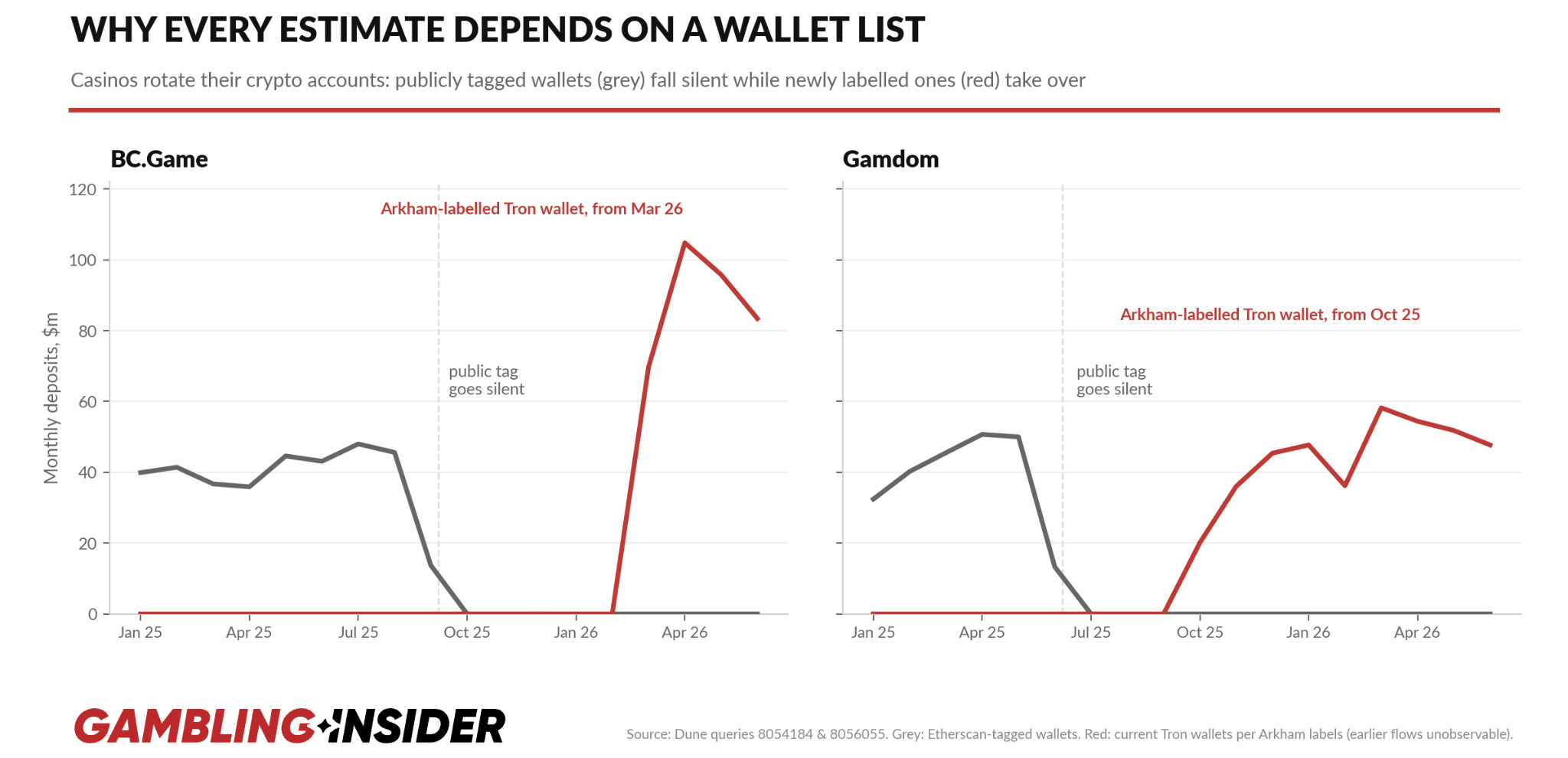
That last point is at the heart of the measurement war this article describes. Every published estimate of crypto gambling’s size depends, at least for the most part, on a privately maintained list of which addresses belong to whom — a list nobody can fully audit. Yield Sec has a different take on this, as we shall see.
Tanzanite, whose ~$10–11 billion industry estimate rests on tracking more than 90 wallets across four networks, discloses its method but not its full list, and the firm consults for the operators it measures.
Yield Sec’s $81.4 billion figure does not come from the blockchain at all. It is built from web traffic monitoring multiplied by unpublished assumptions about spending per visit. Its first published citation is one line — and one chart (see directly below) — in a single Financial Times article.
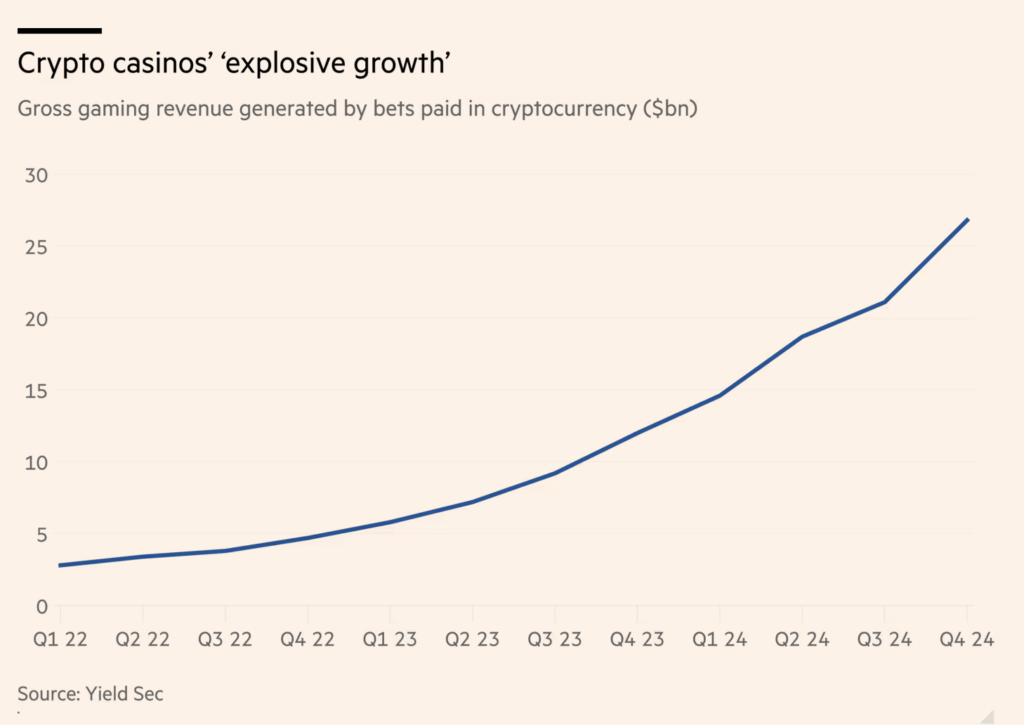
Source: The chart is from the Financial Times article published on April 21, 2025 and is available in PDF format on the Yield Sec website
That chart, the only breakdown of the figure ever published, shows the $81.4 billion accumulating quarter by quarter, ending 2024 at a rate of $27 billion in the final quarter alone. That’s an exit pace of over $100 billion a year, with no published workings behind any point on the curve.
One fairness point should be stated plainly. As far as direction goes, Yield Sec and our data agree that crypto gambling is growing fast. For instance, our own data series shows Stake’s Tron deposits doubling in the second half of 2025.
Where the two part company is level — and there the gap is an order of magnitude. Our exercise cannot settle the industry’s true size. What it can do is establish a hard, checkable minimum — and test which of two numbers, eight times apart, that minimum is consistent with.
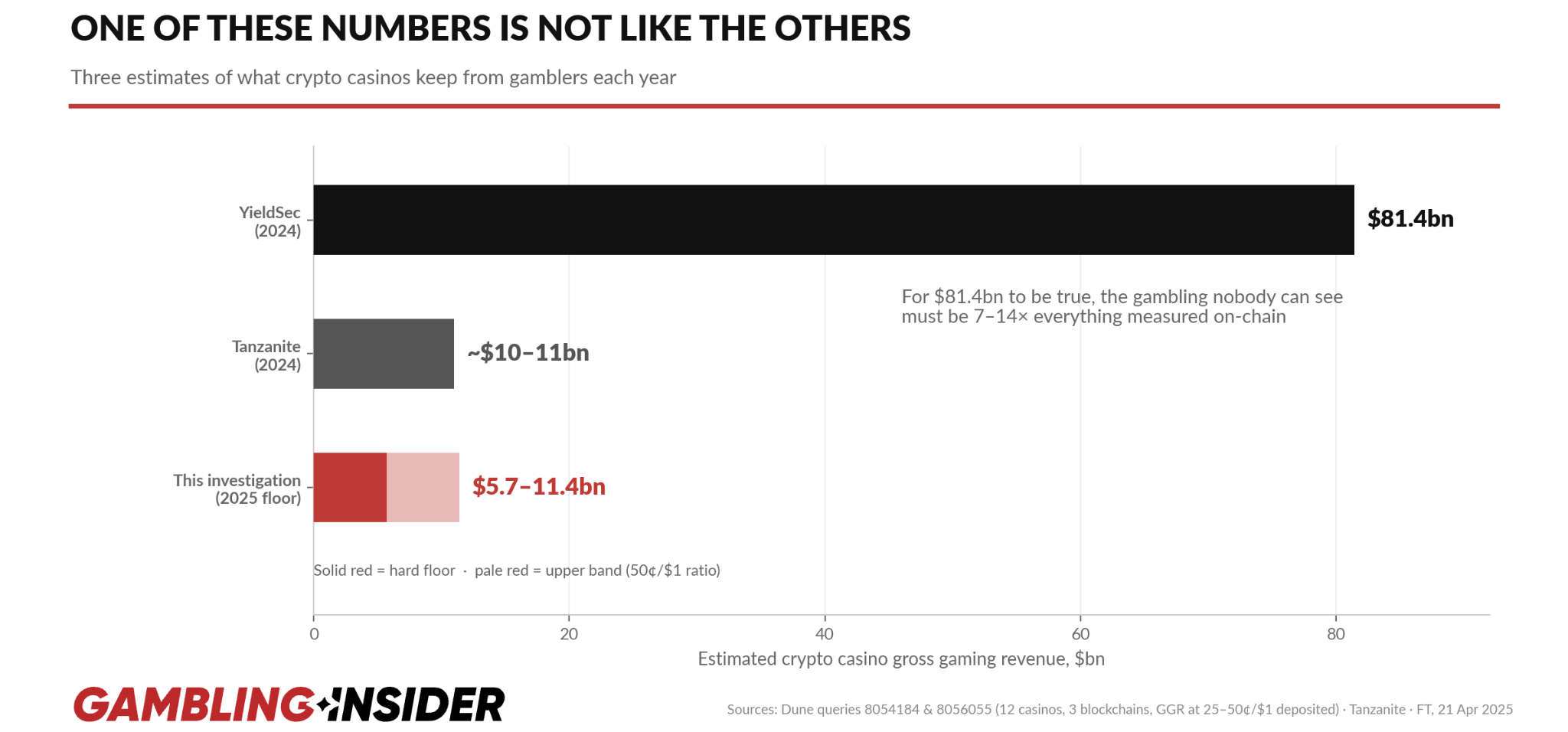
With Tron included, the test sharpens. Our partial floor — 12 casinos, three networks, known gaps — already reaches $5.7–11.4 billion.
For Yield Sec’s figure to hold, the gambling nobody can see would have to be roughly 7 to 14 times larger than everything now measured. For Tanzanite’s, the visible and invisible parts simply have to add up — which, on these numbers, they comfortably do.
Yield Sec’s Ismail Vali on a Mission to Expose the Dark Side
Yield Sec’s Vali, who is now president of Gaming Compliance International (GCI), which acquired the business in November 2025, shared more details on the methodology and assumptions behind the $81.4 billion figure with Gambling Insider.
Vali was at pains to stress that he didn’t have a beef with any other data providers in the space, but he took the opportunity to defend Yield Sec’s work.
In a nutshell, the crypto casino data gap in Vali’s view is explained by two things: definition and scope.
Vali began our discussion with a slide showing the breakdown of the headline figure. Yield Sec allocates 58% of all crypto gambling to “crypto casinos”, totaling $48 billion.
Here’s the breakdown:
Crypto Online Gambling Product Splits According to Yield Sec
| Product splits | % Share | $ Value |
| Crypto Casino | 59% | $48,026,000,000 |
| Crypto Sports Betting | 23% | $18,722,000,000 |
| Crypto Fake Financials | 8% | $6,512,000,000 |
| Crypto Predictors | 7% | $5,698,000,000 |
| Crypto Skins Betting and Trading | 2% | $1,628,000,000 |
| Crypto Lottery | 1% | $814,000,000 |
| Source: Yield Sec. NOTE: Yield Sec proprietary data | ||
“The list of sites in there comes down to a difference between what some people want crypto gambling to be, and what we know crypto gambling to be,” says Vali.
And here’s the definition of what, in Yield Sec’s view, constitutes crypto gambling. It’s a broad definition:
Crypto gambling is any gambling service that defines itself as ‘crypto’ related. This includes using cryptocurrency for deposits and withdrawals, as well as using fiat currency on a gambling operator site/app, and where that fiat currency is converted for the customer into a ‘crypto balance’.
“Crypto gambling also includes products that do not define themselves as ‘crypto gambling’ but leverage the crypto label to convince audiences they are somehow distinct and different from gambling, when all they actually are is gambling. This includes fake financial products, fake trading products and fake investment products.”
Why then does the FT lead with the $81.4 billion figure as the total for crypto casinos?
“The FT thing in particular got notoriety, because they kept saying crypto casino, and hard number is for gambling,” Vali explains. “We don’t control what journalists write — so we can give them the work and they can position it how they want to.
They used a slightly salacious headline by calling it crypto casino when it’s just all forms of gambling in there.”
OK, but the chain doesn’t lie. If Yield Sec is right, then the vast majority of crypto gambling, casino or otherwise, must actually be with regular currency. Read on.
What They Take And What They Tell You They Take
The second reason for the discrepancy in the figures is what Vali describes as “the difference between what they take and what they tell you they take”.
“When these crypto gambling companies talk about on-chain, that’s only when they tell you it’s on-chain. So we are clearly seeing that with a lot of the illegal crypto gaming and crypto gambling companies,” he contends.
“They are moving wallets when it suits them. They go, well, we’ll declare some stuff that’s on-chain, and we’ll declare some stuff that’s off-chain. Also, what happens to all the fiat currency that goes into these crypto gambling companies? None of that’s on the blockchain?”
Vali continued:
We have a view that, basically, there’s regulated gaming, unregulated gambling, and then you’ve got [what’s] unacknowledged as gambling.
“There’s a whole bunch of stuff that jurisdictions may not be saying are necessarily gambling now, as they don’t necessarily have the rules for it in many jurisdictions — but it fits that stake, uncertainty, reward [model], it defines itself as gambling, and when we look at it that way.”
These might be fair points from Yield Sec, though they don’t make our job of verifying $81.4 billion any easier.
Yield Sec Stands By Its ‘Apples and Apples’ Methodology
Vali stands by Yield Sec’s approach and restates the broad brush of its methodology. “Basically, we’re looking at audience and their activity. Some of that will be traffic-related, some of it will be dwell time,” he told us.
“Which pages did they stay on? Which pages did they go through for transactions on this? How many times do you get to deposit page? How many times do you get game pages, basically, and of which nature — sports betting, lower margin; casino pages, high margin, etc.”
“So there’s a whole bunch of complicated stuff we go through to get to where our estimates are. We’re doing that for legal and illegal sites, and we obviously end up with an apples and apples methodology.”
Does our investigation bring clarity to the party? Well, sort of. Our analysis is more verifiable than either Yield Sec’s or Tanzanite’s, with all wallet lists, public tags, Arkham labels fully disclosed, publicly available SQL queries to run against live databases (blockchains), thanks to Dune, and with all blind spots declared. The Gambling Insider findings line up well with Tanzanite’s $10 to $11 billion estimate based on 20 casinos and four networks.
The outlier is Yield Sec. But if Vali is right, that’s not because of sloppy workings. Instead, blame the “salacious” FT headline and a lack of scrutiny over the $81.4 billion number.
In Yield Sec’s world, the $81.4 billion was an estimate for the entire crypto gambling industry, including activities that, on their face, don’t appear to be gambling, but are in Yield Sec’s view. As Vali puts it, “We have a broad definition of what cryptogambling is.”
The growing army of crypto casino users probably doesn’t care much about industry data reporting and just wants to bet on whatever they want. For those users, wherever they are in the world, VPN is their friend, and the regulators are still playing catch-up.
The Reconciliation Table — Numbers Compared
| This investigation | Tanzanite | Yield Sec | |
| Headline figure | $5.7–11.4bn GGR, 2025 | ~$10–11bn GGR, 2024 | $81.4bn GGR, 2024 |
| Covers | 12 casinos (7 majors + 5 tail), 3 networks (Ethereum, BNB Chain, Tron) | ~20 casinos + estimated tail, 4 networks | Claims “tens of thousands” of casinos, all channels |
| Method | Sum of deposits to 29 labeled casino accounts; revenue at 25–50¢ per $1 deposited | Deposits to 90+ privately tracked accounts; revenue at 37¢ per $1 | Web-traffic monitoring × unpublished “value per visit” assumptions |
| Raw deposit data | $22.7bn (2025, published, rerunnable by anyone); Stake $15.2bn, Roobet $4.2bn; the 5 tail casinos $151m combined | ~$1.6–1.7bn/month for Stake alone (published league tables) — our 3-chain count: $1.26bn/month, consistent | None — not blockchain-based |
| Source of wallet list / inputs | Etherscan public tags + FBI release + Arkham labels — fully disclosed | Proprietary; methodology published, list not | Proprietary; neither published |
| Independent verification | Anyone can rerun the two public Dune queries | Partially replicable (this Gambling Insider exercise now substantially confirms it) | None possible; figure appears only in one Financial Times article (21 Apr 2025) |
| Known blind spots | Bitcoin/Litecoin, most of Solana, payment processors, pre-rotation Tron wallets, ~40 smaller casinos | Bitcoin/Litecoin, processors, hybrid casinos (estimated) | Unknown — method opaque; double-counting risk from mirror sites |
| Commercial interest | None | Consults for casino operators (smaller number flatters clients) | Sells monitoring to governments/regulators (larger number flatters the threat) |
| Verdict vs our floor | The measured floor. Hard checkable minimum | Confirmed in substance. Our three-chain floor already spans most of a ~$10–11bn market | Yield Sec says the headline figure refers to all crypto gambling. Requires the market nobody can see to be ~7–14× the market everybody can see |
Table compiled by Gambling Insider
Database queries on Dune:
https://dune.com/queries/8054184 (ETH/BNB)
https://dune.com/queries/8056055 (Tron)
CSV file:
https://www.gamblinginsider.com/wp-content/uploads/2026/07/casino-deposits-master-2025-2026.csv


Gambling Insider delivers the latest industry news, in-depth features, and operator reviews that you can trust. Our team combines rigorous editorial standards with decades of specialized expertise to ensure accuracy and fairness. We are committed to delivering clear, impartial, and dependable coverage across the global gambling sector.