Prediction Markets Weekly Roundup: Litigation Spreads as Congress Joins the Fight
New lawsuits, tribal intervention, and the first federal prediction market bill to advance from committee made for another eventful week.

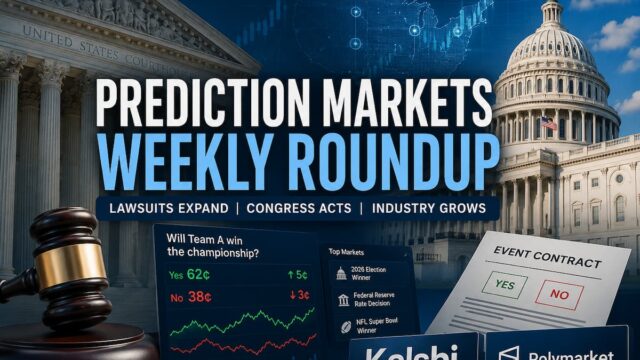
Prediction market litigation continued to expand across the U.S. this week, with the Commodity Futures Trading Commission (CFTC) suing Kentucky, Kalshi challenging Illinois’ recently enacted regulatory framework, and a federal judge remanding Michigan’s case against Kalshi back to state court.
At the same time, Congress advanced the first prediction market bill of the year, tribal gaming organizations deepened their involvement in ongoing litigation, and several companies continued expanding despite mounting legal scrutiny.
Litigation Expands Across Multiple States
CFTC Sues Kentucky
One of the biggest legal developments this week was in Kentucky. The CFTC sued the state in federal court following Kentucky’s recent enforcement actions against Kalshi and Polymarket, as well as its newly enacted prediction market law.
The agency argued that Kentucky’s enforcement actions and recently enacted prediction market law interfere with the CFTC’s exclusive authority over federally regulated derivatives exchanges.
The suit marked the ninth state the CFTC has challenged, and the first Republican-led one.
Kalshi Challenges Illinois
On the same day, Kalshi challenged Illinois’ newly enacted prediction market framework. The law classifies sports-event contracts as sports wagering, imposes taxes, and requires operators to obtain state licenses.
Kalshi argues that the law conflicts with the Commodity Exchange Act (CEA) and the CFTC’s exclusive authority over federally regulated derivatives exchanges.
Michigan Sends Kalshi Case Back to State Court
A federal judge in Michigan remanded Attorney General Dana Nessel’s lawsuit against Kalshi back to state court. The court found that the company had not established federal jurisdiction.
Judge Paul Maloney rejected Kalshi’s arguments that the case belonged in federal court. Maloney found that Michigan’s claims did not necessarily raise federal questions and were not completely preempted by the CEA.
While acknowledging that prediction market litigation remains an evolving area of law, the court concluded the dispute belongs in state court.
Ohio Relies on Michigan Decision in Sixth Circuit Appeal
Michigan’s recent federal decisions are already influencing litigation elsewhere.
Ohio’s Attorney General Andy Wilson filed last week’s decision denying Polymarket’s motion for a preliminary injunction as supplemental authority in the Sixth Circuit appeal involving Kalshi’s challenge to Ohio’s cease-and-desist order.
Wilson argued the Michigan court addressed “a comparable preemption theory,” concluding there was no clear congressional statement demonstrating that Congress intended federal derivatives law to supersede states’ traditional role in regulating gambling.
Tribal Litigation Continues to Grow
Kalshi also moved to dismiss the federal lawsuit brought by several New Mexico tribes. The company argued that the tribes lack regulatory authority over non-members’ activities and that the CEA preempts their claims.
According to Kalshi, tribal gaming laws cannot be enforced against a federally regulated derivatives exchange operated by a non-member.
Separately, tribal organizations are seeking to join Rhode Island litigation.
The Indian Gaming Association, National Congress of American Indians, United South and Eastern Tribes Sovereignty Protection Fund, multiple state tribal gaming associations, and 31 federally recognized tribes sought permission to file an amicus brief supporting Rhode Island’s opposition to preliminary injunction requests filed by Kalshi, Polymarket, and the CFTC.
The proposed brief argues that accepting the exchanges’ preemption arguments could undermine tribal sovereignty under the Indian Gaming Regulatory Act and disrupt a key source of funding for tribal governments and essential public services.
Congress Increases Its Focus on Prediction Markets
First Federal Prediction Market Bill Advances
Congress reached a milestone this week when the House Administration Committee advanced the Stop Lawmakers From Predicting Act. The 5-4 vote made the legislation the first of more than 25 federal prediction market bills introduced this year to move beyond the introduction stage.
The proposal would prohibit members of Congress, their spouses, and their dependent children from trading certain prediction-market contracts.
The bill covers contracts tied to government policy, government action, political outcomes, or other events that come to a covered individual’s attention because of a member’s congressional service.
Senate Democrats Target CFTC Funding
Meanwhile, a group of Senate Democrats led by Richard Blumenthal and Jeff Merkley sent a letter to the Appropriations Committee to block the CFTC from using federal funds to pursue litigation against states over their efforts to regulate prediction markets.
The lawmakers argued that states should retain authority to enforce their own gambling laws while broader legal questions surrounding sports-event contracts remain unresolved.
Industry Continues to Expand Despite Legal Challenges
Legal uncertainty has done little to slow commercial activity.
Meta is reportedly working on a prediction market app known internally as “Arena.” The app would initially allow users to forecast real-world events using points rather than real-money wagers.
Kalshi, meanwhile, exited the Indian market by adding the country to its restricted jurisdictions list. The move came as reports emerged that the company is seeking fresh investment at a valuation approaching $40 billion.
Elsewhere, Novig strengthened its executive team ahead of its anticipated launch. Meanwhile, Rebet and Realtime Sports submitted applications to become National Futures Association members. Additionally, Underdog filed its first rule submissions with the CFTC following its acquisition of Aristotle Exchange.
Polymarket also continued expanding its commercial presence. The company partnered with Relevent Sports to become the official prediction market partner for Bundesliga coverage in the United States.
This week’s developments highlight that the debate over prediction markets is not only in the courtroom.
While courts continue to debate whether sports-event contracts fall under federal derivatives law or state gambling law, companies continue investing in the sector, and lawmakers continue proposing new ways to regulate it, with little sign that the pace of developments will slow.


Gambling Insider delivers the latest industry news, in-depth features, and operator reviews that you can trust. Our team combines rigorous editorial standards with decades of specialized expertise to ensure accuracy and fairness. We are committed to delivering clear, impartial, and dependable coverage across the global gambling sector.