UK Regulator Searching for Answers After Annual Gambling Survey Reveals Uptick in Older Men Gambling
Rising gambling participation among men aged 55 and over and falling help-seeking among older women point to a more complicated picture, despite the annual U.K. gambling survey showing an overall decline in problem gambling.

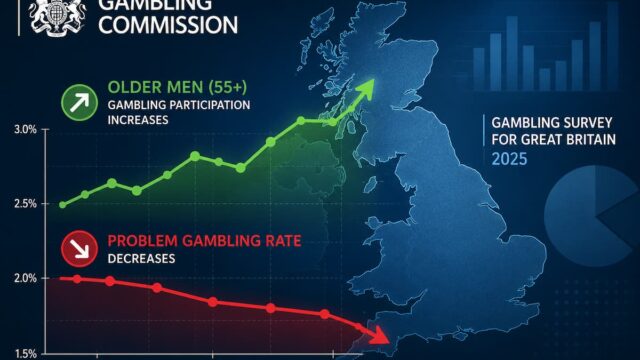
The U.K. Gambling Commission’s third annual survey found that problem gambling declined in 2025. Still, one demographic stood out: men aged 55 and over were the only group to record a statistically significant increase in non-lottery gambling participation.
According to the Gambling Survey for Great Britain (GSGB), published by the commission on July 16, the rate of problem gambling in Great Britain fell to 2.4% in 2025, down from 2.7% the previous year.
The figure represents the proportion of adults who scored at least eight on the Problem Gambling Severity Index (PGSI) and equates to approximately 1.3 million people. The figure fell for the first time in the survey’s three-year history.
Gambling participation among 18 to 24-year-olds continues to fall. It was down to 48% in 2025, compared to 52% in 2024 and 54% in 2023. The 35 to 44-year-old group had the highest gambling participation rate, at 66%.
Men Aged 55+ Showing Significantly Higher Participation
One of the more interesting aspects of the publication was a seven-page trends report comparing 2023 and 2025 across six key measures. The regulator’s own summary states that most of the metrics remained evidently stable.
However, men aged 55 and over represented one exception. Participation in gambling activities other than lotteries during the past year rose from 27% in 2023 to 32% in 2025. The past four-week participation figures show the same pattern, rising from 18% to 22%. No other age group or women showed either pattern.
The outlier is notable because most other demographic groups are either stable or moving in the opposite direction. Non-lottery participation among men aged 18 to 34 went from 54% to 51% during the same period. Meanwhile, the 35 to 54 bracket fell from 49% to 48%. Older men were the only demographic group to show a statistically significant increase in non-lottery gambling participation.
The data also pointed to a smaller shift among older adults more broadly. Participation in non-lottery gambling among people aged 65 to 74 rose from 25% in 2023 to 29% in 2025. At the same time, their participation over the past four weeks increased from 16% to 19%.
The commission conceded that it doesn’t know why this is happening, which explains why it explicitly called for further analysis into which activities older male participants are now more likely to undertake.
Support Gaps Emerging in Older Age Groups
Two other findings reached the significance threshold and somewhat contradict one another. Among 35 to 54-year-olds, the rate of people seeking help for their own gambling rose from 2.4% in 2023 to 3.8% in 2025.
The commission interprets this as a modest increase in the number of people seeking support rather than an increase in the number of people needing help.
The opposite happened with people aged 55 and over seeking support because of someone else’s gambling. The proportion for the group fell from 2.3% to 1.1%. Among women in that age group, the figure more than halved from 2.9% to 1.2%.
In its own conclusion, the regulator makes an unusual point for a statistical release by describing a growing treatment and support gap for women aged 55 and over. In contrast, gambling among men of the same age continues to rise. The report does not explain why fewer affected women are seeking support.
Questions Over the Survey’s Methods
The GSGB and its collection methods have been the subject of persistent criticism since the commission published its first edition.
One of the critics is Dan Waugh, a partner at Regulus Partners and a researcher at the University of Liverpool Management School. In a June presentation, he claimed that the survey produces inaccurate results. He argued that stronger academic scrutiny and tighter commercial controls would expose its weaknesses.
He has highlighted several gaps in the data. Waugh pointed out that the survey estimated that between 467,499 and 611,768 people use betting exchanges. He says the figures far exceed the 172,409 to 177,051 active customers reported by Betfair, the region’s most dominant exchange.
Football Pools, which effectively operates as a monopoly, had about 862,961 participants, according to the survey. This allegedly contrasts with the operator’s own records, which showed 108,699 unique customers, representing a 694% difference.
The U.K. regulator still maintains that it used the correct methodology and points to an independent review and extensive pilot testing conducted before the first survey.
However, one aspect that’s hard to explain is how NHS health surveys have consistently found that problem gambling affects well under 1% of people, while the most recent GSGB survey places the figure at 2.4%.
The debate over the survey’s merits will likely continue, but it still allows researchers to compare annual trends using the same collection methodology.


Gambling Insider delivers the latest industry news, in-depth features, and operator reviews that you can trust. Our team combines rigorous editorial standards with decades of specialized expertise to ensure accuracy and fairness. We are committed to delivering clear, impartial, and dependable coverage across the global gambling sector.