Las Vegas Sands Q2 Earnings: Hold Volatility, World Cup Headwinds Mask Underlying Growth
Las Vegas Sands was down on its luck in Q2 2026, but it is gaining market share in Macau and printing cash at Marina Bay Sands in Singapore.


Las Vegas Sands (NYSE: LVS) released its second-quarter 2026 financial results after the bell on Wednesday, revealing a complicated quarter in which underlying operational improvements were heavily obscured by poor luck at the tables and disruption caused by the FIFA World Cup.
The global casino operator missed Wall Street’s consensus expectations on both the top and bottom lines. The results ended a four-quarter streak of earnings beats and sent shares tumbling in after-hours trading.
Despite the disappointing headline results, LVS leadership remained defiant on the earnings call. Management pointed to structural market-share gains and the stepped-up capital-return program.
Headline Numbers: Tale of Two Misses
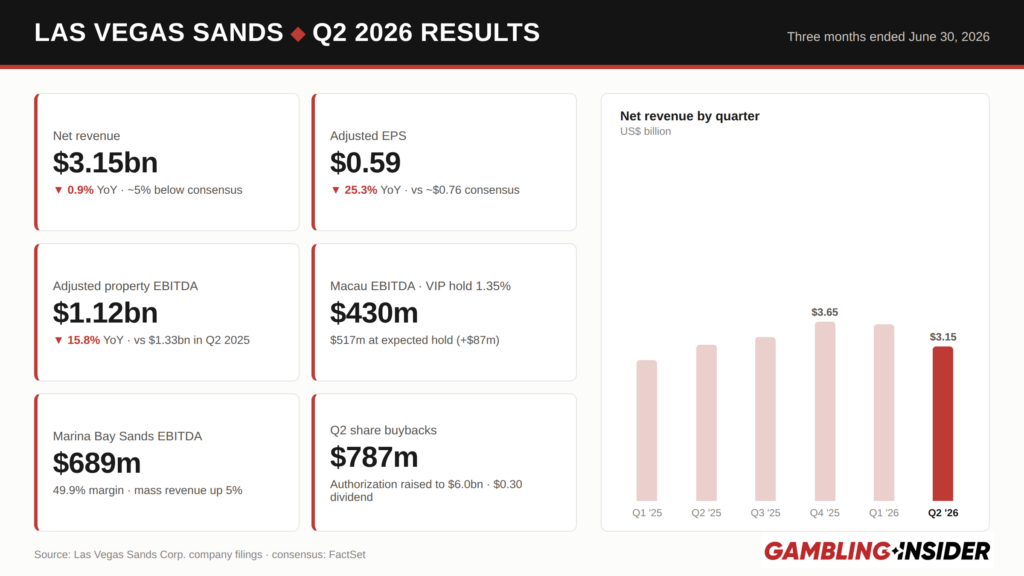
For the quarter ended June 30, 2026, Las Vegas Sands reported net revenue of $3.15 billion, down 0.9% year-over-year and roughly 5% below the analyst consensus forecast of $3.31 billion.
The pressure was more pronounced on the bottom line. Net income fell 28% to $373 million, with GAAP diluted earnings per share (EPS) of $0.53, down from $0.66 in the prior-year quarter.
On the adjusted basis that Wall Street tracks, EPS of $0.59 was 25.3% below last year’s $0.79 and was markedly below the consensus estimate of roughly $0.76 by more than 20%.
Consolidated adjusted property EBITDA totaled $1.12 billion, a 15.8% decline from the $1.33 billion generated in Q2 2025 — a comparison made tougher by the fact that the year-ago figure was itself flattered by favorable hold in Singapore, worth some $107 million.
The Culprits: Bad Luck and the Beautiful Game
On the earnings call, management moved quickly to contextualize the numbers. It attributed the shortfall almost entirely to factors outside the company’s core operational control: namely, unusually low VIP rolling hold in Macau and the disruption caused by the 2026 FIFA World Cup.
In Q2, VIP rolling chip hold in Macau came in at an exceptionally low 1.35%, well below the theoretically expected rate of around 3.30%.
Chairman and CEO Patrick Dumont — who took over both roles from Rob Goldstein on March 1 — was direct in explaining the mathematical impact of the anomaly.
“If we had held as expected in our rolling play, our EBITDA would have been $87 million higher, or $517 million for the quarter,” Dumont told analysts, referring to Sands China’s $430 million in reported EBITDA. Notably, the weak hold came on sharply higher activity, with rolling chip volume up 73% year-over-year.
Compounding the bad luck at the tables was the 2026 World Cup in North America, which altered the travel patterns of the company’s highest-value customers.
There was a decrease in visitation to both Marina Bay Sands and our Macau properties by our high-value patrons during the World Cup football tournament,” Dumont said, calling the effect “very noticeable in June.” He added: “Unfortunately, a lot of our high-value patrons are followers of a lot of the players and teams, and that drove a lot of tourism away from our two markets.”
Grant Chum, CEO and President of Sands China, provided a timeline of the quarter’s momentum. “May was an all-time high for us in SCL in terms of monthly mass GGR,” he noted, referring to gross gaming revenue at the Hong Kong-listed unit.
The momentum broke in June, however, as the tournament took center stage and Macau recorded its softest month of 2026 so far.
Marina Bay Sands: Singapore Juggernaut Rolls on
Amid volatility in Macau, Marina Bay Sands (MBS) in Singapore continued to serve as the primary driver of the company’s profitability and a proof of concept for its high-value asset strategy.
MBS generated $689 million in adjusted property EBITDA at a remarkable 49.9% margin. Unlike Macau, MBS benefited from favorable hold, which boosted EBITDA by roughly $37 million; even after stripping that out, underlying performance remained strong, with mass gaming revenue up 5% year-over-year.
The headline EBITDA figure was nonetheless 10% below the $768 million reported a year earlier — a quarter inflated by an exceptional $107 million high-hold benefit.
The continued mass-market growth at MBS — which is operating at 95.6% occupancy with an average daily rate of $982 — validates the company’s heavy investment in its rebuilt suite product, which has expanded the property’s premium inventory from 135 to 770 suites.
The next leg of growth is already funded: the $8 billion fourth-tower expansion remains on track to open in early 2031.
Digging Deeper: Market Share Gains in Macau
While the headline EBITDA figure for Macau ($430 million, with Sands China net income halving to $107 million) was disappointing, the underlying volume metrics suggest Sands China is structurally outperforming its peers, even as it undergoes major renovations.
Sands China’s mass gross gaming revenue (GGR) grew 8% year over year, double the 4% growth rate of the broader Macau mass market. Total GGR rose 4% while the overall market was flat. Perhaps most encouragingly for the company’s long-term thesis, Sands China captured a market-leading 26% share of VIP rolling-chip volume during the quarter.
Dumont was keen to stress he considered these volume gains to be the true indicators of the company’s trajectory.
Management reaffirmed its long-term target of $700 million in quarterly Macau EBITDA.
“We retain our goal of reaching $700 million in quarterly EBITDA,” Dumont said, while conceding the company has “some work to do” to get there.
The ongoing refurbishment of all 2,900 rooms and suites at The Venetian Macao, which began in March and is scheduled for completion by Chinese New Year 2028, is billed as the next major catalyst for premium growth; roughly 400 keys were out of inventory on average during the quarter, a drag expected to run at 400–500 keys through 2027.
Aggressive Capital Returns Put Floor Under the Stock
Perhaps the loudest signal of management’s confidence in underlying cash flow was its capital return activity during the quarter.
Unfazed by the earnings volatility, Las Vegas Sands repurchased $787 million of common stock (approximately 15 million shares at an average price of $52.37) during Q2.
Since restarting buybacks in late 2023, the company has retired 124 million shares — some 16.3% of its outstanding stock — at an average price of $48.49.
The Board of Directors also increased the company’s share repurchase authorization to $6.0 billion, running through July 2029. That comes on top of the quarterly dividend of $0.30 per share — raised 20% from $0.25 in an increase announced last October and effective this year, for an annualized $1.20 — with the next payment due on August 12.
Our strategic priorities remain clear and consistent,” Dumont emphasized on the call. “We will continue to invest with discipline with the fundamental objective of creating meaningful shareholder returns over the long term.”
Market Reaction and Analyst Sentiment
Despite management’s detailed explanations of the temporary nature of the quarter’s headwinds, the market reacted sharply to the shortfall in the earnings results.
Shares of Las Vegas Sands, which closed Wednesday’s regular session at $45.25, fell as much as 7% in after-hours trading to around $42 — below the stock’s official 52-week low of $44.22, set only a week earlier — before paring the decline to finish the late session near $43.00, down about 5%.
The stock has now lost roughly 30% year-to-date, while the S&P 500 is up around 10%.
Formal sell-side reactions to the print were still landing on Thursday morning, but the Street had already been aggressively de-risking ahead of the report.
In the two weeks before the release, Wells Fargo cut its price target from $65 to $53 (Equal Weight), JPMorgan from $68 to $64 (Overweight), Goldman Sachs from $73 to $63 (Buy), Bank of America from $70 to $60 (Neutral) and — just hours before the results — Susquehanna from $72 to $64 (Positive).
Jefferies, which cut its target from $63 to $52 (Hold) in early July, had warned that “land-based gaming remains the most out-of-favor subsector” among investors.
Even so, the consensus view remains constructive. Of the 18 analysts tracked by MarketBeat, 11 rate the stock a Buy and seven a Hold, with no Sell ratings, and an average price target of $65 — implying upside of more than 40% from Wednesday’s close.
Bulls continue to point to LVS’s dominant position in the Asian gaming market, its massive cash flow generation from Singapore, and the expected structural improvements in Macau as renovations conclude.
Bearish arguments center on the timeline for a full recovery in Macau’s base mass business, elevated capital spending, and the company’s heavy exposure to the highly volatile premium gaming segment — a risk fully on display in Q2.
Will ‘Unlucky’ Streak Continue?
Las Vegas Sands’ Q2 2026 results serve as a stark reminder of the inherent volatility of the high-end casino business. A few unlucky rolls by VIPs and a football tournament half a world away were enough to erase $87 million in expected EBITDA and end a four-quarter run of earnings beats.
However, looking past the latest financial underperformance reveals a business steadily gaining market share in Macau and operating a cash-printing juggernaut in Singapore.
With a newly enlarged $6 billion buyback program acting as a financial shock absorber, management believes the market is mispricing the structural improvements underway across the portfolio.
The coming quarters will show whether the math normalizes in Macau — or whether the “unlucky” streak continues.
Las Vegas Sands (LVS): quarterly results vs expectations, 2025–26
| Quarter | Metric | Actual | Consensus | Beat / Miss | vs consensus | YoY change |
|---|---|---|---|---|---|---|
| Q1 2025 | Net revenue | $2.86bn | $2.87bn | Miss | -0.5% | -3.3% |
| Adj. EPS | $0.59 | $0.60 | Miss | -1.7% | -21.3% | |
| EBITDA | $1.14bn | — | — | — | -5.8% | |
| Q2 2025 | Net revenue | $3.18bn | $2.83bn | Beat | +12.4% | +15.2% |
| Adj. EPS | $0.79 | $0.55 | Beat | +43.6% | +43.6% | |
| EBITDA | $1.33bn | — | — | — | +24.3% | |
| Q3 2025 | Net revenue | $3.33bn | $3.02bn | Beat | +10.3% | +24.2% |
| Adj. EPS | $0.78 | $0.62 | Beat | +25.8% | +77.3% | |
| EBITDA | $1.34bn | — | — | — | +35.2% | |
| Q4 2025 | Net revenue | $3.65bn | $3.34bn | Beat | +9.3% | +25.9% |
| Adj. EPS | $0.85 | $0.77 | Beat | +10.4% | +57.4% | |
| EBITDA | $1.41bn | — | — | — | +27.0% | |
| Q1 2026 | Net revenue | $3.59bn | $3.33bn | Beat | +7.8% | +25.4% |
| Adj. EPS | $0.91 | $0.75 | Beat | +21.3% | +54.2% | |
| EBITDA | $1.42bn | — | — | — | +24.6% | |
| Q2 2026 | Net revenue | $3.15bn | $3.31bn | Miss | -4.8% | -0.9% |
| Adj. EPS | $0.59 | $0.76 | Miss | -22.4% | -25.3% | |
| EBITDA | $1.12bn | — | — | — | -15.8% |
Table notes: EPS figures are LVS’s adjusted diluted EPS, the basis on which consensus estimates are compiled. Corresponding GAAP diluted EPS: Q1 2025 $0.49; Q2 2025 $0.66; Q3 2025 $0.61; Q4 2025 $0.58; Q1 2026 $0.85; Q2 2026 $0.53. Consensus estimates per Zacks (FactSet for Q2 2026); consensus figures for adjusted property EBITDA are not consistently published. EBITDA is the consolidated adjusted property EBITDA. Q2 2025 EBITDA included a c.$107 million favorable hold benefit at Marina Bay Sands; Q2 2026 Macau EBITDA was reduced by c.$87 million of adverse VIP hold. Sources: Las Vegas Sands Corp. earnings releases (Q1 2024–Q2 2026); Q2 2026 earnings call, July 22, 2026; Zacks; FactSet; MarketBeat.


Gambling Insider delivers the latest industry news, in-depth features, and operator reviews that you can trust. Our team combines rigorous editorial standards with decades of specialized expertise to ensure accuracy and fairness. We are committed to delivering clear, impartial, and dependable coverage across the global gambling sector.