Mississippi Advances Sweepstakes Casino Ban While Maryland Lawmakers Debate Enforcement
Lawmakers in Mississippi and Maryland took different procedural steps this week on bills aimed at curbing online sweepstakes casinos. Mississippi lawmakers moved a bill forward after adopting amendments that sharpened enforcement authority, while Maryland legislators held an extensive hearing focused on regulatory gaps but did not take a vote.

Mississippi Senate Committee Advances Amended SB 2104
The Mississippi Senate Judiciary, Division B Committee amended Senate Bill 2104 and voted to recommend the measure advance to the next step in the legislative process.
Testifying before the committee, Jay McDaniel of the Mississippi Gaming Commission said the bill mirrors legislation that passed the Senate last year but stalled in conference.
“It’s a criminal penalties bill,” McDaniel said. He explained that Mississippi’s current gambling penalties — a misdemeanor punishable by a $500 fine and up to 90 days in jail — were designed before modern online platforms.
McDaniel said those penalties are ineffective against large-scale operators.
“With the proliferation of online gaming, we have bigger fish to fry,” he said. “Misdemeanor penalties really just don’t scare them away.”
Under SB 2104, operating an illegal online gambling platform — including sweepstakes casinos — would be a felony. It’s punishable by fines of up to $100,000 per conviction and up to 10 years in prison.
“It doesn’t increase the charge for someone just playing the game,” McDaniel added. “But someone that’s operating an online platform — that would be a felony.”
The committee advanced the amended bill without opposition.
Key Amendments Adopted by the Committee
Lawmakers adopted a committee substitute that narrowed the bill’s scope and clarified enforcement targets after similar language failed to pass last year. McDaniel said the most significant change is that criminal liability is directed at the operator of an illegal online gambling platform, rather than the technology or service providers that host or transmit activity.
The revised language “protects the platforms from being the ones charged with the penalties, but it actually goes after the operator,” he said.
The amended bill also expands forfeiture authority to reflect how online gambling operations function. While existing law allows the state to seize illegal gambling machines, SB 2104 would permit prosecutors to pursue funds and assets tied to online gambling activity. That includes proceeds generated through digital platforms.
“Since they’re sending it through a platform, we could also go after the funds — anything associated with that crime,” McDaniel said.
At the same time, the committee substitute preserves existing misdemeanor penalties for individual players and promoters. It reserves felony exposure for companies and individuals that operate illegal online gambling platforms.
McDaniel said the changes aim to address concerns raised during last year’s conference process. It would also give prosecutors a more effective tool against large, often offshore operators.
Maryland Hearing Highlights Enforcement Gaps, Regulation Debate
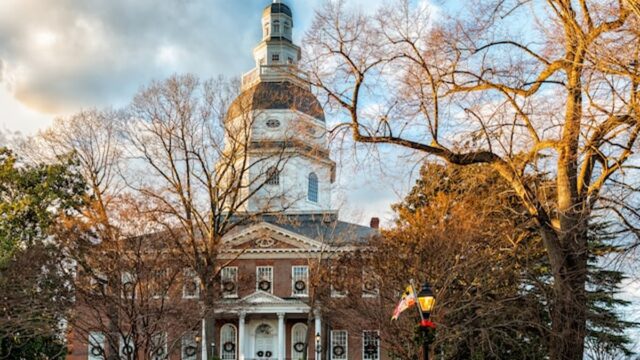
In Maryland, lawmakers held a hearing on Senate Bill 112, which would prohibit unlicensed “interactive games,” including sweepstakes casinos. The Senate Budget and Taxation Committee did not take a vote, however.
Appearing before the committee, John Martin, Director of the Maryland Lottery and Gaming Control Agency (MLGCA), said the agency lacks effective tools to address the growing number of illegal online platforms.
“Illegal online games are growing exponentially in Maryland because of ambiguities and loopholes in existing statutes.”
Martin said the agency currently relies on cease-and-desist letters, an approach he described as only partially effective. He mentioned that six states have enacted bans on sweepstakes casinos, and nine states have introduced legislation in 2026.
“We got about a 33% success rate,” he said.
He added that the commission has sent 75 cease-and-desist letters, with roughly a third of operators complying. “There are significantly more bad actors in the space.”
Martin said SB 112 would allow the agency to target illegal operators and collaborate with law enforcement more effectively. He noted that such platforms are not licensed and do not pay taxes.
During questioning, Sen. Craig Zucker asked whether regulation could be a better solution.
Jennifer Baskett, MLGCA’s Director of Legislation and Policy, said the bill targets operators outside Maryland’s 26 regulated gaming licensees. She added that any entity that wants to operate legally in the state can apply for a license.
Support for the bill came from the commercial casino sector. Ryan Eller, Executive Vice President and General Manager of Live! Casino & Hotel Maryland said that while data shows legalizing online gaming does not curb illegal gambling, the bill is a right step forward.
VGW, SGLA Testify in Opposition
Opposition testimony came from representatives of the sweepstakes and social gaming industries.
Sean Ostrow of the Social and Promotional Games Association, a trade group representing sweepstakes casinos, warned that the bill would criminalize businesses that have operated in Maryland for years. He said that members of the Association follow Maryland and Federal sweepstakes laws.
Representing VGW, Dwight Ramenaden and Derek Brinkman said the platforms offer robust responsible gaming and player protection tools. Ostrow, Ramenaden, and Brinkman testified in favor of regulating sweepstakes casinos. They claimed the industry could bring upwards of $20 million to Maryland annually.
Sen. Shelly Hettleman pushed back on those claims, stressing that the legislation is about enforcement, not regulation.
“I guess I’m a little confused, because if you’re upstanding actors in this area, then you would not be fearful of having this bill, which would ensure those who are not complying with the current law aren’t taking advantage of the current system.”
Brinkman said sweepstakes casinos follow similar laws to those governing the McDonald’s Monopoly game. However, Sen. Paul Corderman said that at McDonald’s, participants are not playing slots or other casino-style games.


Gambling Insider delivers the latest industry news, in-depth features, and operator reviews that you can trust. Our team combines rigorous editorial standards with decades of specialized expertise to ensure accuracy and fairness. We are committed to delivering clear, impartial, and dependable coverage across the global gambling sector.