Michigan Governor Proposes Illinois-Style Per-Bet Sports Tax, iGaming Tax Hike
Michigan Gov. Gretchen Whitmer’s FY27 budget would add a $0.25–$0.50 per-bet sportsbook tax and raise online casino rates to 36%, targeting nearly $200 million annually for Medicaid.

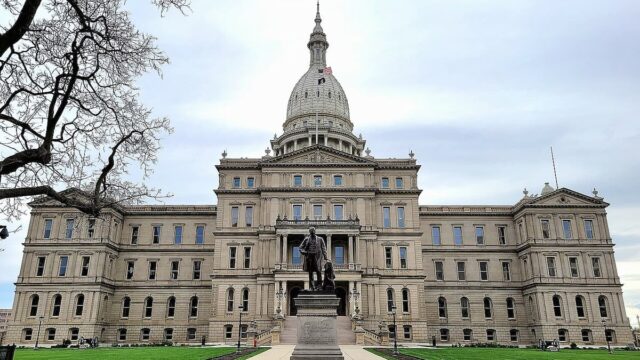
Michigan Gov. Gretchen Whitmer is proposing significant changes to the state’s gambling taxes that would introduce a per-wager sportsbook fee that mirrors Illinois’ approach and sharply raise rates on the largest online casino operators, positioning gaming as a primary funding source for Medicaid.
The changes, part of Whitmer’s FY27 executive budget, would generate roughly $195 million in new annual revenue, according to state forecasts. The plan combines three levers: a per-bet charge on sportsbooks, a higher marginal tax rate for top iGaming operators, and the elimination of promotional “free play” deductions.
Illinois-Style Per-Bet Tax Targets Wager Volume
Michigan would begin taxing sportsbooks for every wager placed, rather than solely on revenue.
According to the administration’s briefing paper:
“A new 25 cents per bet tax would apply on a licensee’s first 20 million wagers annually. For wagers after 20 million, the tax on those would increase to 50 cents per bet.”
The structure — $0.25 per wager on the first 20 million bets and $0.50 thereafter — is identical to the model Illinois adopted last year.
The state projects it will generate $38.8 million in FY27.
Costs Passed to Consumers in IL, Wagers Down
Illinois implemented the per-wager structure in July 2025. Sportsbooks quickly passed those costs to customers through either a per-bet surcharge or minimum wager requirements.
Most operators rolled out the changes on September 1. Since then, data from the Illinois Gaming Board show that the number of bets placed has steadily declined.
For the four months through December, Illinois bettors placed 27.9 million fewer bets than in the same period in 2024. While the yearly drop from September to November was around 15%, December saw a 25% decline.
Industry estimates suggest this translated into roughly $6.9 million less tax revenue than projected during the period of declining wagers. For the entire 2025, total bets fell 4.1% statewide.
As a result, bills have already been introduced to repeal the tax.
Online Casino Tax Would Rise to 36% for Largest Operators
Michigan’s proposal also introduces a new top bracket for online casinos.
The budget would apply a higher marginal rate to operators with annual adjusted gross receipts (AGR) exceeding $185 million. For revenue above that threshold, the tax rate would rise eight percentage points, from 28% to 36%. The state estimates the change will bring $135.5 million in additional annual revenue.
The budget briefing notes that just three casinos exceed the threshold. However, data from the Michigan Gaming Control Board suggests that four operators would likely fall into the higher bracket: FanDuel ($768.1 million AGR in 2025), BetMGM ($735.5 million), DraftKings ($434 million), and BetRivers ($212.1 million).
Caesars narrowly missed the threshold with $182.1 million in 2025 AGR.
Free Play Deduction Eliminated
Sportsbooks would also lose the ability to deduct promotional credits from their taxable base. The budget forecasts the change will generate $21.1 million in FY27.
Between the per-wager tax, the higher iGaming tax, and the elimination of the free-play deduction, the budget estimates an additional $195.4 million annually, with most of the proceeds directed to the Medicaid Benefits Trust Fund.
AZ Governor Also Proposes Higher Sportsbook Taxes
Michigan is not alone in leaning more heavily on gambling to address budget pressures. Arizona Gov. Katie Hobbs has proposed higher sportsbook taxes for large operators.
Her plan includes raising the tax rate from 8% to 45% for operators with monthly gaming revenue exceeding $75 million. It’s important to note that there’s ambiguity around the “average monthly revenue” language used in the budget.
If the governor meant adjusted gaming revenue (what operators retain after payouts), then no operators fall under the $75 million monthly threshold. However, if she meant the handle (total dollars wagered), then FanDuel, DraftKings, BetMGM, and Fanatics would be subject to the tax.
Elsewhere, the Sports Betting Alliance has warned of potential sportsbook tax increases in other states, including Iowa, though no formal proposal has been detailed in official budget documents.
Meanwhile, other governors are looking for alternative ways to raise revenue. Pennsylvania Governor Josh Shapiro has proposed regulating skill games in his 2026-2027 budget, arguing that it would generate $2 billion in new tax revenue. Lawmakers declined to advance a similar proposal last year.
What Happens Next
Whitmer’s recommendations are not yet law. The legislature must pass implementing bills before the July 1 fiscal deadline.
Image Credit: Mojnsen via Wikimedia Commons (license)


Gambling Insider delivers the latest industry news, in-depth features, and operator reviews that you can trust. Our team combines rigorous editorial standards with decades of specialized expertise to ensure accuracy and fairness. We are committed to delivering clear, impartial, and dependable coverage across the global gambling sector.