Genius Sports Q1: Prediction Markets and Legend Push Company Beyond Sports Data
Genius Sports’ Q1 earnings call outlined a broader strategic shift, positioning prediction markets and the recently closed Legend acquisition as key drivers of future growth.

Prediction markets and the recently completed Legend acquisition dominated Genius Sports’ Q1 earnings call, as executives increasingly framed the company as more than a traditional sports data supplier.
Genius Sports reported Q1 revenue of $188 million, up 31% year over year, while adjusted EBITDA rose 21% to $24 million. Betting Technology, Content & Services revenue increased 33% to $146.2 million, while Media Technology revenue rose 22% to $41.7 million.
Genius also raised its full-year 2026 outlook following the closing of the Legend acquisition on May 1. The company now expects:
- Revenue between $990 million and $1.01 billion (up from $810 to $820 million)
- Adjusted EBITDA between $270 million and $280 million (up from $180 to $190 million)
- Adjusted EBITDA margin of roughly 28% (up from 23%)
CEO Mark Locke said:
We are moving from a data provider to the operating system and monetization layer of global sport.”
Prediction Markets Emerging as “Meaningful New Ecosystem”
Management spent considerable time discussing prediction markets, describing the sector as a significant long-term growth opportunity for the company.
Locke said:
Prediction market[s]… [are] a meaningful new ecosystem for Genius Sports.”
Genius Sports repeatedly framed its role as an infrastructure provider rather than an operator. On the call, the company said it had already onboarded “several high-profile market makers” during the quarter using Genius’ official low-latency data feeds.
Management also emphasized that prediction markets create opportunities across:
- Official sports data
- Market-making infrastructure
- Advertising demand
- Customer acquisition spending
Locke compared prediction markets to the early expansion of the U.S. online sportsbook market, stating:
We are applying the same proven model in the U.S. online sports betting market to a new category.”
Later in the call, executives suggested they increasingly view major prediction market operators similarly to top sportsbook companies from a revenue perspective.
Locke said that, internally, Genius models companies such as Kalshi, Robinhood, and Polymarket as comparable to large sportsbook operators when estimating the market opportunity.
Management Signals Expectation of Closer League Integration
Leadership also suggested they expect prediction markets to gradually move closer to traditional sports betting structures.
Locke said:
For the prediction markets to have a long and rosy future, they’re going to want to work especially with those leagues and with the CFTC.”
Management repeatedly referenced the Commodity Futures Trading Commission’s (CFTC) evolving approach to sports-event contracts and official data.
Locke added:
You’re only going to get the official result from the official holder of data.”
Genius suggested that official data requirements and league relationships will become increasingly important as the prediction market sector matures. Recently, several major U.S. sports leagues and players’ associations asked the CFTC for a more direct role in oversight of event contracts tied to their competitions.
Analysts Press Management on Legend Acquisition
The recently completed Legend acquisition remained another dominant theme throughout the call. Executives repeatedly described the transaction as transformative for Genius’s business model, particularly in terms of audience ownership, advertising, and fan engagement.
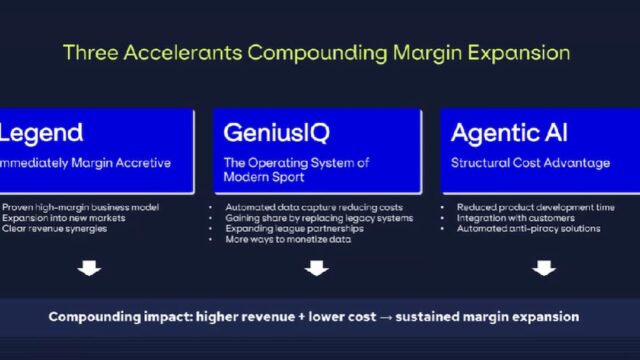
Across the call, executives increasingly framed Genius less as a sports data vendor and more as a vertically integrated sports media, advertising, and monetization platform.
Locke said:
Legend adds the intent layer of the system that we have been building for two decades.”
Another recurring theme throughout the call was management’s focus on “intent” and behavioral targeting as the next phase of sports monetization.
Locke argued:
The economy has moved from selling attention [to] capturing intent.”
However, analysts repeatedly pressed management on whether the Legend acquisition can justify the company’s aggressive long-term margin and monetization targets. The tone of several questions reflected lingering investor skepticism remaining since the last quarter, following the acquisition announcement earlier this year.
Multiple analysts questioned executives about:
- Integration progress
- Commercial traction
- Cross-selling opportunities
- Advertising demand
- Whether projected integration benefits are already contributing to guidance
Management responded by pointing to early integration progress and growing customer demand following the acquisition.
Locke said the “combined offering is going down very well,” while CFO Brian Hess highlighted increasing cross-selling opportunities between Genius’s sportsbook infrastructure business and Legend’s audience acquisition network.
Hess repeatedly stressed that potential upside from the integration has not yet been included in the company’s financial outlook.
AI and “Intent” Become Core Narrative
The comments also reflected a broader industry debate over whether generative AI could commoditize sports content and affiliate traffic, particularly after the Legend acquisition expanded Genius’ media and audience business.
Locke argued that proprietary sports data and owned audience destinations become more valuable in an AI-driven ecosystem.
He said:
AI doesn’t threaten our core, it compounds it.”
The company highlighted its “Moment Engine” advertising product, which identifies high-engagement sports moments and matches them with targeted advertising audiences in real time.
Management said the product is already integrated with platforms that represent roughly 90% of the programmatic advertising ecosystem and has been used during events such as the Super Bowl and March Madness.


Gambling Insider delivers the latest industry news, in-depth features, and operator reviews that you can trust. Our team combines rigorous editorial standards with decades of specialized expertise to ensure accuracy and fairness. We are committed to delivering clear, impartial, and dependable coverage across the global gambling sector.