Ireland, India Cases Highlight How Prediction Market Integrity Concerns Are Expanding Globally
Recent developments in Ireland and India have intensified scrutiny around prediction market integrity, market manipulation, and cross-border enforcement.

Irish Finance Minister Simon Harris called prediction markets a “wild, wild west” this week as authorities in Ireland and India intensified scrutiny of platforms such as Polymarket and Kalshi. The developments highlight the growing global concerns surrounding the emerging sector.
While prediction market operators such as Kalshi and Polymarket currently operate within a federally regulated framework in the U.S. under Commodity Futures Trading Commission (CFTC) oversight (a structure currently at the center of multiple legal disputes with state regulators), many international jurisdictions lack a comparable regulatory system for prediction markets.
As a result, governments outside the U.S. have increasingly approached prediction markets through existing gambling and financial enforcement frameworks. At the same time, developments in India have highlighted how crypto-based platforms can continue operating across borders even after restrictions are imposed.
Ireland Raises Concerns Over “Suspicious” Prediction Market Activity
Earlier this week, Harris instructed officials to conduct a “deep dive” into suspicious betting activity on the Dublin Central by-election on Polymarket.
According to The Irish Times, accounts engaged in “highly suspicious betting behavior” placed a series of wagers on candidate Gerry “The Monk” Hutch to lose the election.
Experts cited by the publication said the betting patterns could indicate illicit activity. Those include money laundering, market manipulation, or attempts to artificially inflate market activity. There is no suggestion that Hutch or any other candidate was involved in the betting.
Speaking on Tuesday, Harris told reporters that he had instructed officials to coordinate with the Department of Justice, An Garda Síochána, the Gambling Regulator, and the Central Bank of Ireland as authorities examine the issue.
This is a relatively new and emerging issue,” Harris said.
The Finance Minister framed the issue as extending beyond gambling oversight into broader financial integrity concerns.
I think [there are] two elements, from my perspective, to this,” Harris said. “There’s the element of gambling and, therefore, the potential role for the gambling regulator […] and then secondly, the potential concern that this is a vehicle that could be used in terms of money-laundering as well.”
Harris later described prediction market activity tied to cryptocurrency as a “wild, wild west.”
What seems to be developing at a global scale and, indeed, at a rapid pace now is a kind of wild, wild west where people are placing bets in the form of cryptocurrency in a secretive, murky, and unregulated manner,” he said.
Harris also referenced growing international concerns surrounding prediction markets and insider trading.
The Irish Times cited a The New York Times investigation that found unusual betting patterns tied to highly specific geopolitical events, including President Donald Trump’s ceasefire announcement regarding Iran, displayed characteristics commonly associated with insider trading.
The report said more than 11,000 Polymarket accounts exhibited suspicious betting patterns. The report cited well-timed long-shot wagers, newly created accounts, and unusually consistent profits among the suspicious activity patterns.
India Highlights Cross-Border Enforcement Challenges
At the same time, a Bloomberg report stated that India’s Ministry of Electronics and Information Technology warned that users were continuing to access “illegal and blocked prediction market and online betting platforms” despite “domestic restrictions.”
The ministry specifically referenced Polymarket and Kalshi in an April advisory. It warned that VPN services enabling access to restricted platforms could face legal exposure.
The scrutiny comes after India’s Promotion and Regulation of Online Gaming Rules (PROGA) took effect on May 1. According to Indian gaming attorney Jay Sayta, prediction markets would “obviously fall under online money games under PROGA, and therefore there is a blanket ban.”
Despite the warnings, Bloomberg reported that both Polymarket and Kalshi continued allowing Indian users to access their services.
Indian authorities have also raised concerns about stablecoin payments and the use of blockchain-based financial rails tied to online betting. The ministry warned such activity could create “financial risks” and threaten “public order and economic integrity.”
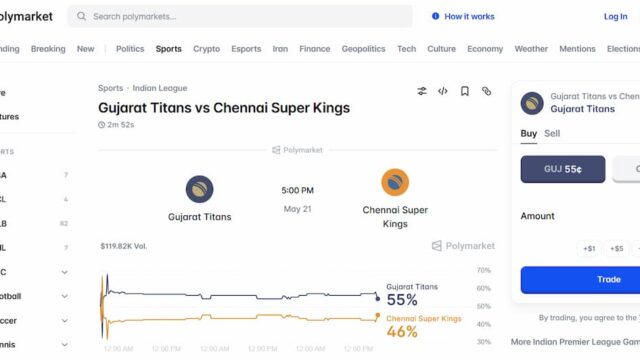
Sports event contracts tied to cricket have highlighted the issue. Bloomberg reported that a May 7 Indian Premier League match between Lucknow Super Giants and Royal Challengers Bengaluru generated $27.7 million in trading volume across Kalshi and Polymarket. The data, however, does not indicate how much of the volume came from India.
Earlier Incidents in France, Israel Add to Growing Prediction Market Scrutiny
The Ireland and India reports add to previous international incidents, intensifying scrutiny of prediction market integrity.
Earlier this month, Israeli authorities charged an Israeli Air Force officer with allegedly using classified information tied to military operations to place profitable bets on Polymarket.
The case followed earlier reports involving an Israeli civilian and an IDF reservist accused of using classified military information to place wagers on Polymarket.
Meanwhile, French authorities launched an investigation last month into possible tampering with temperature sensors at Charles de Gaulle Airport after unusual betting activity tied to temperature-related prediction contracts on Polymarket.
The investigation was a result of a complaint by Météo France, the national meteorological agency, after detecting bets on the prediction platform that generated roughly $35,000 in profit.
The incidents come as multiple governments have moved to restrict or block prediction market platforms. Brazil blocked access to Polymarket and Kalshi last month.
Meanwhile, regulators in Portugal, Hungary, and New Zealand have also taken action against prediction market operations. Additionally, an Argentine judge issued a nationwide injunction against Polymarket in March.


Gambling Insider delivers the latest industry news, in-depth features, and operator reviews that you can trust. Our team combines rigorous editorial standards with decades of specialized expertise to ensure accuracy and fairness. We are committed to delivering clear, impartial, and dependable coverage across the global gambling sector.