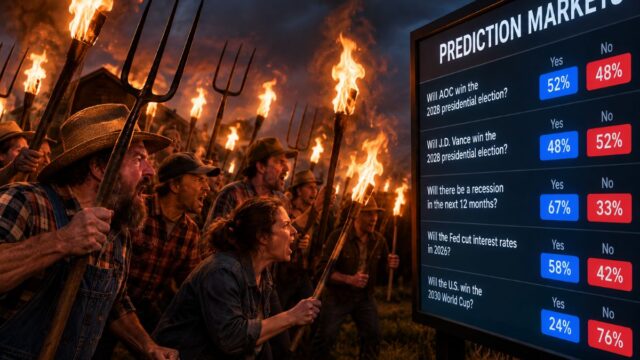
Wisconsin Warns Election Prediction Market Traders They Could Face Felony Charges
The Elections Commission says trading election prediction contracts may disqualify voters from casting a ballot in that election.


The Wisconsin Elections Commission (WEC) has warned that residents who trade election prediction market contracts could face felony charges if they later vote in the same election.
WEC concluded that election-related contracts offered by platforms including Kalshi and Polymarket likely constitute a “bet or wager” under Wisconsin election law. Under state law, voters who make or become interested in a bet on an election are disqualified from voting in that election. Intentionally voting without the necessary qualifications is a Class I felony.
The warning adds a new dimension to Wisconsin’s ongoing legal battle over prediction markets. While state, federal regulators and tribal gaming interests continue fighting in court over whether the products are gambling or federally regulated financial contracts, WEC says Wisconsin’s election law is “relatively clear”.
WEC Says Election Prediction Markets Likely Count as Bets
The Commission issued the warning after unanimously approving a legal memo during its July 9 meeting. The memo directed staff to inform voters about the potential consequences of trading in election prediction markets.
We want voters to understand that they cannot legally make a bet on an election and cast a ballot in that same election,” WEC Administrator Meagan Wolfe said. “We are not able to police someone placing a bet on these platforms, but it’s important for voters to understand the consequences if they bet on an election outcome.”
According to WEC, Wisconsin Statute § 6.03(2) disqualifies a voter from participating “in any election in which the person has made or become interested, directly or indirectly, in any bet or wager depending upon the result of the election.”
WEC concluded that election prediction contracts fall within that prohibition, writing:
Commission staff believe the prohibition against ‘any bet or wager depending upon the result of the election’ § 6.03(2) includes making trades on election-related prediction markets.”
The memo notes that Wisconsin law defines a bet as an agreement under which one party stands to win or lose something of value based on chance, even if accompanied by some degree of skill.
The memo further states:
At the very least staff do not see how an elector could… truthfully say that they ‘have not made any bet or wager’ if they have offered money in a prediction market, and would receive money if they are correct and lose money if they are incorrect.”
The Commission’s analysis does not address whether placing election prediction trades is itself lawful. Instead, staff concluded that Wisconsin law likely prohibits people who make such trades from voting in the same election.
Kalshi, Polymarket Reject Commission’s Interpretation
Prediction market operators disputed the Commission’s conclusions.
“Kalshi has hundreds of thousands of users in Wisconsin,” a Kalshi spokesperson told Wisconsin Public Radio.
Implying they can’t vote because they use Kalshi is not only dishonest, it is voter suppression! If even a handful of our users in Wisconsin see this and get scared away from voting, that could EASILY swing an election.”
The spokesperson called the Commission’s warning “incredibly dangerous to democracy.” They added: “We hope the WEC retracts their statement before a court forces them to.”
A Polymarket spokesperson said the company would address the Commission’s claims “through the appropriate legal process.”
Both companies continue to argue their products are federally regulated event contracts overseen by the Commodity Futures Trading Commission (CFTC) rather than gambling products.
Commissioner Ann Jacobs defended the restriction during the Commission’s July meeting.
You want people who have the ability to vote based upon who they believe is the best person for the job,” Jacobs said. “Not to line their pocketbooks.”
Wisconsin Continues Multi-Front Fight Against Prediction Markets
The WEC action comes as Wisconsin continues pursuing prediction markets through multiple legal avenues.
In April, Wisconsin sued Kalshi, Polymarket, Robinhood, Coinbase and other companies in state court. The state alleged that the companies are facilitating illegal gambling under state law.
The following week, the CFTC sued Wisconsin. The federal regulator argued that the Commodity Exchange Act gives the CFTC exclusive authority over federally listed event contracts and preempts the state’s gambling enforcement.
Wisconsin is also home to a tribal lawsuit brought by the Ho-Chunk Nation against Kalshi. The tribe alleges that Kalshi’s sports-event contracts constitute unauthorized Class III gaming on tribal lands, in violation of the Indian Gaming Regulatory Act, tribal gaming ordinances, and the tribe’s gaming compact with Wisconsin.
Because of the lack of legal clarity and consensus over whether prediction markets qualify as betting, WEC said many Wisconsin residents may not understand that participating in election prediction markets could prevent them from voting in the same election.
Many Wisconsinites may not understand using prediction markets as betting at all, or that such actions prevent them from voting under Wis. Stat. § 6.03(2) subject to felony-level consequences,” Commission staff wrote.


Gambling Insider delivers the latest industry news, in-depth features, and operator reviews that you can trust. Our team combines rigorous editorial standards with decades of specialized expertise to ensure accuracy and fairness. We are committed to delivering clear, impartial, and dependable coverage across the global gambling sector.