Super Bowl Prediction Markets Beyond the Game: Protests, Props, and Pop Culture
While sports contracts drive most Super Bowl volume, prediction markets are generating headlines with novelty bets on protests, broadcast chatter, and commercial slots that raise integrity questions.

While game-related sports event contracts dominate Super Bowl trading on platforms like Kalshi and Polymarket, the markets drawing outsized buzz and social chatter are the oddball ones: halftime politics, announcer catchphrases, and commercial slots that critics say could reward insider knowledge.
Unlike regulated sportsbooks, prediction platforms price nearly any off-field moment as a tradable binary outcome. That creates a menu of wagers that feel less like football bets and more like social commentary wrapped in a financial instrument.
Below are some of the most unusual, attention-grabbing markets trading during Super Bowl week.
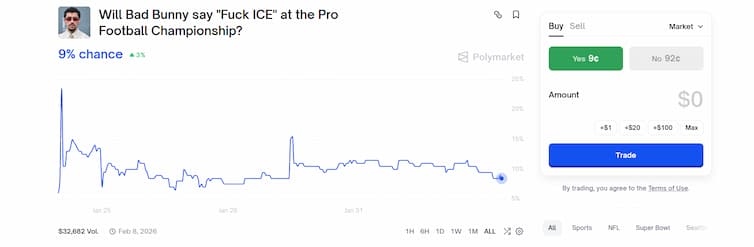
Will Bad Bunny Say “F* ICE”?
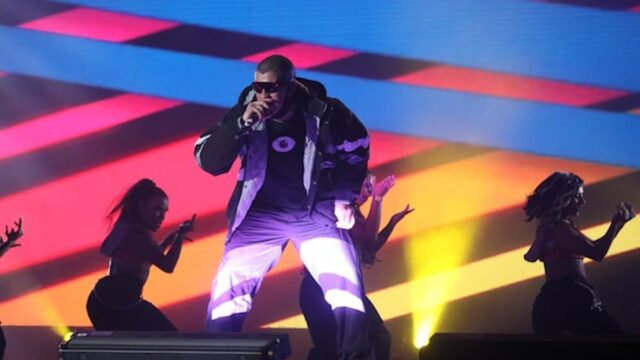
One of the most eye-catching markets asks whether Bad Bunny — the headline performer for the Super Bowl LX halftime show — will utter “F* ICE” during the event.
If Bad Bunny instead makes a more general protest or uses different wording, the contract would resolve as a loss. At one point, the probability peaked above 24 percent. However, it has fallen to 9% after the artist said “ICE out” during the Grammys.
NFL Commissioner Roger Goodell later commented that the Grammys are a different platform and that the Super Bowl is meant to unite people. That contrast underscores how politically sensitive these markets can be.
Wardrobe and Halftime Props
Another standout market on Polymarket tracks whether Bad Bunny will wear a dress or skirt during his performance. Early rumors triggered a spike in implied probability — climbing into the 70-plus percent range. That has since cooled as conflicting social chatter dampened confidence, settling below 20 percent.
One of the highest-volume markets on Kalshi related to Bad Bunny is his first song. Currently, the market trades at around $2.5 million, with Tití Me Preguntó comfortably leading. The song is also leading on Polymarket, although trading is significantly lower.
Meanwhile, Cardi B leads both platforms’ markets for a halftime appearance.
The Ad Markets — and the Insider Problem
The most controversial contracts may involve Super Bowl commercials.
Kalshi and Polymarket allow users to buy “yes” or “no” shares on whether specific companies will air ads. Some examples include Salesforce, Google, Toyota, State Farm, Liquid Death, and Pepsi. Some of those probabilities exceed 95%.
At those prices, the upside looks trivial. A $10,000 position at 99 cents might return roughly $102 in profit. Not exactly life-changing money.
But the catch is that thousands of agency employees, vendors, production crews, and brand partners often already know the outcome weeks or months in advance. For anyone with that information, the trade can look less like speculation and more like a near-risk-free return.
Critics argue that such contracts effectively invite trading on material non-public information. Even if the margins are small, the structure raises the same fairness questions seen in traditional financial markets: should participants be allowed to profit from answers that aren’t publicly available?
In January, a user on the platform made a profit of $409,882.03, a 1108% return on markets related to the capture of former Venezuelan leader Nicolas Maduro. The win raised fresh questions about insider advantages and information asymmetry.
Polymarket has previously argued that informed trading improves price discovery and market efficiency. Kalshi, by contrast, says participants with insider knowledge are prohibited from trading those markets.
While prediction markets pitch themselves as financial exchanges, the lack of guardrails that regulated sportsbooks must follow has raised questions about the integrity of the markets they offer.
And during the biggest advertising event of the year, even a small, “almost certain” contract can start to look like free money to the people who already know the script.
“Mention” Markets: What Will Announcers Say?
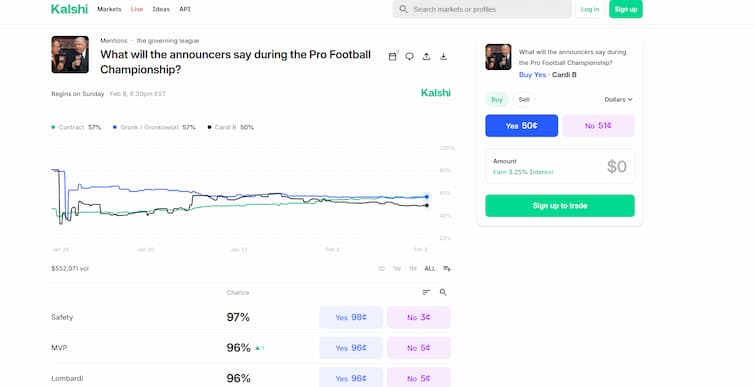
Prediction platforms have expanded their presence in broadcast chatter through “mention markets.” These are contracts that pay out based on whether specific terms are spoken during the broadcast.
Kalshi opened a Super Bowl mention market featuring dozens of potential terms for NBC announcers Mike Tirico and Cris Collinsworth, including everything from “Lombardi” (the name on the trophy) and “Tom Brady” to “Legion of Boom” and pop-culture topics such as “Taylor Swift.”
Other terms on Polymarket’s roster include phrases like “knee injury,” “baby,” and even “Polymarket” itself. These word markets transform broadcasters into de facto betting outcomes, driving engagement that could reach millions of dollars, based on the growth seen this NFL season.
Celebrity Attendance: A-List Futures
Kalshi has also listed markets on whether high-profile figures will attend the Super Bowl in person.
Odds include names like Tom Brady, Lionel Messi, Elon Musk, and Taylor Swift — whose attendance odds sit in the teens. The odds of President Trump attending are only 6%.
These contracts trade attention and speculation on appearance rather than any competitive element of the game, further blurring the lines between event forecasting and celebrity gossip.
What the Wild Markets Say About Prediction Platforms
These markets don’t represent the future of prediction platforms. Instead, they’re closer to where the space began.
Long before sports contracts dominated trading screens, early prediction markets were built around broad, curiosity-driven questions tied to politics, news events, and pop culture.
Academic exchanges like the Iowa Electronic Markets focused on elections, while early commercial platforms listed contracts on everything from entertainment headlines to corporate developments — essentially allowing users to price whatever might happen next.
Over time, that anything-goes menu narrowed as liquidity concentrated around outcomes that were easier to quantify and attracted consistent participation.
First politics, then sports emerged as the core drivers of volume. Today, contracts tied to sports events account for the overwhelming majority of trading on most days — often exceeding 90%. Meanwhile, novelty-style markets like halftime antics, wardrobe choices, or commercial appearances make up only a small slice of activity.
For context, the market on the Super Bowl winner trades with roughly $160 million in volume on Kalshi, more than 60 times the market volume for the first song. Still, those smaller markets often punch above their weight in visibility.
They’re the ones that get screenshotted, debated on social media, and picked up in headlines — especially during a media spectacle like the Super Bowl — even if the real money is trading on spreads, winners, and totals.
That attention can attract scrutiny. The National Football League has barred prediction market platforms from advertising during Super Bowl LX broadcasts, citing regulatory and integrity concerns.


Gambling Insider delivers the latest industry news, in-depth features, and operator reviews that you can trust. Our team combines rigorous editorial standards with decades of specialized expertise to ensure accuracy and fairness. We are committed to delivering clear, impartial, and dependable coverage across the global gambling sector.