ADI Predictstreet’s $6.9B Blockchain Generates Only $7,248 a Day
Prediction market startup ADI Predictstreet, which, seemingly out of nowhere, became a FIFA partner, values its network in the billions. But Gambling Insider’s investigation reveals a venue that earns just ~$7,000 in daily fees, settles in someone else’s dollar, and answers to three keyholders it has not identified.


Story updated 08:40am UTC, Friday Aug 21 with comment from DAZN source
When ADI Predictstreet appeared on the display boards at the FIFA World Cup this summer, it sold itself as more than a betting operator.
It was, the company said, the front end of ADI Chain — an “institutional-grade” blockchain based in Abu Dhabi — and the reason a startup with no track record could line up alongside Coca-Cola and Visa as a FIFA partner. The blockchain was the story.
A blockchain is a shared public ledger: every transaction is recorded permanently and can be read by anyone.
That openness lets outsiders check what the technology actually does. ADI Chain’s own block explorer and the analytics site DefiLlama tell a plainer story than the marketing does.
The Number ADI Gave — and the One It Didn’t
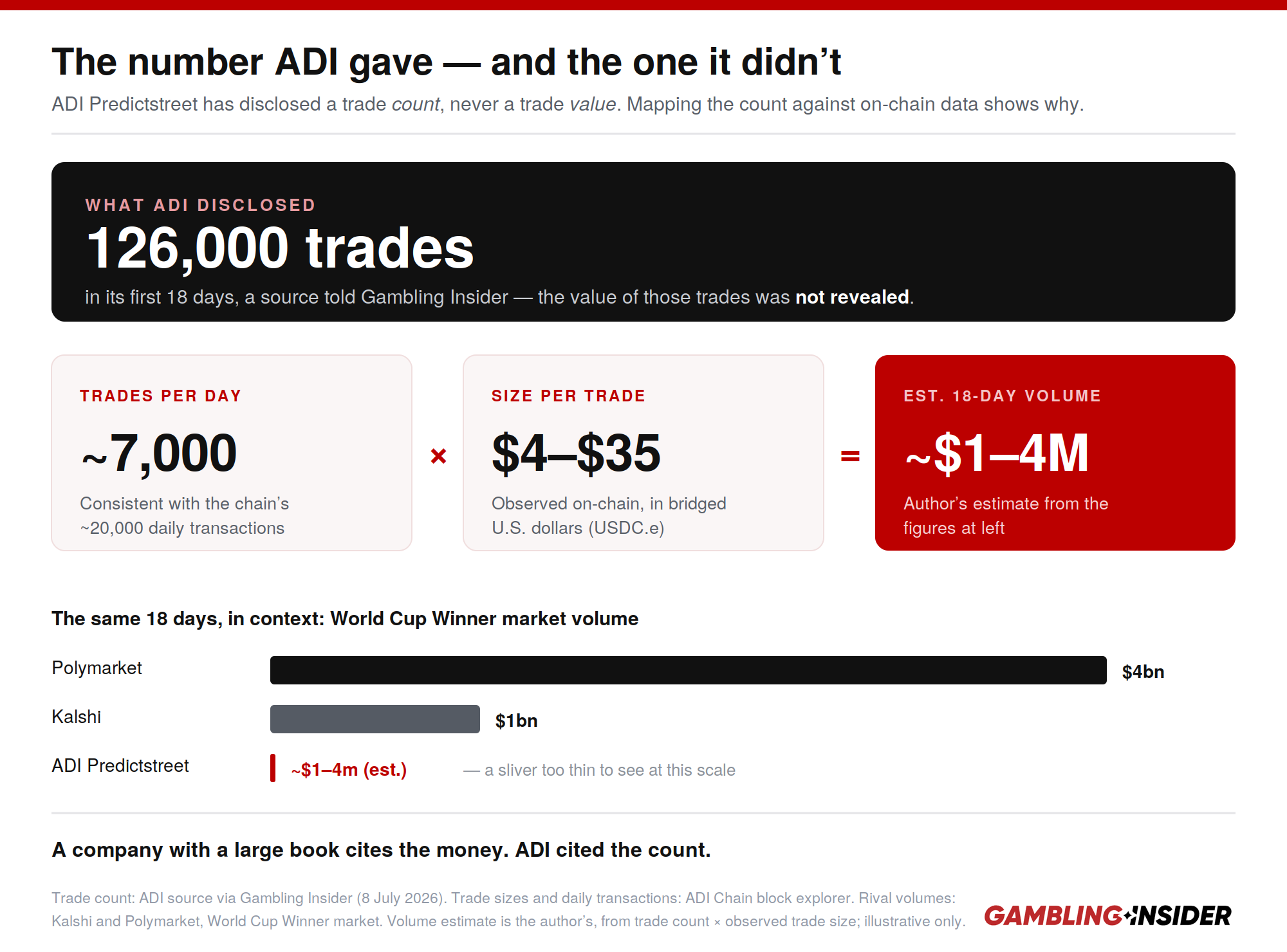
To date, ADI has put a single raw trading figure into the public domain. A source told Gambling Insider in July that the platform had generated about 126,000 trades in its first 18 days. Notably, the source gave a count, not a value. The notional worth of those trades was not disclosed.
That distinction matters, because a count and a value can point in opposite directions, and the ledger lets us bridge them.
ADI’s 126,000 trades over 18 days work out to roughly 7,000 a day. But apply the trade sizes visible on-chain, which on our random check run from about $4 to $35 each, and the value comes into focus: some $1 million to $4 million across the 18 days ADI cited.
It is an estimate, but a telling one, squaring with the roughly $4.14 million locked on the chain and $7,248 in fees over a recent 24-hour period.
And it sits against the roughly $1 billion and $4 billion traded on Kalshi’s and Polymarket’s World Cup winner markets, respectively. A company with genuinely large books cites the money. ADI cited the count.
In late June, Kalshi and ADI Predictstreet announced a strategic partnership, co-branding their way through the World Cup knockout stage. Yet with Kalshi‘s winner market alone turning over more than a billion dollars and ADI’s chain settling a few dollars a trade, what ADI gained from standing alongside it is hard to identify.

Real Trades, at Vanishingly Small Stakes
ADI Chain is not idle, and the trades settling on it are real. But they are tiny. Open almost any trade and the pattern repeats. One order matched on Aug. 19 moved about $28. Others in the same minute settled at $10, $8.60, and $4.40. A larger one involved about $35.
These are the sums a person might stake on a single soccer market — not the flows of national financial infrastructure.
The daily transaction count flatters the picture, too. Most of those transactions are the exchange’s own automated order-matching, submitted by a small set of operator accounts on behalf of the traders. So the figure should not be read as tens of thousands of individual bettors.
The people on either side of the trades vary, which says the market is genuine. It is simply small. How small shows up in the money committed to the chain.
The total value locked (TVL), which is a measure of the pool of assets deposited into the applications it hosts, stood at about $4.14 million in mid-August, according to DefiLlama and had drifted in the low single-digit millions for weeks, including through the World Cup, the loudest moment ADI’s marketing will likely ever have.
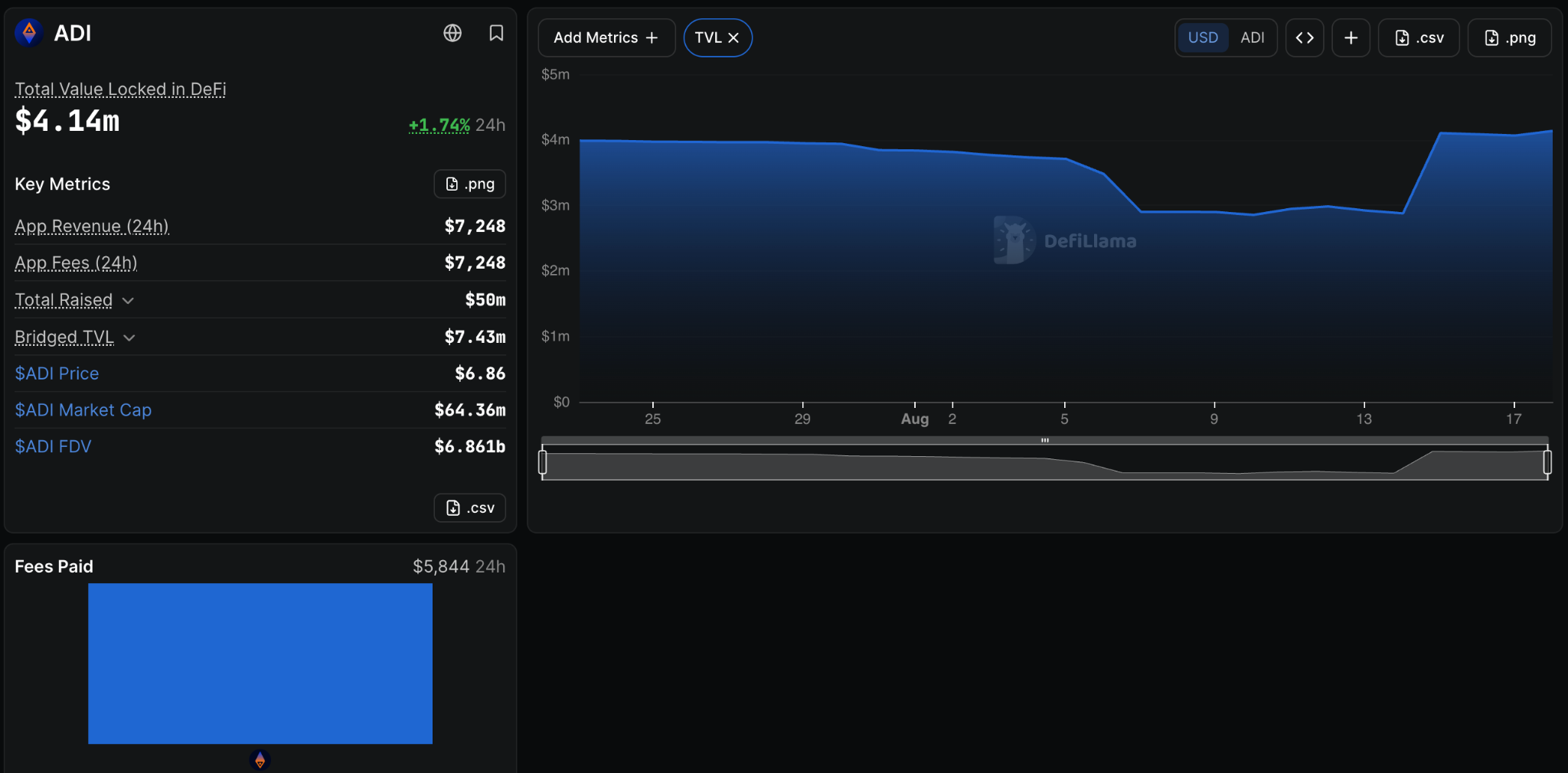
Image: ADI Chain’s total value locked stood at $4.14m in mid-August, against a token carrying a notional fully diluted valuation of $6.86 billion. App fees over 24 hours: $7,248. (Source: DefiLlama)
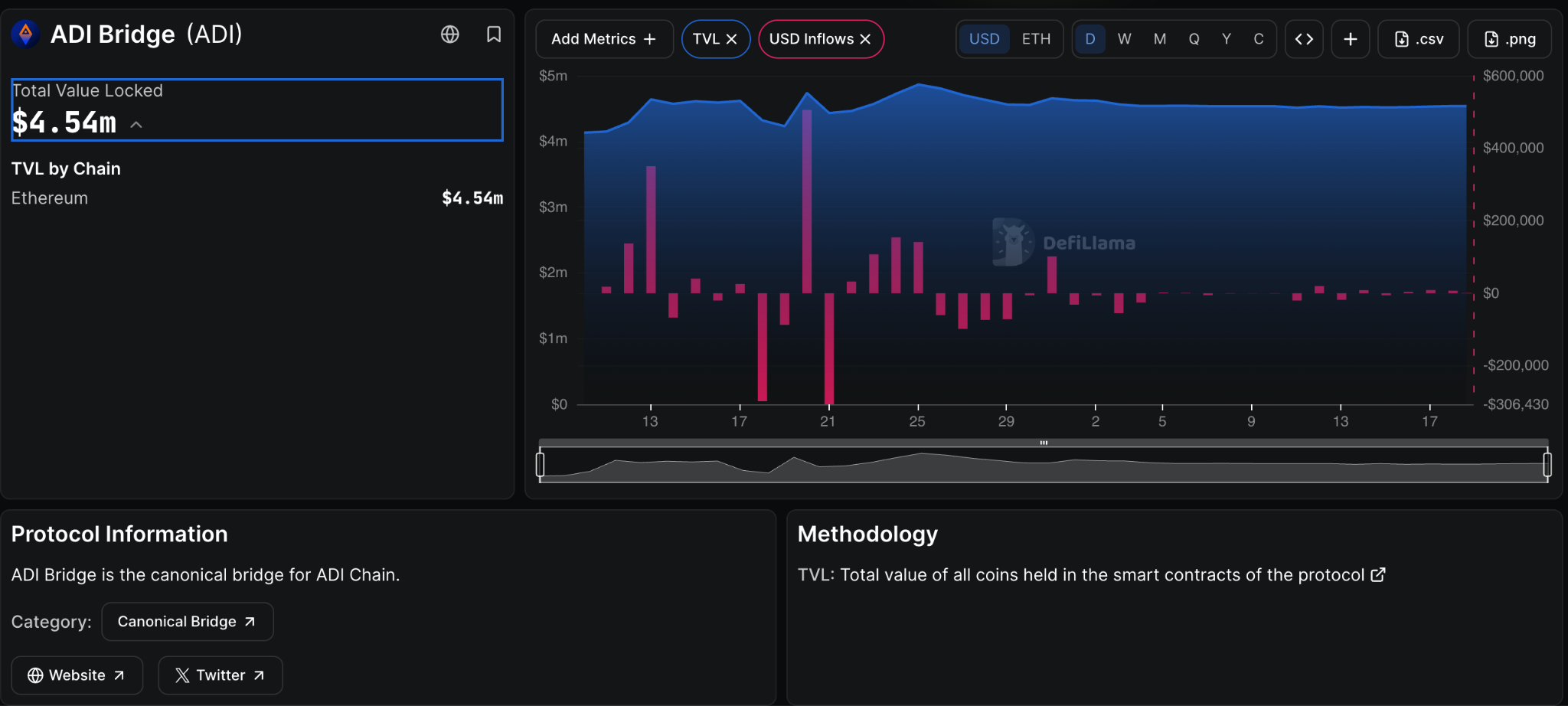
Image: The official ADI bridge is the gateway between Ethereum and ADI Chain. It held about $4.54 million. (Source: DefiLlama)
Settled in Someone Else’s Dollar — Dirham Stablecoin Has Negligible Usage
There is a sharper detail. ADI markets its own “stablecoin rails” — digital tokens pegged to a currency — and its new partners have been promised settlement on them.
Yet the trades on ADI Chain settle in USDC.e, a bridged version of USDC, the U.S. dollar stablecoin issued by Circle. It is the second-most-held token on the chain, with more than 21,000 holders.
A UAE Central Bank-licensed dirham stablecoin, DDSC, does exist on ADI Chain but shows only 63 holders — negligible usage despite its official status,
ADI’s flagship technology, in other words, moves its money on a dollar coin built by someone else.
ADI points to audits by OpenZeppelin, and Hacken as evidence of institutional-grade security.
But the publicly documented scope of that work covers the chain’s token, a gas-sponsorship contract and a certificate-storage contract.
The three Hacken reports and OpenZeppelin’s itemized token audit do not include the governance or admin contracts that control upgrades.
On the public record, the question of who controls the network sits outside what has been independently audited and disclosed.
ADI Chain Has a Familiar Design
The software doing the work is recognizable. The exchange runs on contracts labeled CTFExchange, NegRiskCtfExchange, and ConditionalTokens. That’s the same conditional-token framework that powers Polymarket, one of the best known prediction market platforms.
ADI’s “next-generation” venue is, in its plumbing, closely modeled on an existing one.
That is not improper; much of the crypto industry is built from shared open-source code. But it complicates the claim of proprietary, institutional-grade innovation.
Control by an Undisclosed Multisig Might Undermine Credibility
If the activity is modest, the control is opaque. Behind ADI Chain sit administrative powers: the ability to change the network’s rules and to control the gateway through which money moves in and out.
On Ethereum, the public ledger where ADI’s network is anchored, those powers trace to a single shared wallet — a “multi-signature” account, a vault whose controls are split among several digital keys.
That wallet has three keyholders: the first, the second and the third.
The ledger’s permanent record shows all three were funded within days of one another in late 2025. That’s shortly before the wallet that governs the network was created. They were set up as a set and handed the keys.
Individual keyholders on a public blockchain are often pseudonymous, and reasonably so: naming the people who hold a network’s upgrade keys can make them targets.
The issue here is not that the keys lack name tags — most wallets do. Rather, it is that established projects usually disclose the structure of that control: how many signatures are required to act, and which entities hold the keys, whether a foundation, named team members, or an outside security firm.
Many also route changes through a time delay so that no upgrade can happen instantly or in secret. ADI publishes none of this for the wallet that governs its chain.
For a network marketed as institutional-grade, and on which a FIFA partner and DAZN are building, that silence is the notable part.
ADI fronts named executives for both its prediction-market arm and its chain. Yet, the identities and the structure behind the keys that can rewrite the network remain unstated.
Where the Real Business Happens, the Blockchain Disappears
The most telling evidence comes from where ADI does business under real regulation. In the United Kingdom — one of the world’s most valuable betting markets — a customer who reaches ADI Predictstreet is routed to Matchbook, an established betting exchange running on conventional technology. The blockchain plays no part in the transaction.
There is a benign explanation, and it is probably the main one: partnering with a licensed local exchange is the fastest, safest way into a strict market, without asking a gambling regulator to approve a novel blockchain-settlement model it has never assessed. But the choice is also a signal, and it runs counter to ADI’s own story.
A company whose central claim is that blockchain settlement is the future of the industry has, at the very point where it must handle real customers under real scrutiny, chosen not to use it.
The DAZN Test — Can ADI Predictstreet Get a Pass?
That tension is about to be tested at scale. In July, ADI announced an exclusive global partnership with DAZN. This sports streamer reaches more than 200 markets. The new partnership plans to build prediction markets around live sports — and to introduce a DAZN-branded stablecoin, “powered by ADI Chain.”
Commercially, the logic is strong. ADI Predictstreet’s weakness has never been visibility but conversion, and DAZN offers a large, engaged audience at the moment of peak interest in a live match. But the record here invites doubt about the chain’s role. In the U.K., Ireland, and Brazil, ADI reaches customers on legacy rails.
Across a World Cup’s worth of exposure, on-chain activity barely stirred. Its trades settle in a competitor’s dollar coin (USDC.e).
The likeliest path for the DAZN venture is the one ADI has already walked: conventional, licensed infrastructure at the point of sale, with ADI Chain kept for branding and a stablecoin whose real-world use is still to be shown.
After this story was published a person at DAZN with knowledge of the matter said that “only a free-to-play ADI Predictstreet experience is available on DAZN.”
ADI Needs to Overcome the Disconnect Between Valuation And Business Reality
Which returns to the question beneath the whole enterprise. ADI has raised $50 million and floated a token with a notional fully diluted valuation (FDV) of $6.82 billion, according to CoinMarketCap data. Still, its traction in the prediction market space is dismal.
By way of contrast, Novig’s new prediction market hit first-week notional trading volume of $125 million. Its prediction market launched nationwide in the U.S. on Aug. 4.
Also, bear in mind that FDV is a metric that includes every token that could ever exist, not those actually in circulation. FDV should not be mistaken for real money. ADI coin’s valuation rests on the premise that its blockchain is strategic, institutional, and central.
Its own ledger, and its own commercial choices, describe something quieter: a functioning but marginal betting venue that the World Cup could not fill, that its regulated markets do not use, and that settles its small trades on someone else’s dollar.
The ADI Foundation and ADI Chain must carry an extraordinary share of the company’s valuation and story. Judging by the public record, they carry almost none of Predictstreet’s actual business.
Readers should note that the 18-day volume figure we cite is an estimate derived from that trade count and the trade sizes observed on-chain. It is illustrative rather than exact. On-chain trading and governance details come from ADI Chain’s block explorer and from Ethereum records via Etherscan.
Gambling Insider approached ADI Predictstreet, ADI Chain, the ADI Foundation, and DAZN for comment.


Gambling Insider delivers the latest industry news, in-depth features, and operator reviews that you can trust. Our team combines rigorous editorial standards with decades of specialized expertise to ensure accuracy and fairness. We are committed to delivering clear, impartial, and dependable coverage across the global gambling sector.