I Asked ChatGPT for Sports Betting Tips – Here’s What It Told Me
AI has a tendency to be oversold, so I decided to put it in a situation where any exaggeration would get exposed – sports betting. I asked ChatGPT for betting tips across the UK and U.S. markets, not to find winners, but to see whether it could offer anything useful at all.


Key Insights
- Using ChatGPT for sports betting can explain how betting markets work and how experienced bettors structure decisions.
- Across both UK and U.S. markets, it consistently emphasized bankroll management, discipline, and research over instinct or emotion.
- AI works best as a support tool for understanding risk and process. It’s not a substitute for judgment or a shortcut to winning bets.
What Is ChatGPT?
Before you take advice from a machine, it helps to know what kind of machine you’re dealing with. ChatGPT is an artificial intelligence language model built by OpenAI. It’s software designed to generate text that resembles human writing. It isn’t a digital oracle.
At a basic level, ChatGPT works by identifying patterns in language and predicting the next sequence of words. You give it a prompt, and it responds with the words that statistically make the most sense based on what it has seen before. There’s no live feed of information, no awareness of current events, and no independent judgment behind the output.
People use ChatGPT for a range of fairly practical reasons, including summarizing research, assisting with writing and editing, brainstorming ideas, and learning unfamiliar subjects. In those roles, it can be pretty useful.
But its limits are non-negotiable. ChatGPT doesn’t have real-time data. It can’t predict future events. It can’t guarantee that what it says is correct. It explains ideas and frameworks well. It doesn’t foresee outcomes, and it doesn’t know when it’s wrong.
Why Ask ChatGPT for Sports Betting Tips?
AI tools have become more common, so it’s probably inevitable that bettors would start asking whether they could be useful in gambling, too. This curiosity leads to wondering if a machine that can process language and patterns might help bring a little more structure to how people think about betting.
That question raises a fundamental distinction. ChatGPT betting tips are predictable. They tell you who’s supposed to win or lose. Strategies are frameworks. They address how to evaluate odds, manage risks, and avoid the common mistakes that can turn betting into a bad habit. ChatGPT is poorly suited to the first category and reasonably comfortable in the second.
The AI doesn’t have access to live data or insider information, and it certainly doesn’t have the ability to predict the future. What it can do is explain concepts and outline logical approaches in plain language. Used that way, it’s closer to a guide than an actual tipster.
Asking ChatGPT for Sports Betting Tips in the UK
To assess how ChatGPT handled the UK betting market, the questions were deliberately kept simple. The focus was on horse racing, and the prompts asked for general betting guidance rather than specific picks. The goal was to see how it explained the mechanics of betting in familiar UK markets.
One thing ChatGPT returned was responsible gambling. It stressed bankroll management and setting limits in advance. Importantly, it also talked about avoiding the instinct to chase losses when things don’t go your way. This wasn’t framed as moral advice. Just practical advice.
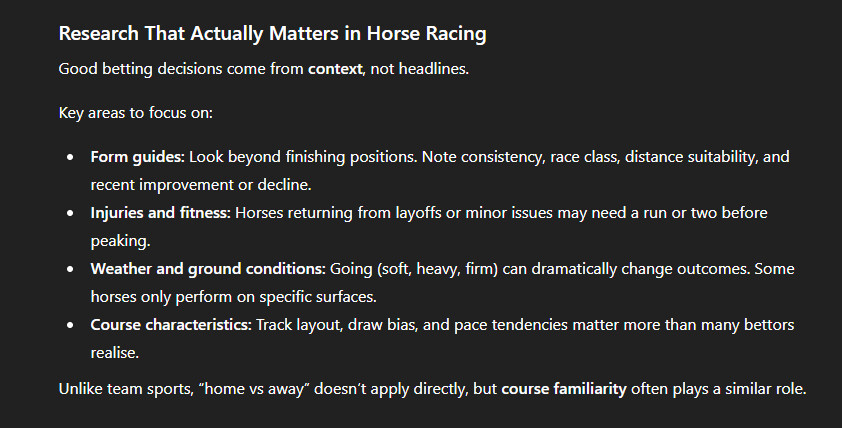
Screenshot showing the key focus areas suggested by AI for horse racing betting tips UK
From there, the emphasis shifted to research. In horse racing, specifically, the focus here led to a reliance on external factors such as weather and track conditions, which can influence results in ways that raw statistics sometimes overlook. It also highlighted injuries, fitness, and form guides as key areas to focus on.
For example, Horses returning from layoffs or minor issues may need a run or two before peaking.
Another theme was value betting. ChatGPT avoided telling you what to back (it would if we framed a ChatGPT sports betting prompt that way, but that wasn’t the goal here). Instead, it spent time explaining how odds work and how implied probability is calculated. It also explained why comparing prices across UK betting sites matters.
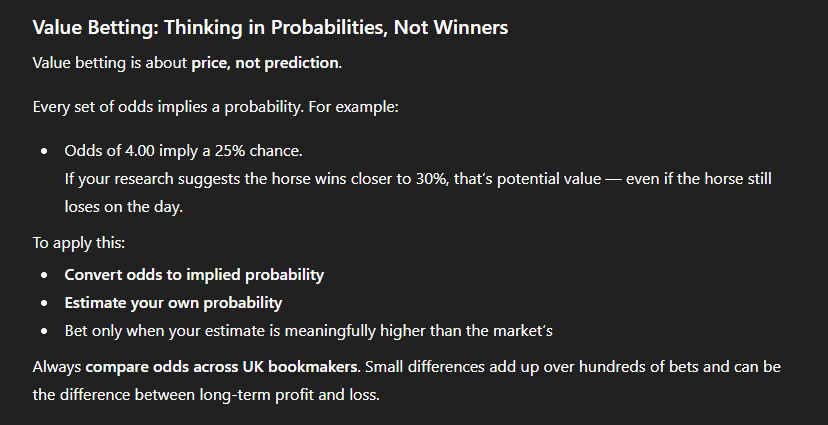
Screenshot showing the value betting tips suggested by AI
The TL;DR of all of this was essentially to make repeatable decisions that make sense on paper. Good advice, but still not a magic bullet.
Asking ChatGPT for Sports Betting Tips in the USA
The U.S. betting market operates differently from the UK, both in how bets are structured and how they’re discussed. With that in mind, the prompts shifted to American sports and conventions. Here, we focused on the NFL.
As expected, ChatGPT spent time on the basics of American odds used in online sportsbooks. It broke down the moneylines, point spreads, and totals, and explained how each works and what they are designed to measure. ChatGPT framed them as tools that require different ways of thinking about probability and risk rather than interchangeable options.
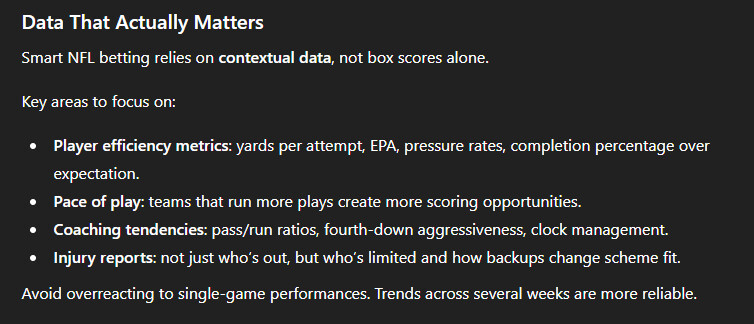
Screenshot showing key NFL betting data points suggested by AI
As it did in the UK prompt, ChatGPT then shifted to data-driven analysis. It discussed the importance of player metrics, pace of play, coaching tendencies, and injury report. It seemed to frame betting as a process of narrowing uncertainty, but not completely eliminating it, which is a good sign.
ChatGPT also acknowledged the regulatory situation in the US. It noted that betting legality varies by state and stressed the importance of using licensed sportsbooks where betting is permitted.
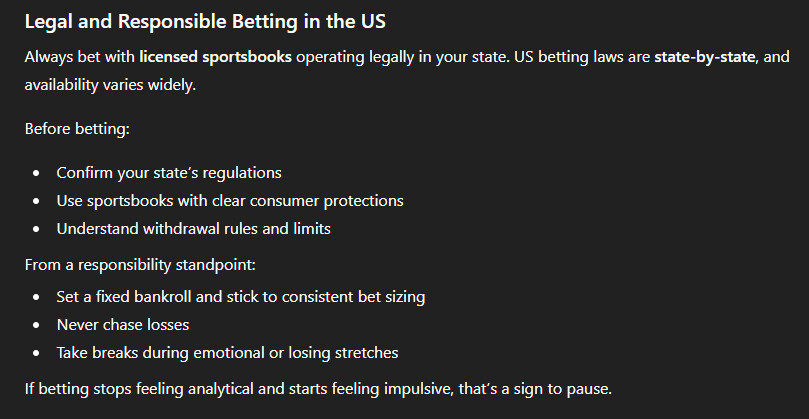
Screenshot of legal betting in the US suggested by AI
Again, ChatGPT remained logical in its response and seemed to steer us towards a more logical decision-making process, rather than an emotional one. Importantly, though, is how you frame the prompt.
Comparing the UK and U.S. Responses
Comparing the UK and U.S. responses side by side made it easier to see what changed in the market and what remained the same. Betting formats and terminology differ, but the comparison reveals how ChatGPT tailors its guidance to local structures without altering its core message.
| Area | UK Focus (Horse Racing) | U.S. Focus (NFL) |
|---|---|---|
| Primary focus | Long-term process and discipline | Market structure and analytical context |
| Core betting lens | Value betting and probability | Margins and matchup dynamics |
| Key research inputs | Form guides, fitness, and course familiarity | Player efficiency metrics, pace, and coaching tendencies |
| External conditions | Weather and ground conditions heavily influence outcomes | Weather (especially wind), travel, rest, and scheduling |
| Market mechanics | Odds comparison across bookmakers to find value | Understanding moneyline, spread, and totals pricing |
| Risk management | Fixed-unit staking, strict limits, avoid chasing losses | Fixed bankroll, consistent sizing, emotional control |
| Regulatory framing | Implied consumer protections and bookmaker choice | Explicit focus on state-by-state legality and licensed sportsbooks |
Despite the apparent differences, which can largely be attributed to the distinct nature of each sport, the underlying principles were generally similar. Both responses emphasized bankroll management, discipline, and selective betting, although the wording differed.
What This Experiment Reveals About AI and Betting
Stepping back from the individual markets, the experiment ultimately reveals itself to be less about betting and more about what AI is actually capable of. ChatGPT works best as an educational tool. It’s good at explaining how betting markets function, why certain factors matter, and how to organize your thinking. In that role, it’s very useful.
It also keeps dragging the conversation back to structure. It discusses processes, risks, and acknowledges that these cannot be wished away. It also emphasizes bankroll management and discipline, which are crucial aspects of betting.
Conclusion
So, what did ChatGPT actually provide me with? Because of the prompts I used, it didn’t give me picks or guaranteed winners. It did offer structure, though. It treated betting as a long-term decision-making exercise, built on research and risk control, rather than confidence or hype.
That may sound obvious, but it’s noticeably different from how betting advice is usually packaged.
Frequently Asked Questions
A: ChatGPT can explain betting concepts, strategies, and risk management practices. Currently, there are no laws prohibiting the use of ChatGPT to provide betting tips.
A: No, ChatGPT doesn’t have real-time data or the predictive ability to accurately forecast match results.
A: AI can be reliable for explaining frameworks and helping structure decision-making, but it can’t validate whether a strategy will be profitable.
A: UK advice tends to focus on odds comparison and value betting, while U.S. advice emphasizes statistics, spreads, and player-driven analysis. However, it really depends on the prompts you use.
A: When used correctly, AI can reinforce bankroll management, discipline, and risk awareness, which can certainly help limit harmful betting behavior.



Gambling Insider delivers the latest industry news, in-depth features, and operator reviews that you can trust. Our team combines rigorous editorial standards with decades of specialized expertise to ensure accuracy and fairness. We are committed to delivering clear, impartial, and dependable coverage across the global gambling sector.