How Are Prediction Markets Taxed? A 2026 Guide for Bettors
The phenomenal growth of prediction markets, where monthly volumes have soared to more than $13 billion since early 2024, is raising numerous questions. One of the most pressing is: how are prediction markets taxed? Anyone looking for prediction markets tax IRS guidance will be disappointed, as no single, unified ruling covers this area. In our analysis of the taxes on prediction markets, we consider how the regulation has moved and what experts are making of the changes.



KEY POINTS
- Wagering on outcomes is booming, but there’s no clear guidance from the IRS when it comes to taxes on prediction markets.
- Different reporting options are in place, depending on whether your wins are classified as gambling income, capital gains, or Section 1256 contracts.
- Countries like the UK and Australia have more favorable tax rules for gambling income than the U.S. does.
- U.S. regulatory changes have created the prospect of phantom income, where people are taxed on profits they haven’t made.
How Are Prediction Markets Taxed in 2026? The “Three Buckets” of Tax Classification
Prediction markets are growing rapidly, putting pressure on authorities, regulators, and tax officials to provide clearer guidance on their tax treatment.
The reality is that requirements depend on the platform structure in place, with prediction market taxes being very much open to interpretation.
One of the biggest conundrums in deciding on prediction market tax treatment is the definition. Are the winnings the proceeds of gambling? How about capital gains? Can they be considered futures contracts?
There is still a lot of confusion about whether participating in prediction markets counts as betting. This makes it difficult for individuals to know how their winnings should be classified, as identical wagers may be treated differently.
As of early 2026, there are three possible options.
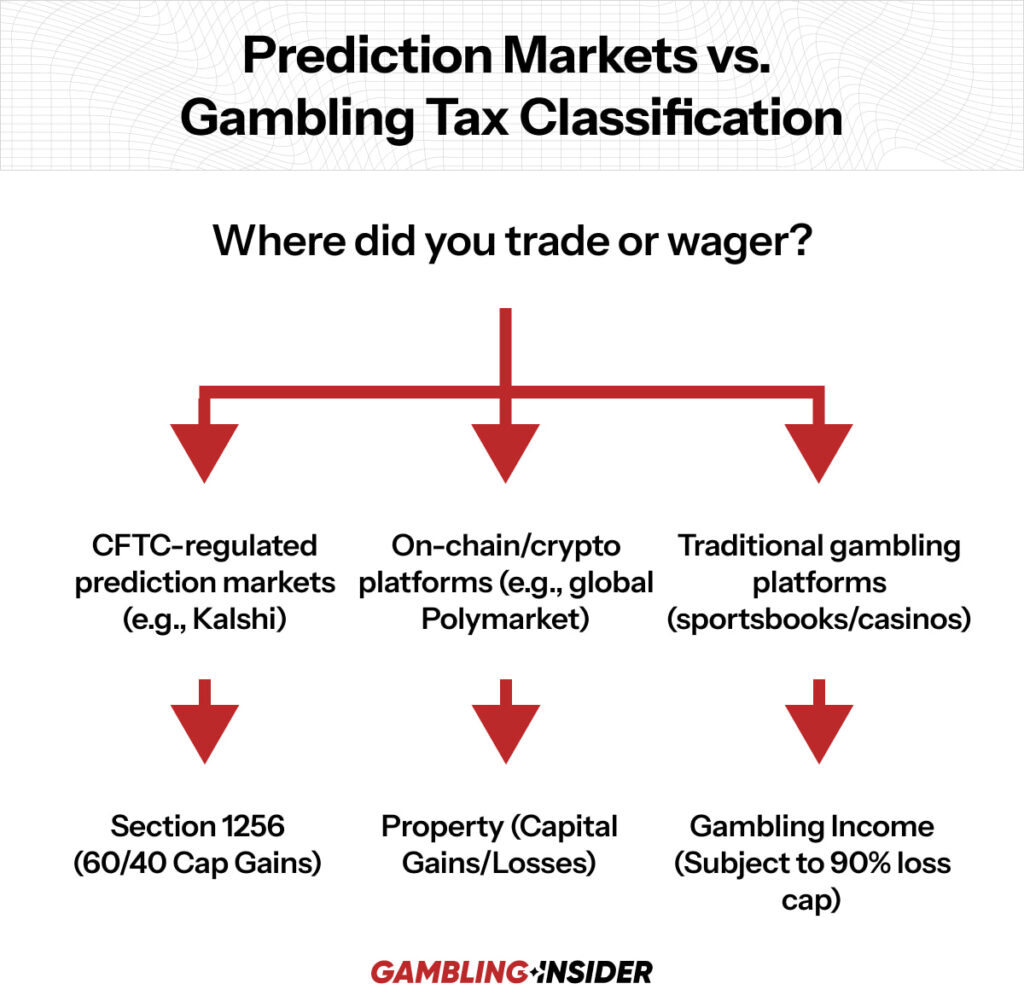
Gambling Income
Standard gambling winnings at sportsbooks and casinos are considered taxable income in the United States and reported on Form 1040 to the Internal Revenue Service. This means they are taxed as ordinary income at up to 37%, but gambling losses can be deducted up to 90% (as of 2026).
Capital Gains
Under this route, most profits made on crypto-based prediction platforms could be treated as capital gains rather than gambling income. It’s a distinction recently raised by Polymarket.
Commenting on Polymarket taxes, the platform stated that the IRS treats Polymarket positions as investment contracts, rather than wagers.
Polymarket winnings are NOT gambling income. They are capital gains, which means different tax rates, reporting requirements, and planning opportunities apply.
Polymarket
The rules then differ depending on how long the positions have been held, but most Polymarket contracts realized as crypto property in 2025 fall under short-term capital gains taxed at 10%–37%.
However, since Polymarket returned to the U.S. market as a CFTC-regulated platform only at the end of 2025, we will most likely see the shift in treating the winnings on this platform from capital gains to futures contracts. This would also mean that if you traded on the global Polymarket, you would need to report that separately from the contracts you participated in on the U.S. platform starting in December 2025.
Section 1256 Contracts (Futures)
The IRS defines Section 1256 contracts as any regulated futures contract on a CFTC-designated exchange (DCM), like Kalshi. Their main benefit is favorable tax treatment.
Profits and losses are taxed using a 60/40 split. This means 60% of gains are taxed at the lower long-term capital gains rate and 40% at the higher short-term rate.
Prediction Market Taxation & the Lack of Clarity
Derek Rawling, owner of the U.S.-based Rawling Tax & Accounting, recently highlighted the problems surrounding prediction market taxation. In a LinkedIn post, he noted that although prediction markets were growing rapidly, their tax treatment remained unclear.
He wrote:
“The IRS has so far provided no direct guidance, leaving taxpayers and practitioners to navigate inconsistent reporting, regulatory overlap, and meaningful tax risk.”
Rawling also pointed out that different prediction market tax treatment could have a significant impact on someone’s finances. He explained:
Experts note that two wagers on the same event – one placed in a casino and one placed through an app – could produce drastically different tax results, even though the underlying activity feels the same to users.
Derek Rawling
The 2026 “Phantom Tax” Warning
Paying tax on income you didn’t receive might sound wildly unfair, but it becomes a reality under newly introduced U.S. legislation.
The One Big Beautiful Bill Act (OBBB), coming into effect at the start of 2026, limits the amount of gambling losses a taxpayer can claim to 90% of their winnings. The new rules mean that even someone who breaks even will be subject to taxes on their gambling activity, according to Franklin Templeton.
An individual winning $10,000 and losing $10,000 would still have to report $1,000 as income on their tax return. Prior to the new law, there would be no income tax consequences in this example.
Bill Cass, CFP, CPWA, Director of Wealth Planning, Franklin Templeton
This gambling tax deduction limit of 2026 has potential ramifications for anyone deciding whether to engage in traditional betting or switch to trading on prediction markets. Since regulated prediction market taxation brings incentives, especially in how it treats losses, the winner is clear. This is particularly important for high-volume traders.
Platform-Specific Breakdowns: Kalshi vs. Polymarket
Because Kalshi has always operated as a CFTC-designated contract market (DCM), its contracts have unambiguously qualified as Section 1256 contracts. For the 2026 Kalshi prediction market tax season, this means traders should continue to enjoy the favorable 60/40 split.
Moreover, Kalshi users are shielded from the new 90% gambling loss cap because their losses are classified as capital losses (which can be carried back three years) rather than itemized gambling deductions.
Kalshi provides a standard Form 1099-B, simplifying the reporting process into a single aggregate entry on Form 6781.
In contrast, Polymarket’s recent transition creates a unique “hybrid” tax year for 2026 filers. For activities prior to December 2025, Polymarket trades occurred on-chain (Polygon) without U.S. regulation, classifying them as Property/Digital Assets. These trades must be reported on Form 8949 using strict “crypto” rules: every trade is a taxable event, losses carry forward only (no carryback), and short-term capital gains rates apply to 100% of profits.
However, for activities after the CFTC’s approval, Polymarket’s new U.S.-regulated contracts are likely to qualify for the same superior Section 1256 status as Kalshi. This forces 2026 filers to double their returns: filing one form for their “Old Polymarket” crypto trades and a separate form (6781) for their “New Polymarket” futures trades.
Prediction Market Taxes: The U.S. vs. The World
While prediction market taxation in the U.S. remains a point of confusion for many, lacking clear guidelines for regular users, other countries seem to have it simpler – and better. However, the benefits also heavily depend on what is considered gambling and what type of platform the action is happening on.
Generally speaking, traditional gambling taxes are more generous in areas like the UK. HM Revenue & Customs (HMRC) doesn’t consider wins coming in from traditional gambling in casinos or sportsbooks as taxable income. This, however, applies only to casual bettors – professional gamblers, like professional poker players, must report their wins as income.
The situation with traditional gambling taxation is similar in Australia and many EU countries – you don’t need to report or pay taxes on casual gambling winnings. Instead of taxing users, regulators in these countries tax operators.
When it comes to prediction markets, it should be noted that platforms like Kalshi or Polymarket still don’t operate in countries like the UK or Australia. While Matchbook is bound to open the first prediction market in the UK soon, its contracts are expected to be treated as gambling products.
While this will limit the scope of available contracts and events, it would also mean the winnings would be exempt from taxation for regular users, just like on betting exchanges or traditional gambling platforms.
⚠️Note: UK or Australian citizens who trade on (offshore) crypto-based prediction platforms should be extra careful, as such income in cryptocurrencies is treated as capital gains and taxed at different rates. If this applies to you, we advise you to reach out to a local tax professional for more specific clarification.
⚠️Note: U.S. citizens who wish to take advantage of tax-free gambling or contract trading in countries like the UK or Australia should be careful because American citizens need to report their worldwide income to the IRS – as long as they carry a U.S. passport.
How to Report Prediction Market Wins on Your Tax Return
Anyone looking to fill in their tax returns must be clear on one key question: how are prediction markets taxed in their jurisdiction?
Here is an overview of the process involved in reporting income, depending on the various tax treatment types we covered earlier in this article.
- Establish which tax bucket applies to you.
Considering recent Polymarket updates, understanding your tax bucket may not be so straightforward, so you will probably need to seek the advice of a tax professional to ensure you start the process correctly.
- Record all information.
Irrespective of which tax bucket applies to your situation, it’s crucial to keep records of all trades, amounts invested, fees, winnings, and losses suffered.
- Report your winnings (and losses).
While the first two steps apply to everyone, the third will depend on how the income is being reported.
• Gambling – You must use Form 1040 to report gambling winnings, according to the IRS. You can also itemise your losses.
• Capital Gains – Form 8949 will be used for this purpose. There will be guidance on this form to differentiate between short-term (up to one year) and long-term transactions.
• Section 1256 contracts – You will need a Form 6781 if you’re going down this route with income from a CFTC-regulated market such as Kalshi.
⚠️Note: As our analysis of prediction market taxes illustrates, this is a hugely complicated area where there is a distinct lack of clear guidance available. That’s why it’s essential that you should consult a CPA or another qualified tax professional who can give you advice based on your own circumstances.
Conclusion
Unfortunately, there’s no clear, 100% reliable guidance available when it comes to taxes on prediction markets.
The fact is, there are too many variables at play. Even tax experts have warned about the intricacies involved in prediction market taxation.
This has to change. The increasing popularity of this area means the pressure will be on to provide clear, fair advice when it comes to prediction market tax treatment.
Frequently Asked Questions
A: There is no unified answer to this question. It depends on the provider and how it’s being classified.
A: Yes. You can generally deduct prediction market losses, although the extent to which this is possible depends on their definition and the country-specific rules in place.
A: Irrespective of whether or not you receive a tax form from Polymarket, the company is quite clear that all net gains must be reported on your tax return.
A: Generally, the answer is yes. However, in the U.S., for example, the legalities are dependent on it taking place within the boundaries of specific, regulated platforms. You will need to know the rules for when it comes to reporting election betting income.
References
- Prediction Markets: The Next Frontier of Financial Markets (Keyrock)
- Topic no. 419, Gambling income and losses (IRS)
- Major gambling tax changes in the One Big Beautiful Bill Act: What US citizens, expats, and non-residents need to know (Taxes for Expats)
- Polymarket vs Traditional Gambling: Key Tax Differences Explained (Polymarket Tax Blog)
- Investment Income and Expenses (IRS)
- Section 1256 Contracts: What They Are and How to Report (Yahoo Finance)
- Prediction Market Tax Treatment Unclear Under Federal Law (LinkedIn)
- Text – H.R.1 – 119th Congress (2025-2026): An act to provide for reconciliation pursuant to title II of H. Con. Res. 14 (Congress.gov)
- OBBBA: Ten tax law changes taking effect in 2026 (Franklin Templeton)
- HM Revenue & Customs (GOV.UK)
- Crypto asset prizes and gambling winnings (Australian Taxation Office)
- US ‘prediction market’ gambling boom hits Britain (The Telegraph)
- About Schedule A (Form 1040), Itemized Deductions (IRS)
- Form 8949 (IRS)
- About Form 6781, Gains and Losses From Section 1256 Contracts and Straddles (IRS)



Gambling Insider delivers the latest industry news, in-depth features, and operator reviews that you can trust. Our team combines rigorous editorial standards with decades of specialized expertise to ensure accuracy and fairness. We are committed to delivering clear, impartial, and dependable coverage across the global gambling sector.