GambleAware’s controversial study: Are safer gambling ads really increasing gambling?
When the findings from the latest study commissioned by GambleAware were released, they painted an interesting picture about how we could improve safer gambling messaging. However, did GambleAware go too far with its own conclusions? Megan Elswyth and Rory Calland investigate.


Feyness is a feeling a person might experience when they have a clairvoyant sense of their own impending doom. It’s an eccentricity that might see you skip around near a cliff edge or take a pop at your boss during your notice period. GambleAware’s closure was announced in July, but won’t take place until March 2026. So the organisation isn’t done yet, and early signs show it may feel empowered to be a bit more firebrand.
The first major piece of research since confirmation was an intriguing psychological analysis of people’s reactions to operators’ responsible gambling awareness ads. It was commissioned by GambleAware and undertaken by Professor Elliot Ludwig, Professor of Psychology at the University of Warwick. From the results to the conclusion, there seems to have been a slight leap of faith (or ideology), and from the researchers to GambleAware Comms, the emotion is ratcheted up.
The intriguing thing is that within the research, the objectives are laid out clearly in the introduction: “With many gambling companies required to allocate 20% of digital and broadcast budgets to safer gambling messaging, the demand for strong evidence on what works is greater than ever.”
This couldn’t be more true, but combative messaging coming out the other end of the study doesn’t seem to engage with this, choosing instead to fire some parting shots in a way that feels slightly less than constructive.
So what are the real results of this study as we can parse them…
What did the study entail?
A group of 4,013 people were recruited into a study, where they were given clear instructions before they began. They were going to watch a short video, then “choose what to do next.” After watching a gambling advert, a pop-up offer would appear on screen. If participants did not click it and chose to watch another video, the pop-up would reappear. As Ludwig says, “this was an attempt to maximise the number of participants who eventually enter the gambling app simulation and therefore have more datapoints to analyse for our secondary measures.”
The participants were warned beforehand that the study would contain elements related to gambling. They were told to make a decision when the pop-up appeared. To suggest that some participants may have guessed that this was the desired path of the study is no great leap.
Once they had clicked through to the gambling app (one created for the study), participants could toggle between Promotions, Live Bets, Safer Gambling and Casino. Alternatively, they could just leave. Some of them did.
The issue here is that only a small percentage browsed the safer gambling tools. GambleAware takes this to mean that “some adverts actually encouraged viewers to gamble more” because of the “videos reinforcing the idea that gambling is safe and ‘harmless fun.’”
These results should be treated as descriptive findings only and treated with caution. We would recommend further research on safer gambling advertising videos’ effect on ‘setting deposit amounts’ – Professor Ludwig
However, the participants were not interacting with the app with the intent to gamble. They were interacting with it with the intent to complete the study, out of curiosity, boredom or dozens of other reasons.
If somebody watches a PSA about drunk driving, is asked to sit in a stationary car for a moment and does not put on a seatbelt, that does not make them more likely to drive more dangerously on the way home. It means they are aware of the study environment and are only taking the precautions necessary for their own actions in that moment.
Another factor GambleAware noted was that “those aged 18-34 were over three times as likely as those aged 55+ to engage with gambling adverts in the experiment,” although even Ludwig understood that these may have been because the younger crowd were “people who are more online and ‘tech savvy.’” They may have simply been more confident clicking through the pop-up, as opposed to “the industry-produced adverts [increasing] gambling intentions among communities most at risk, including younger people,” as GambleAware concluded.
The adverts used in the study were ‘Made to play safely’ (888), ‘Top tips for positive play’ (William Hill), ‘Play at your best’ (Betfair), ‘Take time to think’ (BGC) and ‘Magnets’ Stigma Campaign (GambleAware)
An analysis of the results
GambleAware’s summation of the study’s findings was this: “The research has shown that some safer gambling videos produced by gambling operators may increase gambling rather than encouraging safer gambling. Gambling companies presenting gambling as ‘harmless fun’ looks to be a factor driving this ‘backfire’ effect.”
Two premises here look unsteady on their feet:
1: The implication of a ‘backfire effect’ is that the videos are creating the opposite to the intended effect. These videos are meant to encourage safer gambling, the opposite of which is problem gambling. But GambleAware has justified its claims of a ‘backfire’ by suggesting that the videos may ‘increase gambling.’ See how gambling and problem gambling are conflated.
2: Putting point one aside, does the data show that some safer gambling videos increase gambling? The differences in responses to the materials are nuanced and non-uniform. A video may be effective in decreasing one person’s problem gambling, while subconsciously increasing the likelihood of another casual gambler to make a bet within their financial means.The needlessly binary conclusions take the videos in unnecessarily bad faith, obscuring the genuinely useful lessons that could be absorbed about what works well and what works less well.
Two of five videos increased the likelihood of click-through. The inverse statistic tells us that the majority of operator-led safer gambling videos are effective at deterring people from gambling, despite this not being their primary function. Clearly, two of the videos make the case for responsible gambling perhaps less sombrely than they could, but for certain vulnerable gamblers, the mere mention of gambling will incite them to click through.
The average deposit used by participants if they chose to interact with the online casino app
Rather than pointing to this as “failings from the gambling industry,” this study could be a great asset in strengthening efforts by operators
An expert analyst told Gambling Insider: “The overall click-through rate is pretty small. This is something the authors themselves admit and it raises concerns about the reliability of the results.”
For the claims of a significant backfire to hold up, there would need to be compelling evidence that some videos increased the likelihood of problem gambling compared to a control. This is designated as the secondary part of the study and, due to the small click-through rate, it makes use of a far less rigorous-looking sample size.
‘Top tips for positive play’ is the video that performs the worst according to the secondary data. A £110.86 ($149.21) deposit is a notable outlier – you could throw a blanket over the others, including the control. So we’re down to one video that could be argued to be functioning less effectively than the others with regards to problem gambling. But at this diminished sample size with no supportive data like checks denoting that £110.86 is a financially dangerous deposit for the individuals, to draw the stark conclusions that have been drawn seems almost churlish.
What can we reasonably take from this study?
As with any dataset, there are several directions you can take after looking at the results. GambleAware may have taken a particularly cynical one, but others are just as powerful in its messaging, mind the pun.
Professor Ludvig himself highlighted four key areas that should be focused on following this study. These were increased accountability for the 20% of marketing spend by operators on safer gambling advertising; making safer gambling tools more accessible; guidelines on safer gambling campaigns; and testing safer gambling messages before launching campaigns.
To use the language from the study, these seem like “protective” measures, rather than ones that could “backfire” – such as outright claiming that by “some adverts actually encouraged viewers to gamble more.”
A video may be effective in decreasing one person’s problem gambling, while subconsciously increasing the likelihood of another casual gambler to make a bet within their financial means
It’s also tricky. It works in favour of operators to run safer gambling advertisements, as it shows they are taking the issue seriously; but on the other hand, does mentioning the casino at the end overrule the message of the advert?
Casino brands are strong enough that no matter the subject of the advert, merely mentioning the platform could be enough to prompt people to log in and check results, place last-minute bets or use pre-existing promotional offers. It could be a catch-22 situation where there are no clear ways to succeed with the initiative.
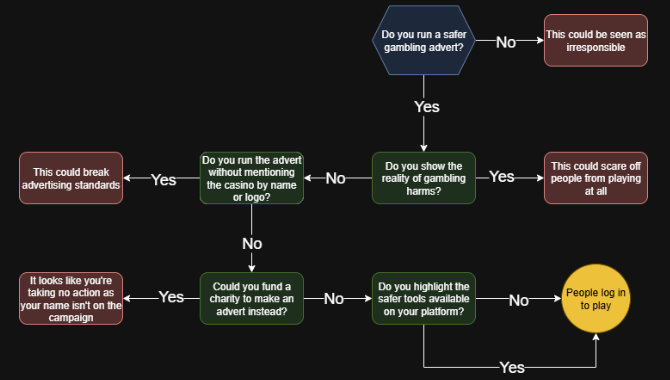
Rather than pointing to this as “failings from the gambling industry,” this study could be a great asset in strengthening efforts by operators.
If the concern is that customers are going to play at a casino after seeing adverts from the operator, perhaps the point of action should be what customers see after logging into the platform, rather than how damning the adverts are against the industry.
Reminders about time or money spent in a certain period, mandatory safer gambling tools or self-assessments – active gambling harm management – will always create more engagement than passive ones such as advertising.
A final index from Professor Lugvig: These results should be treated as descriptive findings only and treated with caution. We would recommend further research on safer gambling advertising videos’ effect on ‘setting deposit amounts.’



Gambling Insider delivers the latest industry news, in-depth features, and operator reviews that you can trust. Our team combines rigorous editorial standards with decades of specialized expertise to ensure accuracy and fairness. We are committed to delivering clear, impartial, and dependable coverage across the global gambling sector.