Republicans Didn’t Let Prediction Markets Off Easy During Senate Subcommittee Hearing
Representing prediction markets, Patrick McHenry was grilled about the rising asset class by his former colleagues during a hearing on Capitol Hill.

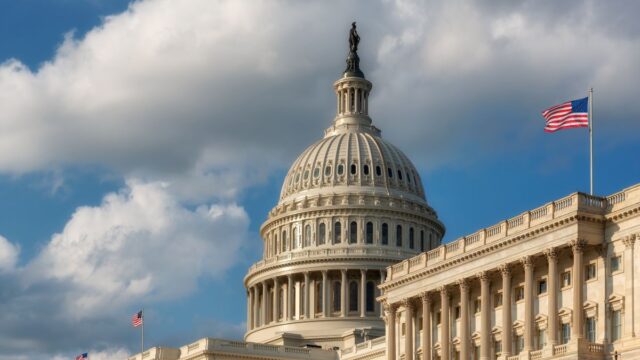
As Wednesday’s congressional hearing veered from the topic implied by the title “No Sure Bets: Protecting Sports Integrity in America”, Republican senators struck a decidedly different tone regarding prediction markets than their GOP colleagues in the House last month.
Among the disparate panel of witnesses, Patrick McHenry, Senior Advisor to The Coalition for Prediction Markets, fielded the toughest questions from members of the Consumer Protection Subcommittee.
Subcommittee Chair Marsha Blackburn (R-TN) cast a wide net in her opening remarks, touching on the erosion of Americans’ “trust in the integrity of sports,” prediction markets functioning “much like traditional sports betting without enforcement of state regulators and attorneys general,” the harassment of college athletes, young people “being inundated with advertisements on social media,” and the risk of gambling addiction.
While that’s a lot to cover in a two-hour session, prediction markets – which have quickly become one of Congress’ favorite topics – dominated the discussion.
McHenry felt heat from multiple angles, including from one of his fellow witnesses. In his testimony, American Gaming Association President & CEO Bill Miller was given and took the opportunity to pile on, calling out prediction markets for their infringement on the gambling industry.
Blackburn and Sen. John Curtis (R-UT) smiled as they expressed what a pleasure it was to have McHenry, who served as a US Representative from North Carolina for 20 years, back in their company, but they and fellow GOPer and Commerce Committee Chair Ted Cruz (Texas) didn’t let their former colleague off easy.
Cruz said in his opening comments:
Prediction markets have started offering, quote, event contracts on sporting events, which for all intents and purposes are sports bets.”
At a House Agriculture Committee hearing last month, Republicans struck a kinder tone with CFTC head Mike Selig; and through his policies, nominations and family’s investments, President Trump, of course, has been unmistakably pro-prediction market during his second term.
McHenry Takes Brunt of It
All the salient points about prediction markets were discussed Wednesday: they offer sports betting outside the purview of state regulation; they market themselves as investing rather than gambling; they encourage insider trading on sensitive geopolitical events; they use social media campaigns to target people too young to gamble in most states.
John Hickenlooper (D-CO) brought up a well-reported social media campaign by Kalshi that showed a young woman claiming she was unable to pay her rent until she started trading on the platform.
Do you think that’s responsible to hold that up as a model for people that are having trouble making their rent that they should go on to prediction markets because they’re going to be better at predicting what is clearly a random occurrence?,” he asked McHenry.
McHenry responded that event contracts are “not fully random” and that he was unaware of the ad the senator was referring to, two dubious statements.
After asking McHenry for a basic definition of prediction markets, Sen. Curtis arrived at the conclusion that with a swap – whether it’s a market tied to weather, an election or something else – someone wins and someone loses. That sounds a lot like gambling, Curtis remarked.
McHenry’s response that farmers can use prediction markets to hedge against a poor crop season was interrupted by Curtis, who wondered how this potential substitute for “insurance” was different from betting at a sportsbook or casino.
“The business models are fundamentally different from a sportsbook,” said McHenry, leaning on the standard argument that a sportsbook sets lines and profits when a customer loses, while an exchange earns a fee from a trade between market participants.
Economic Consequence of Sports
The regulatory justification for prediction markets is that event contracts offer a means to hedge against economic conditions. The case that there’s economic consequence to a team winning or losing a game is far easier than arguing a player prop or micro bet can be used as a legitimate financial hedge.
“When Congress debated Dodd-Frank, some senators expressed concern that event contracts could become a vehicle for sports gambling. Isn’t that, in fact, what has come to pass?,” Sen. Cruz asked McHenry.
Cruz pressed:
The CFTC argues that sports event contracts fit the Commodity Exchange Act’s definition of a swap because sports outcomes have economic consequences. But what is the economic consequence of say whether a pitcher will throw a ball or a strike?”
“It is up to the consumers to decide” what constitutes a swap under the broad definition written in Dodd-Frank, McHenry responded, “and it will be for the courts and the Congress to decide whether or not they like that. … We welcome Congress’ input here and the rulemaking of the CFTC on these definitions”
Micro Betting a Threat to Integrity
Pertaining to the implied topic of the hearing, there was virtual unanimity among senators and witnesses: When it comes to sports wagering, prop bets and micro bets pose the greatest threat to integrity of games.
In her opening remarks, Sen. Blackburn mentioned “high-profile examples of match fixing at the NBA and MLB. What this does is to challenge Americans’ trust in the integrity of sports.”
The AGA’s Miller and Integrity Compliance 360 CEO Scott Sadin, who offered the most meaningful testimony on the subject, both suggested regulation of prop bets is preferred to outright bans.
“I would say generally speaking, player props, micro betting, in-game markets, circumstances in which an individual or singular person may have more impact than a group” are particular threats to integrity, Sadin said in response to Sen. Brian Schatz (D-HI) asking which types of bets are most susceptible to manipulation.
“I still would be a strong proponent of wrapping regulation around those types of markets as opposed to pushing that activity offshore,” Sadin clarified.
Earlier, Cruz asked Miller, “Do you agree that if a league comes to a sportsbook and says a bet creates an integrity risk, the sportsbook should not offer the bet?”
”I do agree with that,” Miller responded.
Don’t Look at Us
Integrity is at the ostensible center of leagues’ prediction market partnerships (MLB has deals with the CFTC and Polymarket; the NHL now with the CFTC and also with both Kalshi and Polymarket), and McHenry stressed the industry is working with the sports properties to help ensure games are on the level.
While there are plenty of player props offered on his group’s members’ exchanges, McHenry claimed that micro bets are where prediction markets draw the line. In fact, this one is on the sportsbooks:
Unlike many sportsbooks and unregulated operators, coalition members do not offer micro bets that are particularly vulnerable to manipulation, such as wagers on the next pitch or the next play. Notably, the sports integrity scandals that have made headlines [recently] involving the NBA and MLB players using insider information and compromised game outcomes occurred on traditional online sportsbooks, not on prediction markets exchanges.”
For now, at least.
Witness Problems: Did Subcommittee Research Harry Levant?
Many around the the sports betting community noticed a glaring omission from the panel asked to testify this week: operators.
Why wasn’t DraftKings or FanDuel represented to give their side of betting’s impact on integrity and what reasonable steps should be taken to address such issues?
The bigger issue, though, may have been the late addition of Dr. Harry Levant, Director of Gambling Policy Public Health Advocacy Institute. While Levant represented the voice of responsible gaming, his participation was ridiculed ahead of the hearing, as reports resurfaced of a felonious and unprincipled past (h/t Blue Ridge Times).
In 2015, the since-disbarred attorney pled guilty to 13 felony counts stemming from stealing $2 million from 12 clients to fund his gambling addiction. The crimes included snatching the legal settlement from a woman after a botched medical procedure left her a double amputee, and his own sister-in-law being forced to sell her home after $1.2 million went missing from her accounts.
Levant still owes his victims about $1.7 million, per public reporting cited in the report.
Ted Cruz Scores With Joke of the Day
Following the panelists’ opening remarks, Sen. Blackburn commented, “I don’t think anyone would have made a bet that we would have five witnesses who stuck to five minutes.”
Cracked Sen. Cruz:
Well, I think that bet may have been on the prediction markets.”
It’s funny because it could very easily be true.
What’s Next?
Hearings such as this are often panned for not resulting in any substantive changes, but the tone and bi-partisanship of Wednesday’s session have to make prediction markets a bit uneasy.
While the state of New Jersey wants its case against Kalshi to be heard by the Supreme Court, which seems destined to have a major say in the ultimate legality of prediction markets, anti-exchange momentum continues to build on Capitol Hill.
Prediction markets will still be pulling for the red team when midterm elections roll around, but Republicans’ support may not be as unwavering as they had hoped.


Gambling Insider delivers the latest industry news, in-depth features, and operator reviews that you can trust. Our team combines rigorous editorial standards with decades of specialized expertise to ensure accuracy and fairness. We are committed to delivering clear, impartial, and dependable coverage across the global gambling sector.