PENN Earnings Beats Suggest Early Positive ESPN Exit Impact
PENN Entertainment (PENN) beats on earnings, revenue and EBITDA, as the termination of the ESPN deal bears fruit and the HG Vora settlement beds in.

PENN Entertainment’s (PENN) Q4 2025 earnings release provided investors with their first clean opportunity to assess the early termination of its 10-year partnership with ESPN – the news is positive.
As predicted by analysts, losses per share have widened, but not as much as some had feared. Losses narrowed to -$0.14, which was a beat of the consensus estimate of -$0.21 loss. Non-GAAP adjusted EPS for Q4 2025 was $0.07.
The numbers suggest that the cost discipline the new board has been looking for is starting to deliver, post the ESPN partnership exit and the curtailment of promotional activity.
Meanwhile, revenue also showed improvement, up from Q3 2025 ($1.72 billion) and Q4 2024 ($1.67 billion) to $1.81 billion. That was a beat of the Q4 2025 analyst consensus of $1.76 billion.
The revenue upside was driven by strong retail performance and good digital volume during the football season, prior to the brand transition.
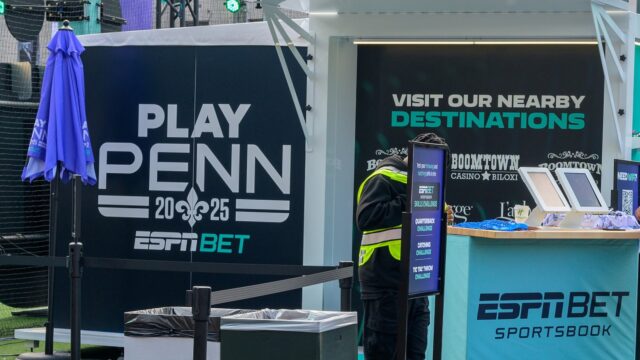
Since Dec. 1, ESPN Bet has been rebranded as theScore Bet in the hope that the success of that pre-existing brand operating in the Canadian market will rub off on the new-look US operations.
Although PENN watchers have been transfixed by the ESPN strategic divorce story and the costs it entails, the Hollywood iCasino app continues to be a star performer, posting record revenues again.
PENN Entertainment stock is up 6.4% in pre-market trading at $13.35.
Hollywood iCasino Pulls in All-Time High Revenues
Although the app figure is not split out from the interactive segment, total revenue was $398.7 million, up from $275.0 million in the same period in 2024. Management was able to confirm that interactive gaming (iCasino) revenue is at an all-time high in Q4 2025.
Impairment charges and migration costs incurred from moving customers from ESPN BET over to theScore Bet account for the dent in EPS.
On the conference call, CEO Jay Snowden addressed the ESPN exit, framing it as a resource-optimization issue rather than an outright failure of strategy and execution.
“While our collaboration with ESPN made significant strides in product evolution, we mutually agreed that the best path forward for PENN is to fully own our customer funnel through theScore Bet.
Snowden continued, “By reclaiming the $150 million annual fee and reinvesting a fraction of that into theScore’s native ecosystem, we are choosing profitability over high-priced brand visibility.”
Adjusted EBITDA came in at $482 million, 2.6% better than the forecast $470 million. The numbers tell us that retail margins (33%) are holding up well, even though interactive is still losing money.
Aside from the end of the ESPN partnership, shareholders focused on losses in the interactive division and on management’s thinking regarding the settlement with activist investors.
The main issues facing the company can be broken down into three categories: the dissolution of the ESPN partnership, the persistent losses in the interactive segment, and the recent settlement with activist investor HG Vora Capital Management.
On a full-year view, PENN’s revenue grew roughly 6% year-over-year to $6.97 million from $6.58 million in FY 2024. Disappointingly, full-year EBITDA was a 13.5% miss (1086 vs the forecast of 1255), which is much improved on the 49% miss in Q3, hinting at progress in operational stabilization.
Interactive Still Bleeding, But Expenses Coming Under Control
PENN’s interactive segment, which comprises online sports betting and Hollywood iCasino, is still piling up excessive expenses.
The poorly constructed partnership with ESPN, from PENN’s standpoint, is mostly to blame.
For instance, PENN was paying $150 million in cash annually to ESPN through fixed licensing fees. Without delivering substantial scale, that fee was a bridge too far for profitability hopes. Additionally, stock warrants negatively impacted the bottom line.
Like other operators chasing online customer growth, the promotional costs are particularly burdensome. The plan was to spend to leverage the ESPN audience and take market share from DraftKings and FanDuel.
That didn’t happen, despite the generous bonuses and matched bets promos. It was reported that the cost of promotions was as much as 32% of handle.
PENN had expected great things from its ESPN BET app, given the huge footprint of the media company it was named after. But the volumes it needed to see in the app never materialized, and market share remained around 3%.
The app worked well from a technical perspective. However, it lacked all-important features that would keep the high-volume bettors coming back for more, such as Same Game Parlays. The app experienced high churn, indicating its inability to convert casual viewers into bettors.
It turned out that the Big Two had nothing to fear from PENN and its $1.5 billion investment in the ESPN partnership. DraftKings and FanDuel, together, still account for up to 80% of the US sports betting market.
Speaking to the interactive segment losses, Snowden said:
“The Q4 interactive loss was a necessary byproduct of our final transition costs and rebranding expenses. However, I want to be clear: The digital business achieved positive adjusted EBITDA in the month of December.
“This is a powerful proof of concept that our underlying product, particularly in iCasino, is now capable of self-sustaining growth without the marketing training wheels.”
Will Settlement with HG Vora be Start of Better Days for PENN?
A lacklustre share price and the failure of the growth strategy brought it to the attention of activist investors. Its share price is off 38% over the past 12 months, trading at $12.5.
HG Vora Capital Management built up an 18% stake in the company (now reduced to about 4.8%). It demanded that independent directors be appointed to the board, that an aggressive buyback program be launched, and that the digital division be sold.
The $4.3 billion PENN had splashed out on theScore ($2 billion) and Barstool Sports ($500 million) acquisitions, as well as the ESPN licensing deal, attracting the ire of HG Vora.
It said the company should abandon its digital pivot strategy and focus on its regional casino business. According to HG Vora, PENN risked sacrificing its best-in-class position in regional casinos due to distractions from the failing digital push.
The activist investors were also less than impressed by the $120 million in compensation that CEO Jay Snowden has received since 2021 – a period during which the stock’s value has fallen by $11 billion.
A settlement has now been agreed. Three independent directors have been added to the board, with a commitment to imposing cost discipline.
Management has committed to achieving break-even on its digital business by the year-end. Investors will be watching for guidance on progress with what amounts to a new strategic pivot.
Snowden underlined the shift to prioritizing operational efficiency:
” Our focus has shifted from expansion to maximizing free cash flow. Every dollar of marketing spend in 2026 will be held to a higher hurdle rate of return.”
| Period | Revenue ($B) | Revenue Forecast | Beat/Miss (%) | Adj. EBITDA ($M) | EBITDA Forecast | Beat/Miss (%) | EPS ($) | EPS Forecast | Beat/Miss (%) |
| Q1 2024 | $1.61 | $1.63 | 🔴 1.2% | $101.40 | $105.00 | 🔴 3.4% | -$0.79 | -$0.59 | 🔴 33.9% |
| Q2 2024 | $1.66 | $1.65 | 🟢 0.6% | $367.00 | $360.00 | 🟢 1.9% | -$0.18 | -$0.27 | 🟢 33.3% |
| Q3 2024 | $1.64 | $1.65 | 🔴 0.6% | $193.50 | $198.00 | 🔴 2.3% | -$0.24 | -$0.28 | 🟢 14.3% |
| Q4 2024 | $1.67 | $1.69 | 🔴 1.2% | $165.20 | $190.00 | 🔴 13.0% | -$0.44 | -$0.29 | 🔴 51.7% |
| FY 2024 | $6.58 | $6.62 | 🔴 0.6% | $827.10 | $853.00 | 🔴 3.0% | -$2.05 | -$1.43 | 🔴 43.4% |
| — | — | — | — | — | — | — | — | — | — |
| Q1 2025 | $1.67 | $1.70 | 🔴 1.8% | $173.30 | $185.00 | 🔴 6.3% | -$0.25 | -$0.29 | 🟢 13.8% |
| Q2 2025 | $1.77 | $1.73 | 🟢 2.3% | $236.10 | $215.00 | 🟢 9.8% | $0.10 | -$0.04 | 🟢 350% |
| Q3 2025 | $1.72 | $1.73 | 🔴 0.6% | $194.90 | $385.20 | 🔴 49.4% | -$0.22 | -$0.10 | 🔴 120% |
| Q4 2025 | $1.81 | $1.76 | 🟢 2.8% | $482.00 | $470.00 | 🟢 2.6% | -$0.14 | -$0.21 | 🟢 33.3% |
| FY 2025 | $6.97 | $6.92 | 🟢 0.7% | $1,086.30 | $1,255.20 | 🔴 13.5% | -$0.51 | -$0.64 | 🟢 20.3% |


Gambling Insider delivers the latest industry news, in-depth features, and operator reviews that you can trust. Our team combines rigorous editorial standards with decades of specialized expertise to ensure accuracy and fairness. We are committed to delivering clear, impartial, and dependable coverage across the global gambling sector.