Polymarket Sued Over Strategy Bitcoin Market Resolution
Plaintiffs allege the prediction market platform improperly changed its interpretation of a Strategy Bitcoin contract after the outcome had already occurred, denying payouts on winning "Yes" positions.

Two Polymarket users have sued the company in New York, alleging Polymarket improperly changed the interpretation of a Strategy Bitcoin market after the event had already occurred, resulting in the denial of their payouts. The complaint names Adventure One QSS Inc. d/b/a Polymarket.com, Blockratize Inc. d/b/a Polymarket, CEO Shayne Coplan, CMO Matthew Modabber and unnamed defendants.
The opening of the complaint, filed July 3 in the Supreme Court of the State of New York, says, “A prediction market has one purpose: to reward people for being right about the world.” The plaintiffs allege Polymarket failed to uphold that principle in resolving the disputed market.
Plaintiffs William Wood and Thomas Bush contend they correctly predicted that Strategy Inc. (formerly MicroStrategy) would sell Bitcoin by May 31, 2026. Polymarket resolved the market “No.”
Plaintiffs Challenge Market Resolution
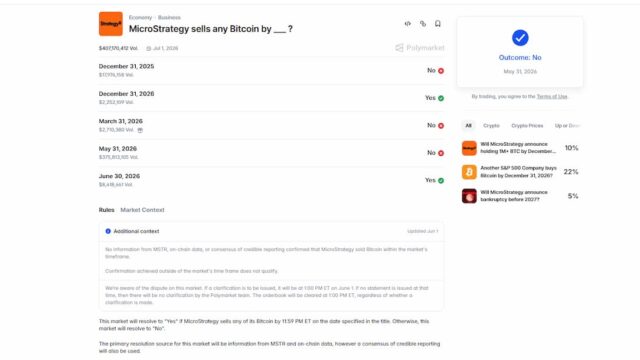
The lawsuit centers on a Polymarket contract asking whether Strategy would “sell any of its Bitcoin by May 31, 2026.”
According to the complaint, Strategy’s June 1 Form 8-K disclosed that the company sold 32 Bitcoins during the reporting period from May 26 through May 31. The plaintiffs argue that the filing established the market should have resolved “Yes.”
Instead, Polymarket settled the contract as “No.”
The complaint alleges Polymarket changed the market’s interpretation after the outcome was known. The market page currently includes an “Additional context” section stating:
No information from MSTR, on-chain data, or consensus of credible reporting confirmed that MicroStrategy sold Bitcoin within the market’s timeframe.”
It further states, “Confirmation achieved outside of the market’s timeframe does not qualify.”
The plaintiffs argue that the market asked only whether Strategy sold Bitcoin before the deadline. It states that the SEC filing was the proof.
Complaint Says Polymarket Controlled the Resolution Process
The lawsuit argues the dispute is “not about a close call or ambiguous outcome.” Instead, it contends the opposite:
A prediction market that will not honor a proven, unambiguous event does not seek truth; it controls payout.”
The complaint also challenges Polymarket’s reliance on UMA’s Optimistic Oracle, the decentralized oracle system used to resolve disputed markets. It alleges Polymarket, not UMA, controlled the drafting of the market rules, issued the clarifications provided to users and framed the question ultimately submitted for resolution.
The complaint states:
Defendants controlled the very input that produced the ‘No’ resolution.”
Wood and Bush assert claims for breach of contract, breach of the implied covenant of good faith and fair dealing, money had and received, unjust enrichment, and deceptive business practices and false advertising under New York General Business Law Sections 349 and 350.
They seek damages, restitution, injunctive relief, attorneys’ fees, interest and payment of the denied value of their “Yes” positions.
Plaintiff Publicly Criticized Resolution Before Filing Suit
The disputed market drew widespread criticism from some users before the lawsuit was filed.
On June 2, plaintiff William Wood, posting on X under the account @willo2_Poly, argued that Strategy’s SEC filing confirmed that the company had sold Bitcoin before the market deadline. He claimed that Polymarket had effectively changed the contract’s interpretation after the fact.
In a series of posts, he said the disputed resolution cost him approximately $500,000. Wood accused the platform of denying payouts to traders who correctly predicted the outcome.
The market page itself acknowledged the controversy, displaying a notice stating “We’re aware of the dispute in this market.”
The lawsuit arrives amid broader debate over the governance of prediction markets following a Wall Street Journal investigation into Polymarket’s UMA-based dispute-resolution system.
That report raised questions about voting concentration, potential conflicts of interest among token holders participating in disputed market resolutions and the broader integrity of decentralized settlement mechanisms.
The complaint now places those issues before a New York court, alleging Polymarket, not UMA, controlled the rules and ultimately the outcome of the disputed market.


Gambling Insider delivers the latest industry news, in-depth features, and operator reviews that you can trust. Our team combines rigorous editorial standards with decades of specialized expertise to ensure accuracy and fairness. We are committed to delivering clear, impartial, and dependable coverage across the global gambling sector.