In or out: Hiring from outside of gaming
Malta and iGaming go together like Google and search, peanut butter and jelly, and sweet and sour chicken.

According to the Malta Gaming Authority’s (MGA) 2024 annual report, gambling and betting activity added a gross value of €1.39bn ($1.61bn) to the nation in 2024. This was up by 7.9% from 2022’s full-year figure, with the MGA collecting €82.4m in taxes and fees that year. This is despite the number of licences and companies in the sector dropping by 9.8% to 323 and 10% to 315 in two years.
Yet, even with licences declining, the number of full-time employees working in Malta under a licensed B2B or B2C business was up 7.3% to 14,357 individuals – a significant portion of the island’s estimated 550,000-person population. Of this, 10,305 worked in the online segment, while the remainder worked in Malta on non-licensed gaming and in land-based establishments.
Malta is a small archipleago and it must also be acknowledged that 14,357 full-time workers is only a drop in the wider gaming industry bucket. Flutter Entertainment alone employs over 27,000 people across its global enterprise, while Caesars Entertainment employs roughly 50,000 people.
However, where Malta differs from these tier-one operators is in the work being done. While Flutter and particularly Caesars hire significantly more staff, a significant portion of these individuals will be working in retail and hospitality roles, working at betting shops, on casino floors and more. But, in Malta, iGaming roles are far less customer-facing, with more emphasis put on game and software development, compliance, management roles and so on.
Bookmakers are considered semi-skilled workers in the UK, while designers are considered skilled workers. These roles require specialised training and experience to complete their roles effectively, often making them harder to come by, and highly sought after.
The gaming industry also has one more problem: it can be somewhat insular. Gaming industry veterans will joke that once you’re in the industry, you’re in for life. This sense of collectivism and community can be felt at industry conventions like iGB Live and ICE, yet often the gaming industry is made up of just this: gaming industry long-timers.
Looking beyond the industry
Bringing talent from outside gaming into skilled worker roles has been high on the agenda for many businesses for some time. Almost two years ago, Gambling Insider attended a panel featuring LiveScore’s Sam Talbot, Kate Parker and Gabrielle Hone, where discussions were had about the importance of having a diverse team. Talbot said: “Everyone’s been in the industry so long, you sit on a panel and everyone introduces themselves – they say, ‘I’ve been in the industry my entire career’, everyone says that and there’s very little diversity because of that fact.
“We encourage looking outside of the industry and trying to get more people in from other geographical areas, political areas and work backgrounds. And it pays massive dividends.”
This sentiment was one echoed by EveryMatrix HR Transformation Manager, Simona Busuioc, who tells Gambling Insider: “Hiring people from outside the iGaming industry brings significant value to an iGaming company by introducing fresh perspectives, innovation and diverse expertise,” she said. “Many critical functions such as financial and legal are not exclusive to iGaming and often benefit from methodologies developed in other fields.

Compliance and ethics are increasingly important in iGaming, and hiring professionals from highly regulated industries like finance or banking can help build stronger governance and data protection frameworks. Ultimately, hiring from beyond the iGaming space strengthens innovation, improves operational maturity, enhances compliance and prepares the company to compete more effectively in a fast-evolving global industry.”
In conversation with Gambling Insider, BettingJobs CEO Jennifer Innes noted that, while the “overwhelming majority of our placements are with candidates who have prior iGaming experience, a notable outlier remains in technical roles such as .Net Developers and Cloud Solution Architects, where skill sets are more transferable, and clients are more open to considering talent from out with the industry.” She also noted AI and chatbot tech as key verticals seeking non-industry experience, though this technology as a whole is also causing roles to shift, and in some cases be lost.

Different industry backgrounds provide different perspectives and skills – something critical for expansion and key in creating fresh ideas in an industry where ideas are often borrowed and followed. “To look outside of our own industry” was a key area for improvement for the gaming industry, according to Talbot.
But what happens when your talent pool consists of only half a million people?
“With a relatively small population and a high concentration of iGaming professionals, companies often recruit from the same limited pool that can lead to onboarding employees with similar backgrounds, experiences and perspectives,” explains Busuioc. “To diversify, iGaming companies often opt for international hires and relocation. Actively sourcing talent from across the EU and beyond, using remote work, advantageous vacation policies, relocation packages and benefits are ways to attract candidates from aboard.”
Indeed, it is clear that foreign nationals are coming to Malta for work. According to a 2021 consensus, the population of Malta increased from 417,432 in 2011 to 519,562 a decade later. In this, the percentage of Malta residents identified as Maltese dropped from 95.1% to 77.8%, while the number of non-Maltese citizens jumped from 4.9% to 22.2%. But, even with this influx, not all these individuals will be moving into the gaming industry.
While Malta is a hub for iGaming, other significant industries to the Maltese economy that require skilled workers include financial services, ICT and real estate, with other industries of note including tourism and manufacturing.
“Malta has a diverse economy with several significant industries outside of iGaming,” Christine Hili, Recruitment Consultant at Gaming Recruitment Solutions, tells Gambling Insider, listing sectors including financial services and fintech, tourism and hospitality, manufacturing industry, real estate and construction as key to the Maltese economy.
To Hili, hiring from outside of the iGaming industry “can be quite important for iGaming businesses, and its significance can be understood from multiple perspectives such as innovation, creativity, skills, etc.” Of course, “while industry-specific knowledge remains essential, integrating workers from outside the gaming industry brings a balanced mix of industry veterans and cross-sector talent tends to lead to more dynamic and adaptable iGaming companies.”
But this is easier said than done. “Malta’s highly concentrated iGaming industry workforce can have both positive and negative implications for diversity in hiring among Maltese iGaming brands,” explains Hili, reflecting on both sides of the debate. “
On the positive side, this concentration fosters a highly skilled and experienced talent pool, driving high standards and encouraging innovation within the industry
However, it can also pose challenges to diversity, as local talent may dominate the landscape, making it more difficult for newcomers from different backgrounds or countries to break into the sector – especially when there are limited pathways or initiatives aimed at promoting greater inclusion.”

Finding a balance, therefore, is key. Innes explains: “The industry as a whole could benefit from being more open to candidates without prior iGaming experience; individuals who bring fresh perspectives, new ideas and innovative products that often don’t arise when hiring exclusively from within the sector. That said, there’s also a valid case for continuing to hire experienced iGaming professionals, particularly to maintain industry standards, ensure operational excellence and drive differentiation.”
National vs international hires
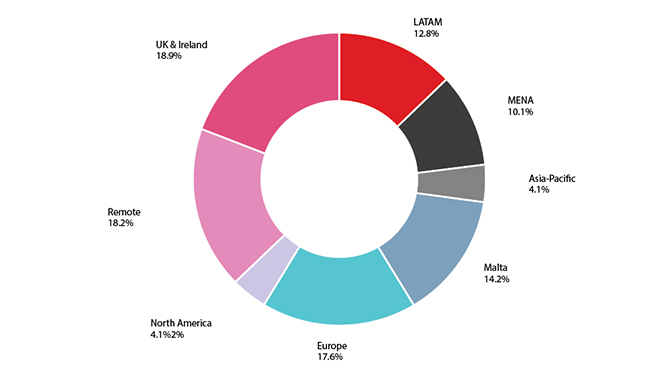
With the need to diversify talent, alongside other contributing factors like local expertise and staff costs, many Maltese iGaming companies will look offshore for new hires. As Innes says, “At BettingJobs, we work exclusively with online betting and gaming companies, so it’s no surprise that 90–95% of the CVs we receive come from candidates with direct industry experience. This reflects the highly specialised nature of our talent pool. As a result, the majority of our conversations are with both clients and candidates who are firmly established in the iGaming sector. The chart opposite shows a breakdown of our placements by location for the first half of 2025. As illustrated, recruitment activity in Malta is thriving (accounting for 13% of all placements during the first six months of the year), returning to pre-covid levels. The majority of this demand continues to be driven by clients within the iGaming sector.”
So, if a Maltese business wanted to hire a non-industry worker from off the island, what are the steps they need to take? “Non-EU/EEA nationals need a work permit and residence licence, and employers must prove no suitable local candidates are available,” explains Hili. “EU or EEA citizens can work and live in Malta without permits, simplifying their move. Non-EU workers must apply for a visa, usually sponsored by the employer, before arriving. Employers must be licensed sponsors and submit required documents, including employment contracts and proof of local advertising.”
Employers are also expected to coordinate travel and integration, handle tax and provide language support to off-island staff. Indeed, post-Brexit, Malta has taken on many of the procedures seen in the UK – a lot of steps to take and, for some, unnecessary ones when a pool of local industry experts is so readily available.
As Innes explains, “most of our clients prefer to hire locally, which makes sense given the strong pool of local talent. One pattern we’ve observed is a clear preference amongst clients in Malta is for candidates who are already living and working on the island. Where there is some openness to hiring internationally, the focus tends to be on EU nationals largely as a result of the complications introduced by Brexit.”
Hili estimates that “roughly 20-30% of jobs in MGA-licensed iGaming companies may be held by workers outside Malta. Many companies hire remote or international staff, reflecting Malta’s role as a global iGaming hub.” Busuioc supports these claims, stating that “a significant amount of the workforce supporting MGA-licensed operations is based outside Malta, especially in tech roles and customer services operations with the purpose of optimising costs and having a larger amount of resource available.”
BettingJobs placements (first half of 2025)
Is it an issue?
With all this talk of diversifying the industry, another question arises. Is it really necessary to hire outside staff? Of course, benefits include an expanded talent pool and transferrable skills, with Busuioc noting that “cross-industry experience across several roles is valuable and might bring a fresh perspective and new skills to organisations, sparking innovation and challenging entrenched practices.” However, she also noted the cons of non-industry hires, including “a possibly slower learning curve,” “cultural adaptation” and “limited industry network.”
So is Malta’s labour force too iGaming-focused? In short, Innes says no. Competitive salaries and benefits have candidates returning to the industry time and time again and, often, companies are looking for those with this experience in the first place. Moreover, iGaming is “one of the more buoyant sectors in Malta,” making it an industry many will return to especially during times of unemployment.
But this also makes the industry appealing to outsiders, too. With outsiders wanting in, and businesses seeking a degree of diversity, the question then becomes: How do we get it right?
Bridging the gap
Getting non-industry candidates prepared to work in iGaming requires time, effort and energy
Both Busuioc and Hili suggest targeted training as a way to encourage industry migration, with upskilling and collaborations with education institutions also suggested as methods to draw in outside talent. They also both suggest hosting events and opportunities for professionals to explore the industry for themselves, be it through job fairs or internal business events. Busuioc also suggested “sharing success stories of employees who transitioned from other sectors can be a testimony of how diverse backgrounds can thrive in gaming,” delivering tangible evidence of the benefits of transitioning to gaming.
Creating an accepting, dynamic work culture with appealing benefits also provides leverage in gaining outside talent. Says Hili: “Providing clear career pathways, competitive packages and a dynamic work environment can attract diverse talent. Additionally, fostering an inclusive company culture that values innovation and development can motivate n-industry workers to explore gaming roles. Offering flexible work arrangements and mentorship programs can also help ease the transition into the industry.”
Busuioc adds: “Rebranding the opportunities within the iGaming industry and emphasising the benefits, dynamic and fun work culture, as well as opportunities for innovation and global reach, can help combat stereotypes. Making job descriptions more inclusive by emphasising skills that apply across industries – like project management, customer service or data analysis can make the industry less intimidating for new joiners.”
Offering these positions with the necessary requirements is easier for some businesses than others. Innes explains: “We’re seeing a growing openness among some clients to consider candidates from outside the iGaming sector, particularly those with experience in other highly transactional digital industries. This trend is especially noticeable in more established iGaming companies that already have a strong foundation of in-house expertise and feel confident broadening their hiring scope.
“In contrast, smaller companies and start-ups tend to rely more heavily on industry specific experience, often prioritising candidates with direct iGaming backgrounds to help support early growth.”
What does it all mean?
In short, while iGaming businesses in Malta may not need non-industry hires, these individuals bring a skill set and perspective that may otherwise be lacking in long-term iGaming professionals. Likewise, iGaming is a lucrative market in Malta, with a buoyancy not seen in other industries.
Where is want and there is demand. But the pros come with cons and, in that, businesses must be prepared to see the diamond in the rough of potential candidates. All this is to say, diversity is a possibility in Maltese iGaming. And like everything in this industry, there will always be a calculated risk.



Gambling Insider delivers the latest industry news, in-depth features, and operator reviews that you can trust. Our team combines rigorous editorial standards with decades of specialized expertise to ensure accuracy and fairness. We are committed to delivering clear, impartial, and dependable coverage across the global gambling sector.
