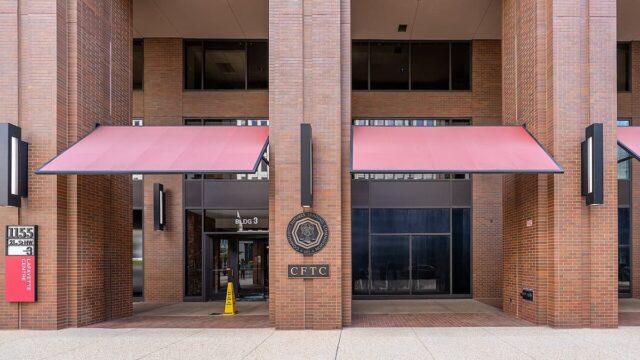
April 24 Marks Escalation Point in Prediction Market Fight as CFTC, Operators Go on Offensive
A surge of filings and rulings on April 24 shows the CFTC and operators stepping up their legal push as courts issued key rulings.

April 24 marked one of the busiest days for prediction market litigation to date, with federal regulators and operators going on the offensive while courts issued key rulings that may shape the path forward.
Federal Offensive: CFTC and Operators Press Their Case
CFTC Targets New York, Backs Kalshi in Massachusetts
The Commodity Futures Trading Commission (CFTC), which oversees federal derivatives trading, escalated its legal push against state-level actions, filing suit against New York and intervening in Massachusetts.
In New York, the CFTC and Department of Justice filed suit seeking to block state enforcement efforts. The agency argued that federal law governs event contracts:
This federal law designates the CFTC as the federal agency with ‘exclusive jurisdiction’ over the regulation of commodity futures, options, and swaps traded on federally regulated exchanges.”
The complaint directly challenges state authority:
New York’s attempt to shut down federally regulated markets intrudes on the exclusive federal scheme Congress designed to oversee national swaps markets.”
The same day, the CFTC reinforced that position in Massachusetts. It filed an amicus brief supporting Kalshi in its state court case, arguing that event contracts fall under federal derivatives law, which preempts state gambling enforcement.
Some states continue to pursue ever-escalating, illegal enforcement actions against CFTC-regulated exchanges, despite rulings from multiple courts halting those efforts,” said Chairman Michael S. Selig in a press release.
Congress has entrusted the CFTC with the sole authority to regulate commodity derivatives markets, including prediction markets. To any state that seeks to nullify federal law and seize authority over these markets, I say again: we will see you in court.”
The CFTC has previously filed lawsuits similar to the one in New York against Connecticut, Arizona, and Illinois. The agency also joined Kalshi’s case against Arizona, securing a temporary restraining order against the state.
Kalshi Accelerates Injunction Push in Utah
New developments occurred in Kalshi’s lawsuit against Utah. After the state notified its intention to take enforcement action, Kalshi filed a renewed motion for a preliminary injunction, with both parties agreeing to an expedited briefing schedule.
The parties agreed that Utah would file its memorandum in opposition to Kalshi’s renewed preliminary injunction motion by May 1 and that Kalshi would file its reply in support by May 8. They ask the court to set a hearing “at the earliest available date after May 8, 2026.”
Operators Move Wisconsin Cases to Federal Court
On April 23, Wisconsin became the latest state to launch enforcement action against prediction markets, filing complaints against Kalshi, Polymarket, Crypto.com, Robinhood, and Coinbase.
On April 24, Polymarket moved to remove the case to federal court. Crypto.com and Kalshi (together with Robinhood and Coinbase) followed shortly after. Their position mirrors the broader federal argument that event contracts are “swaps” subject to the CFTC’s “exclusive jurisdiction.”
Similar cases are pending in other states, such as Washington. Separately, in Nevada, a state court lawsuit was remanded from federal court. That allowed regulators to obtain and extend a temporary restraining order requiring Kalshi to block access for Nevada users.
Courts Continue to Shape the Fight
While that offensive unfolded, April 24 also delivered some judicial updates — most notably from the Sixth Circuit.
Sixth Circuit Denies Emergency Relief, Signals Skepticism
In a potentially significant ruling, the United States Court of Appeals for the Sixth Circuit denied Kalshi’s request for an injunction pending appeal in its challenge to Ohio’s sports betting enforcement.
The court made clear that Kalshi had not met the required threshold on the merits, stating:
At this early stage… Kalshi has not shown that the merits are in equipoise.”
The panel also emphasized that even a closer showing on the merits would not have been sufficient given the competing state interests:
[Kalshi] would still have to enjoin Ohio’s gambling laws pending appeal because of Ohio’s strong interest in enforcing the laws.”
That emphasis on state authority carried through the opinion:
Ohio’s strong interest in enforcing the laws and the underlying public interest that the laws serve.”
The court also acknowledged the division among courts on the matter, noting that:
Several courts have reached conflicting conclusions about whether federal law preempts similar sports-betting laws.”
The ruling is notable for its skepticism toward Kalshi’s arguments. Recently, the Ninth Circuit panel showed similar skepticism in its consolidated case involving prediction market operators and the State of Nevada.
Sixth Circuit’s ruling could provide additional support for states, including Nevada, as similar arguments are litigated across jurisdictions.
Nevada Discovery Advances as Appeal Continues
In Nevada, the federal case remains active at the district court level even as the Ninth Circuit reviews Kalshi’s appeal of an earlier injunction.
On April 24, a federal magistrate judge granted in part a motion to compel. It required Kalshi to search for and produce advertising and marketing materials tied to “sports bets or sports wagers.” The court emphasized that advertising materials are directly relevant to key issues in the case.
Notably, the court ordered Kalshi to search and produce ads on TikTok and Snapchat — platforms associated with younger audiences — within 14 days. According to the filing, Nevada regulators have already received Kalshi advertisements placed on Instagram.


Gambling Insider delivers the latest industry news, in-depth features, and operator reviews that you can trust. Our team combines rigorous editorial standards with decades of specialized expertise to ensure accuracy and fairness. We are committed to delivering clear, impartial, and dependable coverage across the global gambling sector.