New York Bill Banning Sports Betting on College Campuses Misses the Mark, Experts Say
It may be well-intentioned, but legislation requiring operators to block college kids from gambling on campus leaves multiple problems unresolved.

While the language of a bill that finished the New York legislative calendar wallowing in a Senate committee espouses noble intentions – creating a “narrowly tailored geographic safeguard focused on a population with demonstrated vulnerability” – an attorney and gambling industry observer said that SB10470 might not be able to fulfill its intent by simply banning mobile sports betting on college campuses. Similar bills nationally might suffer from the same frailty.
The New York bill, sponsored by State Senator Andrew Gounardes:
“Prohibits mobile sports wagering operators or platform providers from permitting, accepting, or facilitating the placement of a sports wager through a mobile application or platform from any individual on a college campus in the state; requires mobile sports betting platforms to implement geofencing restrictions on campuses and properties; limits exposure to gambling for college-aged students; reduces distractions in academic settings.”
Sounds great. But Douglas Mishkin, a partner at Bryan Cave Leighton Paisner, told Gambling Insider it might not be practical.
You are cutting down [the problem] to an extent, but you’re not solving the problem altogether,” said Mishkin, a compliance expert and former senior vice president of legal and business affairs at Metric Gaming.
“I don’t expect that legislation is passed with the assumption that it’s going to 100-percent address what it’s trying to address, and there’s some threshold where you think it’s still worth it. But that would require some real study, I imagine.”
If the Bill Can Make it Here?
A similar version of the Senate bill, A10526, sat in committee in the Assembly when the New York legislative session ended on June 5. The next session begins in January and the bills would have to be reintroduced.
This could allow Gounardes time to refine – or more importantly broaden, industry sources said – the scope of the bill. The original version proposes new tasks for college administrations, including a requirement to remit to the New York State Gaming Commission (NYSGC) “necessary geographic data and campus boundary information to effectuate compliance” through geofencing.
A similar bill failed to become law in Tennessee this year, and one to geofence K-12 schools was recently introduced in Pennsylvania. A campus-ban geofencing bill failed in Maryland in 2024, with Towson University officials deeming the geofencing facet “not technically feasible.”
Legislators, Mishkin believes, will wrangle with whether this type of enforcement is an acceptable balance of results and effort. The issue of eliminating distraction feels particularly difficult to address for Mishkin.
“What are you ultimately trying to solve for, practically, and would legislation along these lines in fact address those concerns?,” pondered Mishkin, who has no connection with the legislation. “And if so, to what extent would they address them?
“I had also seen a reference to concerns around distractions for college students, but the nature of sports betting is such that there’s the placement of the wager itself, but oftentimes the real distraction isn’t so much from the placement of the wager, it’s from the watching of the match, the event unfolding that you wagered on.
Not to say that it might not be effective, just to some degree, but how effective and is it ultimately worth it? Is this the right way to approach what you’re trying to achieve given some of those practical considerations?”
Students Can Walk Right Through a Geofence
Defending campuses either in rural, smaller urban, or self-contained larger city areas – such as Paul Smith’s College, Cornell, or Syracuse, respectively – would be a simple technological matter. GeoComply, which is contracted with the state of New York to provide geofencing services, has proved its ability to shield granular pieces of real estate in the District of Columbia, which is dotted with almost a thousand parcels of federal land on which gambling is impermissible.
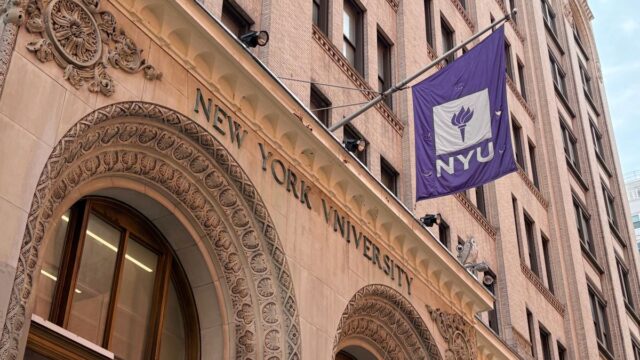
But the feasibility of sectioning off a campus like NYU in Manhattan is questioned by industry sources that foresee public frustration for tech snarls and agitation with sportsbooks.
And students could just cross the street to tap out a parlay.
“It was not uncommon for there to be a lot of wagering activity right across the border when there were states that hadn’t yet legalized but their neighboring states had,” Mishkin said. “And so people who are interested in placing bets will still do so.”
The Tennessee bill would have applied only to public universities, also banning wagering in college sports venues, a provision unlikely to be popular with adult alumni at Volunteers games. New York laws prohibit betting on in-state teams.
Kids These Days: If They Want To Bet …
Professors who demand students’ attention have rules in place to discourage phone use in class. If distractible ones still want to indulge in a parlay in a Cornell lecture hall, geofencing of the Ithaca campus would likely push them to another distraction, Mishkin noted, perhaps one currently beyond the reach of state regulators: prediction markets or offshore sites.
“Are you unintentionally increasing the traffic to avenues where you might find more problems?,” Mishkin wondered. “I would think that would be a consideration.”
Brian Petrotta, an assistant professor of sports media and gambling researcher at Oklahoma State, told Gambling Insider that he would offer “tepid” support to the current bills.
“I don’t think there’s a downside to trying to curb access to sports betting products on college campuses. I’m also not convinced that it will solve a problem,” he said.
“Students are savvy, and if they want to bet they can find technological workarounds.”
Including daily fantasy sports and prediction market language in bills – SBS10470 has none – may be more important.
These are arguably more popular with college students because they serve adults 18 and up,” Petrotta noted. “So, while there may be symbolic value in a university geofencing its campus, I have a hard time believing that it would produce meaningful changes in behavior.”
A student told the University of Tennessee student newspaper in April that they’d used virtual private networks (VPNs) to bypass similar bans on public university campuses for foreign-owned social media platforms.
“The ban hasn’t really affected me at all,” Brooklyn McCorkle told The Daily Beacon. “I think people will find a way around anything that they don’t agree with.”
A More Granular Approach for a Troublesome Issue
Mishskin advocates a more “targeted” approach to addressing the issues that prompted the writing of SB10470. The bill cites National Council on Problem Gambling (NCPG) data finding that “individuals ages 18 to 24 experience problem gambling rates two to three times higher than the general population.”
“That vulnerability,” the bill continues, “is especially significant in college environments, where young adults are navigating academic demands while managing independent finances for the first time. College campuses are designed to support long-term educational and financial development, yet the availability of unrestricted mobile sports wagering in that setting introduces a high-risk activity into a population statistically more susceptible to harm.”
By focusing on the issues at the user level, perhaps limiting the amount college-aged students could wager, how often, or when, could protect them beyond the imaginary borders of campus, Mishkin said. But there would be resistance, he predicted.
“The notion that [some] of your customers can only bet this much, just based on the fact that they’re a college student, certainly operators are going to have concerns about that,” he said. “But, I think, to target this in a way that would be more practical, you have to get more granular as to the exact types of behaviors that you’re trying to curb. And it’s not as simple as wagers placed while on a college campus.
“It’s probably, ultimately, too blunt of an approach. And you have to get much more specific about behaviors from college students who are shown betting repeatedly during classroom hours, whatever it might be, and the kinds of things that could be built into the algorithms of operators to help identify [it].”
Mishkin said including a requirement for more information-sharing between operators and the NYSGC, and implementation of tech-driven mitigation, could strengthen the bill.
“But none of this is easy,” he continued. “I imagine operators would push back to say ‘It’s going to be quite burdensome to do that. It won’t be perfect. And even if we could do it, it’s not going to ultimately address, in every instance, what you’re trying to solve for.’”


Gambling Insider delivers the latest industry news, in-depth features, and operator reviews that you can trust. Our team combines rigorous editorial standards with decades of specialized expertise to ensure accuracy and fairness. We are committed to delivering clear, impartial, and dependable coverage across the global gambling sector.