Kalshi’s Strongest Legal Defense Leg Rests on Less Than 1% of Its Business
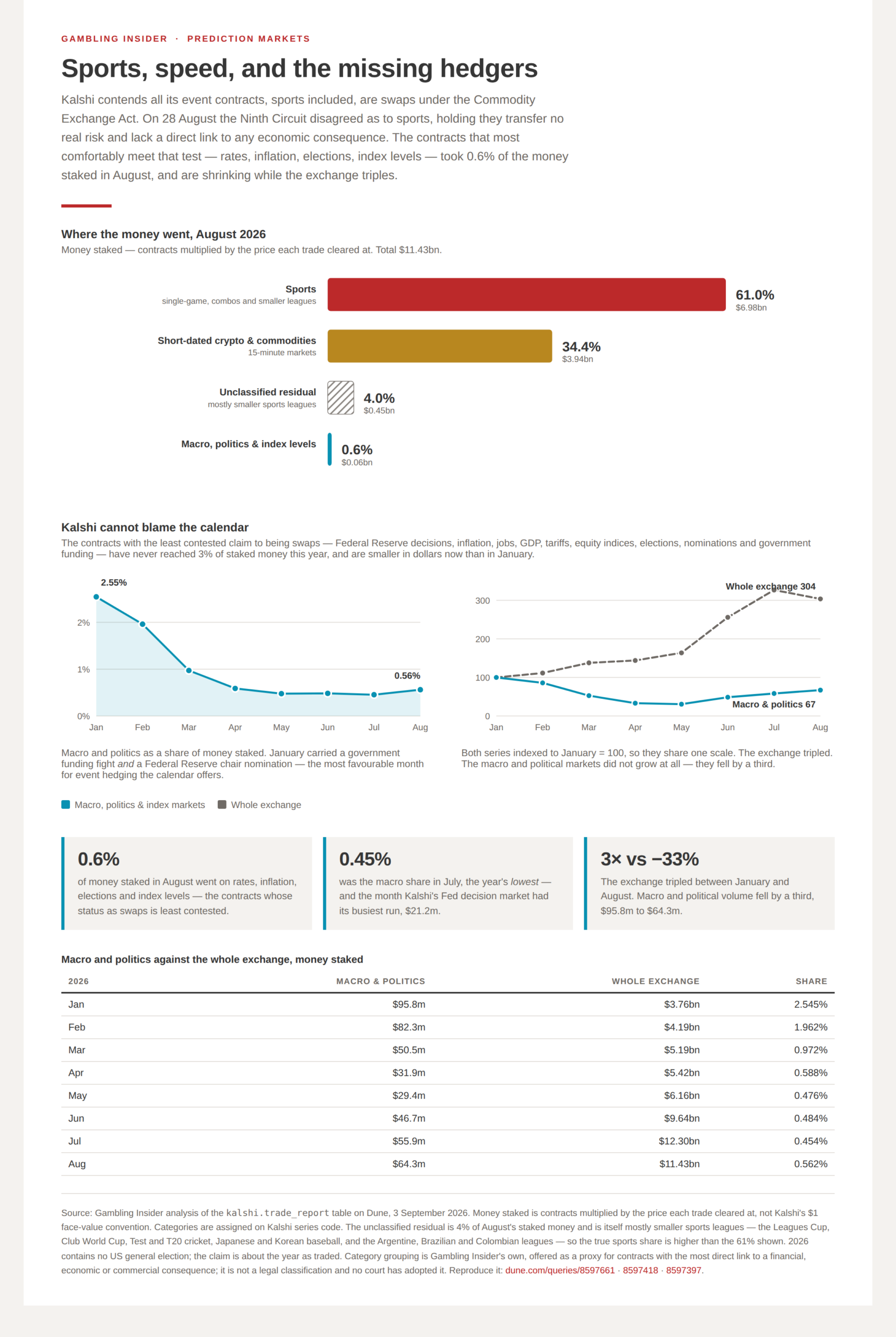
Kalshi's case against the states rests on a single claim: that its event contracts are swaps, putting them under exclusive federal jurisdiction. Two federal appeals courts have now split on whether that holds for sports. Gambling Insider rebuilt Kalshi’s entire trade record and found that the contracts with the strongest claim to being swaps — interest rates, inflation, elections, index levels — took 0.6% of the money customers staked in August.


The argument over whether prediction markets are becoming gambling has been long on rhetoric and short on numbers. So Gambling Insider went to the source data. We rebuilt Kalshi’s trading from its full trade record on Dune, and the picture is sharper than either side of the debate has let on.
Kalshi’s defense is not that its financial markets justify its sports markets. It is broader and simpler than that: every contract it lists, a Yankees game, no less than a Federal Reserve decision, is a swap within the meaning of the Commodity Exchange Act.
If that is right, the CFTC has exclusive jurisdiction, and roughly two dozen states have no say. Kalshi has won on that argument, and it has lost on it, and the disagreement is now the central question in the industry.
What the trade record can settle is not the law but the ground it is being fought over. In August, at least 61% of the money customers staked rode on the outcome of a sporting fixture. Another 34% went into short-dated crypto and commodity price contracts, dominated by 15-minute markets.
Together, that is roughly 95 cents in every staked dollar sitting in the contracts whose status as swaps is contested. The contracts nobody seriously disputes — rates, inflation, index levels, government funding — came to 0.6%.
The scale matters, but for a different reason than the one usually given. At about $11.4 billion of staked money in August against a U.S. legal sportsbook handle running near $13.5 billion a month, Kalshi is now large enough that what it trades is a public question rather than a niche one. Size makes the exchange material.
Composition is what tells you which way its legal argument is pointing (see the first infographic below).
Kalshi’s $40bn Headline Shrinks to $11.4bn
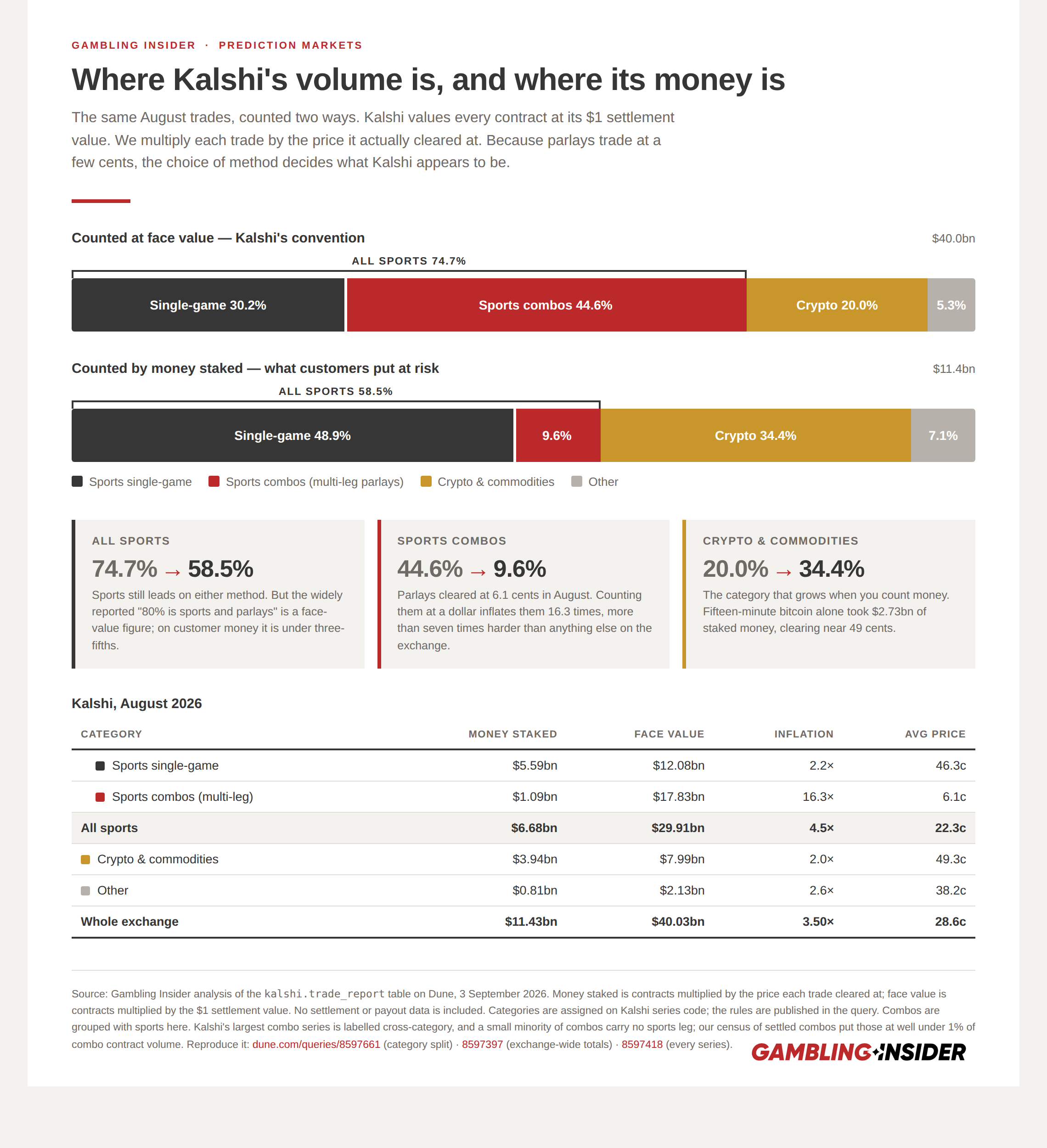
Kalshi reports its own volume in a way that flatters. The figure the firm publishes counts every contract at its full $1 face value, which lumps a penny bet in with a dollar one. Measured that way, August looks like $40 billion. But most contracts do not trade anywhere near a dollar, so that number overstates the money at risk.
The truer measure multiplies each trade by the price at which it actually cleared. On that basis, pulled from the kalshi.trade_report table on Dune, Kalshi did $11.4 billion in August, after $12.3 billion in July and $9.6 billion in June.
U.S. sportsbooks took $40.5 billion of handle in the first quarter of 2026 and $166.9 billion across 2025, according to the American Gaming Association.
Annualize Kalshi’s August and you get about $137 billion, closing on the whole U.S. industry, from a company that did not take a sports bet, in its telling, until last year.
The difference between the two methods is not a matter of rounding. A Kalshi contract pays $1 if the event happens and nothing if it does not, so its face value is always a dollar, whatever it costs.
Someone who buys a contract for two cents has two cents at risk, but Kalshi’s convention records a dollar of volume: fifty times the money. Across the whole exchange in August, the two methods diverge by three and a half times, because the average contract cleared at 28.6 cents.
The Markets With the Strongest Swap Case Are Just 0.6%
To be a swap under the Commodity Exchange Act, a contract must pay out on an event “associated with a potential financial, economic, or commercial consequence.” How much work the word “associated” does is the whole fight.
In April, a divided Third Circuit read it loosely, affirming an injunction that let Kalshi keep trading in New Jersey. Sports outcomes, the majority reasoned, plainly carry economic consequences for sponsors, advertisers, broadcasters, franchises and communities, and an association is all the statute requires.
On Aug. 28, the Ninth Circuit went the other way in KalshiEX, LLC v. Assad, holding that sports event contracts are not swaps and that federal law does not displace state gambling regulation.
It drew a line between an event and its outcome, said the nexus to economic consequence must be direct to the contracting parties rather than diffuse, warned that the broader reading would sweep in ‘bingo games, ping-pong tournaments’ and found that the contracts perform no genuine risk-transfer function, being disconnected from any exposure the parties actually carry.
That last point is where the trade record speaks. Under the Ninth Circuit’s narrower reading, the contracts that pass comfortably are the ones with a direct line to somebody’s balance sheet: an interest-rate decision, an inflation print, an index level, a government funding deadline. Those are also, according to Kalshi’s own data, the contracts that almost nobody is trading. They drew $64.3 million of staked money in August — 0.6% of the exchange.
The obvious objection is seasonality: August had no election, and macro trading is lumpy. It does not hold. Across every month of 2026, the same group of markets has never exceeded 2.5% of staked money. That peak came in January, when traders had both a government funding fight and a Federal Reserve chair nomination to price — about as favorable a month for event hedging as the calendar offers.
Nor is the softness a matter of timing around rate decisions. Kalshi’s Fed decision market had its busiest month of the year in July, at $21.2 million; July was also the month when macro and political contracts hit their lowest share of the exchange, 0.45%.
The starkest number is the trend. Macro and political volume has not grown at all. It was $95.8 million in January and $64.3 million in August, a fall of about a third, while the exchange as a whole grew from $3.8 billion to $11.4 billion.
The exchange’s growth did not come from macro and political markets: their staked volume fell by a third while total exchange volume tripled. The growth was overwhelmingly concentrated in sports and short-dated price contracts. The part of the book with the least contested claim to being a swap is not merely small. It is shrinking.
Mike Roselli, Chief Regulatory Officer at 365Prediction, said in comments provided to Gambling Insider via LinkedIn:
“With the appellate courts now split after the Ninth Circuit’s recent decision, at this point Supreme Court review feels like a matter of when, not if.”
365Prediction was founded by Dr. Laila Mintas, a high-profile entrepreneur and thought leader in the sports betting and iGaming space — she is the CEO of the startup, whose Designated Contract Market license is pending with the CFTC.
More Than Three-Fifths of Kalshi’s Money Is on Sports
Breaking Kalshi’s August down by what people actually traded, and two businesses appear side by side.
Sports single-game markets were the largest category at $5.6 billion, about 49% of the total. Adding multi-leg combos takes sports to 58.5%, and counting the smaller leagues that sit in the residual bucket — the Leagues Cup, the Club World Cup, Test and T20 cricket, Japanese and Korean baseball, the Argentine, Brazilian and Colombian leagues — lifts it to about 61%. That is the sportsbook.
But the second-largest slice, $3.9 billion, or roughly 34%, was not sports at all. It was short-dated crypto and commodity contracts, led by a single product, bitcoin priced in 15-minute windows, that alone did $2.7 billion.
A contract that resolves every quarter hour on where a coin price lands sits awkwardly with the price-discovery rationale, because it is downstream of the spot market it references: it reports the price rather than finding it.
That matters for the legal fight because it is the same distinction the Ninth Circuit drew. The swap characterization is easiest to sustain where a contract answers to a real exposure and hardest where it does not — and the money is overwhelmingly in the second category.
Parlays Look Like 45% of Kalshi — They’re Actually 10%
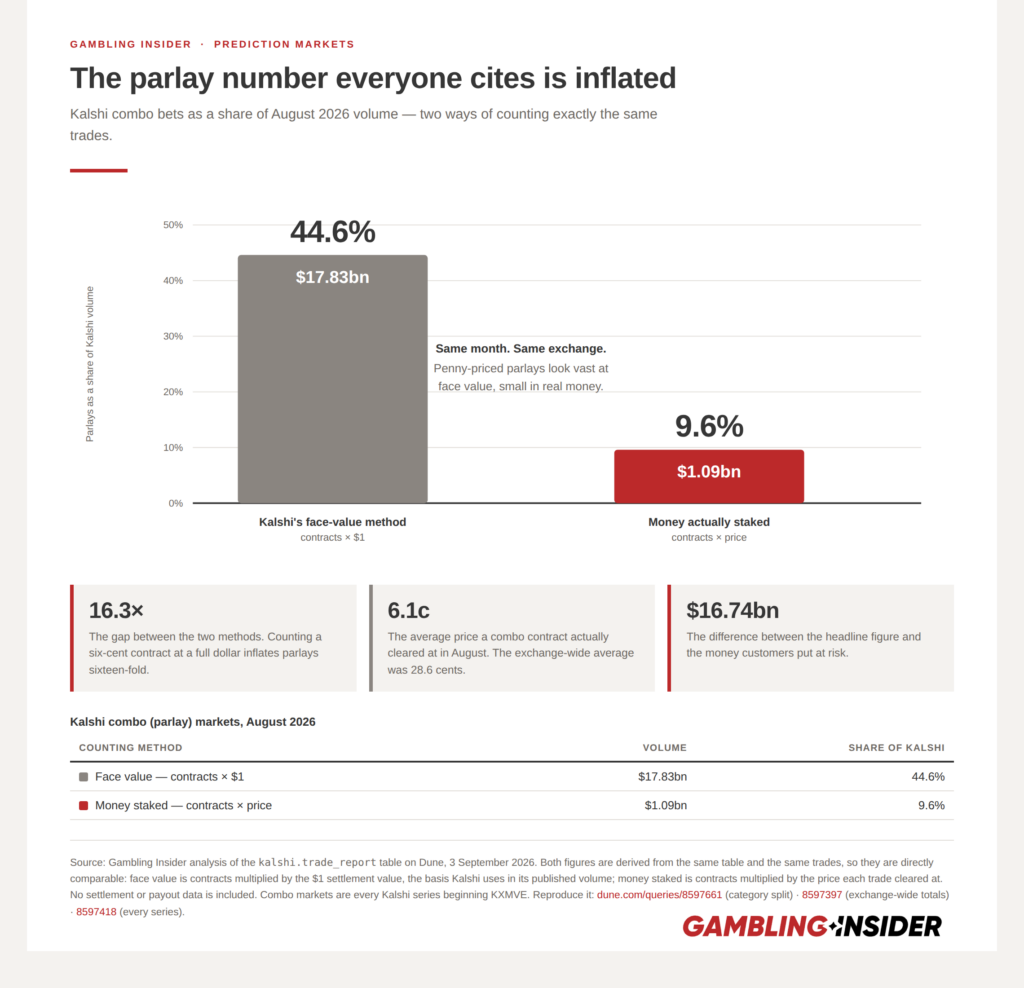
Parlays, Kalshi’s multi-leg “combo” bets, have become the symbol of its drift into sports betting. They are also the clearest case of the measurement trick. On the exchange’s face-value method, combos look enormous, about $17.8 billion in August, or 44% of volume. On the money-actually-traded basis, combos were $1.1 billion, or about 10%.
Both numbers are real. Only one describes customer money. The gap exists because combo contracts are penny bets: Gambling Insider’s earlier analysis found most combo contracts trade below 2 cents.
Counting them at a dollar inflates them roughly 16-fold. So the honest read is not that parlays are half of Kalshi. It is that parlays are a tenth of the money and a very expensive tenth: our trade-by-trade study found parlay buyers losing 16.6 cents on the dollar on ordinary days, against a sportsbook parlay hold of 19% to 21% in the filings of New Jersey and Maryland regulators — in the same territory as the product Kalshi says it is not.
This is also the source of a figure readers will have seen repeatedly: that some 80% of Kalshi’s volume is sports contracts or parlays. That number is counted at face value, and on that basis, it is broadly right.
Our own categorization, published as an open query, puts sports and combos together at 74.7% of August volume on the face-value method. But face value counts contracts, not money. Weighted by what customers actually staked, sports and combos fall to 58.5%, and combos alone collapse from 44.6% of the exchange to 9.6%.
What rises is the part of Kalshi that looks least like a sportsbook and most like a casino: short-dated crypto and commodity contracts go from a fifth of volume to more than a third, because they clear near 49 cents rather than six.
Kalshi has told regulators it is not a sportsbook. It has also earned a reported $35 million in parlay fees this year. Both things are on the record.
Polymarket Is Shrinking as Kalshi Surges
If Kalshi is the story on the prediction side, Polymarket is the cautionary tale. Its international platform, which runs on the Polygon blockchain and is valued at $21 billion after a $300 million investment by 1789 Capital in a $1 billion funding round, traded about $2.4 billion in August, counted the same one-sided way as Kalshi, according to our Polymarket analysis on Dune. Donald Trump Jr. is a partner at 1789 Capital.
Summing all the fills gives $4.7 billion. However, Polymarket’s on-chain data records both sides of each trade, so we halve it to compare like with like. That is real scale, but a fraction of Kalshi’s. Additionally, it is heading in the wrong direction: one-sided volume has slid from about $4.3 billion in June to $3.7 billion in July to $2.4 billion in August, even as Kalshi’s has climbed. The platform trades mostly politics, crypto, and current events rather than sports.
Polymarket runs two separate businesses for regulatory reasons.
U.S. customers have been barred from that international platform since January 2022, when the company settled with the Commodity Futures Trading Commission, paid a $1.4 million penalty, and agreed to block American users.
To get back in, it bought a CFTC-licensed exchange and clearinghouse, QCEX, for $112 million in July 2025. Subsequently, it won the regulator’s approval to open a separate, regulated U.S. exchange, which rolled out in December 2025 behind a waitlist.
Polymarket’s U.S. product is new and small relative to the international platform measured here, and its combo volume is a rounding error compared to Kalshi’s.
In sports and parlays, the very products pulling prediction markets toward the sportsbook, Polymarket arrived late, despite being the crypto-native pioneer of the whole category.
95% of Kalshi’s Money Sits in the Legal Grey Zone
Kalshi is not a sportsbook, and the distinction is worth keeping. On an exchange, both sides of every trade are customers, and the house is not the counterparty, which is why its volume is not straightforwardly comparable to a book’s handle.
The question the trade record answers is narrower: if the swap characterization is strongest where a contract answers to a real exposure, how much of Kalshi’s business actually looks like that? In August’s data, just six cents of every $10.
The convergence runs both ways, which is what makes it hard to regulate. Sportsbooks are pushing in: DraftKings’ prediction product passed $1 billion in annualized consumer volume, FanDuel launched its own, and BetMGM says competition from the category is lifting its customer acquisition costs.
The incumbents are visibly rattled, with DraftKings and Flutter shares well down over the past year, and Caesars and MGM both drawn into takeover talks. At the same time, the prediction venues are building products that look, price, and pay like betting.
The courts are now openly split. The Third Circuit affirmed Kalshi’s injunction in April; the Ninth Circuit held the opposite on Aug. 28; roughly two dozen states are in litigation, and New Jersey has asked the Supreme Court to take the question up. A split this clean on a question this commercially large is the classic candidate for review.
The CFTC still has to decide whether a sports parlay is an event contract or a bet that the exchange is not licensed to take.
The data does not settle the law. But it does answer the question underneath it. Whatever Kalshi is called, more than three-fifths of its money is on sports and a third is on short-dated crypto and commodity price contracts, led by quarter-hour markets. The part of the book with the least contested claim to federal protection is both tiny and shrinking.
Those are the numbers a regulator or an investor sizing a company that was last valued at $22 billion should be working from.
We Counted What Traders Actually Staked
The Kalshi figures are Gambling Insider’s aggregation of the exchange’s public trade record via the kalshi.trade_report table on Dune, as of Sept. 3, 2026 (see the link higher up the story), with volume measured as contracts multiplied by the price each trade cleared at.
We call this the premium, or the amount staked. Kalshi’s own convention instead values every contract at its $1 settlement value, which, based on August’s data, produces a figure 3.5 times larger across the exchange and 16.3 times larger on combos, where contracts cleared at an average of 6.1 cents against 28.6 cents exchange-wide.
No settlement or payout data enter our figures: the source table records trades only, so a winning $2 parlay that returns $98 contributes $2 and nothing more. Each Kalshi trade also has two sides whose prices sum to $1.00, and we count the premium on the ticker that traded. A sportsbook has one staking customer and the house; an exchange has two customers, so there is no single indisputable handle analog.
The table carries no taker/maker flag, so these are not taker-side figures and should not be compared with analyses that isolate takers. The category split classifies markets by their Kalshi series code. Combo (parlay) volume is every series beginning KXMVE.
Short-dated crypto and commodity markets are series ending in 15M, together with the named coin and metal series; sports single-game markets are the named league series; everything else is grouped as other, which is 7.1% of August’s staked volume and is itself mostly smaller sports leagues.
The macro-and-politics figure counts series covering Federal Reserve decisions, inflation, jobs, GDP, tariffs, equity indices, elections, nominations, and government funding. That grouping is our own and is offered as a proxy for the contracts with the most direct link to a financial, economic or commercial consequence; it is not a legal classification and no court has adopted it.
The full rules are visible in the SQL of our category query, and our series-level query lists every market series individually so readers can regroup them.
August is the month quoted for the category split because World Cup soccer series fall outside the league list in June and July. Polymarket figures come from the polymarket_polygon.market_trades table on Dune.
Summing both recorded sides gives $4.7 billion. Taking their mean — equivalent here to halving the combined total — gives about $2.35 billion, consistent with Paradigm’s recommended one-sided-volume approaches. That figure is Polymarket’s international, on-chain platform, from which U.S. customers have been barred since 2022.
Its separate CFTC-regulated U.S. exchange, launched in December 2025, is a different, much smaller product not captured here; Dune indexes only the on-chain international platform, not the CFTC-regulated U.S. venue. Kalshi’s figures and the sportsbook handle are U.S. markets. Sportsbook handle is from the American Gaming Association and state regulator filings.
2026 contains no U.S. general election, so the macro and politics findings describe the year as traded rather than all periods.
Kalshi and Polymarket were contacted for comment, but had not responded by publication time.


Gambling Insider delivers the latest industry news, in-depth features, and operator reviews that you can trust. Our team combines rigorous editorial standards with decades of specialized expertise to ensure accuracy and fairness. We are committed to delivering clear, impartial, and dependable coverage across the global gambling sector.