SiGMA Euro-Med: Is EU regulation ready for AI?
Panellists at SiGMA Euro-Med discussed whether regulation is ready to maintain rapid technological change.

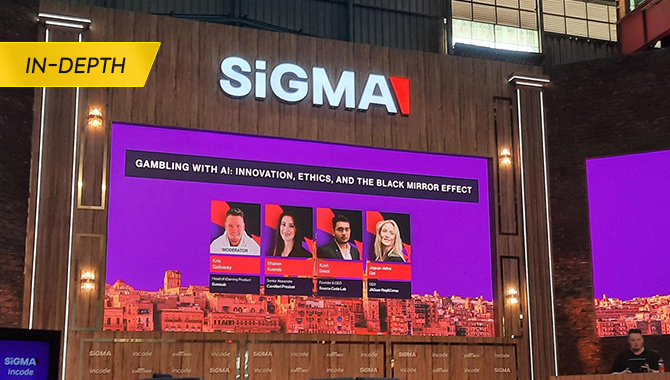
Kris Galloway, Head of iGaming Product at Sumsub, led a panel titled ‘Gambling with AI: Innovation, ethics and the Black Mirror effect’ at SiGMA Euro-Med 2025. Joining him was Sharon Xuereb, Senior Associate at Camilleri Preziosi; Kush Desai, Founder & CEO at Source Code Lab; and Jaguar-Adva Gal, CEO of JAGuar Reg&Comp.
Considering the broader picture and upcoming legislation, is AI the saviour of iGaming, or the start of the industry’s very own Black Mirror episode? And, if it’s the latter, then how does it end?
Sharon Xuereb: In classical legal language, I’ll give you an answer that’s neither here nor there. Let’s start by asking whether we can define it as a saviour or as a Black Mirror dystopia. It would be premature for us to say. We’re not quite there yet, to say we have a dystopian society because of the technology that has been rolled out so far. But, I think we’re at a very crucial juncture. If you take the saviour approach, AI is going to help us determine harmful effects, and could be a legal guardian.
We’ve seen the EU AI Act, the usual suspect, the EU General Data Protection Regulation (GDPR). If we keep things within these parameters, I’m sure we’ll be able to contain certain practices.
Let’s take the Black Mirror angle. We have not so far had the opportunity to see to what extent this technology is going to take us, but we’re certainly going to see things like agentic AI rolled out soon, possibly sooner than we think, and I am not sure if the EU laws have the right safeguards.
From a legal perspective, do you think there’s either a degree of arrogance or do you think we have every right in the world to expect the legal framework to accommodate AI when it specifically comes to iGaming? Or, do we have every right in the world to protect that?
Jaguar-Adva Gal: AI has existed for dozens of years. Generative AI has been out to the public only recently, around 2021, but it has belonged to corporations for 10 years before. It is a technology, it is statistically based. But, the only thing that’s going to be different is that it’s generative. We’ve had PR and we’ve had analytics, the Internet and e-commerce, to gain players. We would be leading them, because of capitalism, to buy more. We sell entertainment – it’s no different to theatre or music.
There are fears of whether it would be able to manipulate users. Of course it will, that’s the whole point of a capitalistic business. What we must discuss is the limits. AI is a great technology for everything, quite like the internet. It’s already changed processes and detection in our area, gaming utilisation and manipulation. It can increase sales.
I think it’s another saviour. Not the saviour, but yet another progress and the whole discussion should be the limits.
Technology will change much faster than the regulations and requirements. Therefore, the ones who will obey will be left behind.
Personalisation makes gambling feel smarter, but when does tailored start to feel like trapped?
Kush Desai: All users want to watch Netflix because Netflix recommends shows we’d like to watch. Personalisation is one of the major use cases for AI. The biggest challenge is going to be finding the balance between personalisation and manipulation. At what point does personalisation become such a compulsive loop for users that they’re addicted to the platform? That’s where the biggest challenge is, between the operator and regulator.
Jaguar: The player will feel trapped. Big news, right? But I think we should not care so much about our opinions, but ask, what is the value? What value can we bring to you?
But surely, if you are bringing value, users should not feel trapped?
Gal: The value [lawyers] bring is, you got it. Go after the clients. Do what you need, because that’s what you know how to do best. Let us, the regulators, regulation advisors such as myself, cover your backs, regarding the limitations, the regulatory hustle and the limits of each new regulation.
Trapped is a negative word. Everybody wants to do things right, responsible gaming, but the whole point is to create stickiness.
There are fears of whether it would be able to manipulate users. Of course it will, that’s the whole point of a capitalistic business
In regard to responsible gambling, do you feel AI can balance proper regulatory protection, or is that really just a sales pitch?
Desai: I think until it’s done, it’s just a sales pitch. The thing is, regulations always follow innovation, correct? AI is very new. None of us know how it’s going to go.
At a regulated level, is there enough for the legislation to be effective?
Gal: Regulations in the very near future will have no chance to fulfil their purpose. The GDPR was successful in increasing privacy, but GDPR was able to educate the world and the media on the importance of privacy. That was great. However, the EU AI Act was drafted very similarly to the GDPR. There’s a major difference here.
For example, you’ve mentioned the fact that to avoid biases… we require a human being. That is it for now. It could work, but it is useless in the future, because some of them who are not regulated (of course, some are doing that already), are doing everything without humans.
Technology will change much faster than the regulations and requirements. Therefore, the ones who will obey will be left behind.



Gambling Insider delivers the latest industry news, in-depth features, and operator reviews that you can trust. Our team combines rigorous editorial standards with decades of specialized expertise to ensure accuracy and fairness. We are committed to delivering clear, impartial, and dependable coverage across the global gambling sector.