Profit is the name of the game in iGaming. Everything revolves around it: building processes, making tough calls, and sometimes parting ways with people you thought were untouchable. If your business isn’t laser-focused on profitability, your chances of surviving in this cutthroat market are slim. And when you realize your profit has flatlined even though the KPIs look good on paper, that’s your cue for a major shake-up. We at PIN-UP Partners hit that exact wall.
Our old management model simply stopped scaling. It couldn’t keep up with new challenges. The warning signs were everywhere in the numbers, in the people, in the results. It became obvious: if we kept moving forward with the same setup, we’d lose both pace and money. That’s when we decided to pull the trigger on a complete “team redesign” — rethinking goals, roles, processes, and structure to match the business’s new reality.
I’ve been working with traffic for over 15 years, growing and scaling dozens of successful projects. One thing my experience has taught me: every single time we’ve done a redesign, profit followed. But it’s not about chasing change for the sake of change. In this piece, I’ll break down what a “redesign” really means, and why it’s the most powerful lever a team can pull.
How PIN-UP Partners got into team “redesigns”
Every team, just like any product, runs through a lifecycle:
formation → growth → overload → transformation
At first, everything runs on enthusiasm and motivation. Then it’s all about experience. But sooner or later, the team starts stalling: goals get fuzzy, the structure no longer fits the tasks, and efficiency drops. That’s the moment you know it’s time for a “redesign.”

Over the past 9 years, PIN-UP Partners went from a classic linear setup to a hybrid model with both centralized and cross-functional teams. This shift made it possible to react fast to changes and manage complex processes at scale. And yes — that translates directly into profit.
Truth is, more than 90% of companies could boost their profit by 1.5–2x just by making smarter management moves. So why don’t they?
- Decisions are made based on gossip and competitor moves instead of complex analytics.
- A “family culture” takes over instead of a real working environment. At PIN-UP Partners, we use the word “team” deliberately because everyone is united by a common goal, not by cozy vibes.
- Leaders cling to people who used to deliver results. Contribution matters, but it’s today’s impact that counts.
- No regular performance reviews, especially with metrics that show real profit, not vanity numbers.
The fix? Accept that redesigning your team isn’t a one-time crisis response; it’s an ongoing fine-tuning process. Treat it like calibration, not like putting out a fire after the house is already burning.
Team redesign as a continuous process
Management isn’t like software development, and there’s no “final version.” What works today might hold you back tomorrow. I’ve seen strong teams slip into irrelevance simply because they kept playing by outdated rules. Some stuck with KPIs that no longer mattered, others clung to “right” metrics that had nothing to do with the actual state of the business.
So how do you know it’s time to shake things up? For me, the signal is simple: any dip in profit or in the team’s energy.
That’s why at PIN-UP Partners, we regularly review and reset:
- Our structure and management model.
- KPIs and performance metrics.
- Individual goals for everyone (from juniors to C-level execs).
My experience has proven one simple truth: performance drops for everyone, sooner or later. People’s goals shift. Motivation changes. Some burn out, others are hungry for a new challenge. The leader’s job is to spot this in time and rebuild the system so both the people and the business keep growing.
Up next, three real stories from my practice where structural changes directly pushed our profit up.
Redesign #1: shifting traffic media buying priorities
Back in 2018, traffic acquisition for PIN-UP Partners was simple and almost routine. We had three specialists running two main sources — Facebook and ASO. That was more than enough.
Traffic was dirt cheap ($20–25 per FD) and paid back within two months. The setup was straightforward: a small pool of sources, minimal experimentation, and clear ROI. But golden ages in business never last. Comfort zones have a nasty way of blinding you to how fast the market is changing. That’s exactly what happened at PIN-UP Partners.
About a year later, it became obvious the whole approach needed a shake-up:
- For every new player, three old ones were churning back.
- Our monobrand user pool had become one of the smallest on the market.
- Payback periods stretched longer and longer (a global trend, fueled by rising competition, weak BI that couldn’t track ROI, and the usual copy-paste bidding wars against competitors).
We hit a paradox: the team was grinding harder than ever, but growth had flatlined. The issue wasn’t the people, it was the system itself. It no longer matched the scale and complexity of the business.
After discussing it with the team, I made the call to launch a redesign.
At times, it felt counterintuitive, like we were breaking something that had worked well for years. Not everyone agreed. But you can’t argue with economics, so we dove into changes. First, we shifted from opportunistic media buying to a systematic approach where every channel could be tracked and counted. Second, we started building the brand and branching out to new platforms. For example, movie sites, where we quickly carved out a niche and locked in long-term contracts.
Step by step, the redesign rolled out:
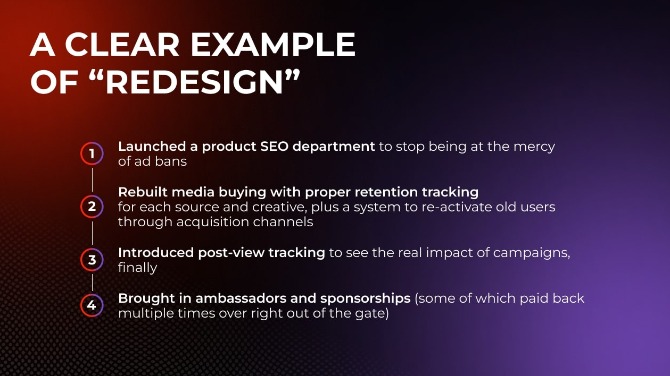
The result was great. Key business metrics and profit went up. But the real win was bigger: PIN-UP Partners learned how to build processes and departments around the business’s current needs, not outdated habits.
That was the first time I fully grasped the power of a team “redesign”, and how it could open completely new horizons for an affiliate program.
Redesign #2: optimizing in-house SEO
The traffic acquisition overhaul taught us to pay closer attention to unit economics. Naturally, we tried the same lens with SEO, and that’s when the bomb dropped: one branded FD was costing us over $100, four times higher than the market average. It was clear as day: if we didn’t change the course, we’d just keep losing money.
When PIN-UP Partners first got serious about in-house SEO, the branded traffic market was running on gut feel. Advertisers were throwing absurd amounts of money into PPC and SEO, and nobody was counting profit. GGR hypnotized everyone. In hybrid models, this was especially glaring.
Starting wasn’t easy. The community was closed off, affiliate teams didn’t get SEO, and webmasters dictated the rules. Without some baseline standards, the whole system was doomed. So I made one of the most important calls: we set a fixed bid on our brand, the same for both SEO and PPC. Later, every competitor copied this practice, though much later.
The real challenges were still ahead. Competition among webmasters was thin, and trying to negotiate site setups for branded traffic was next to impossible. So I went public with a case study showing traffic volumes on our brand. That flipped the switch: within six months, SEO competition heated up, we gained control over SERPs, and could finally push back against cross-brand cannibalization.
On the surface, things in licensed GEOs looked transparent. But inside, cracks appeared. The SEO team had grown to 120 people and was operating like its own mini-company, detached from the wider business goals. It seemed to be running fine until we started looking at the numbers.
In the end, SEO was brought under the PIN-UP Partners umbrella, and we had to rebuild its structure from the ground up. I personally went through hundreds of pages of regulations, dissecting every process, and cut out everything that didn’t serve efficiency.
Here’s how we approached the SEO “redesign”:
- Shifted from classic white-hat SEO to modern, market-driven methods.
- Spun off part of the team into a separate business unit.
- Introduced profit-based bonuses tied to real GEO market rates.

Today, our in-house SEO holds strong positions in branded SERPs and is gaining share in key markets. By year-end, our goal is to capture up to 40% in several of them. The big win? We’re no longer drifting along and bleeding profit. PIN-UP Partners actively manages SEO as a profit center, and that only became possible through redesign.
Redesign #3: retargeting
My love affair with retargeting started back in the TraffLab days. Retargeting “pops” (basically homepage traffic) were pulling 3000% ROI. It was the golden age of AliExpress, Wildberries, and Lamoda, when a single well-tuned stream could pay back dozens of times over.
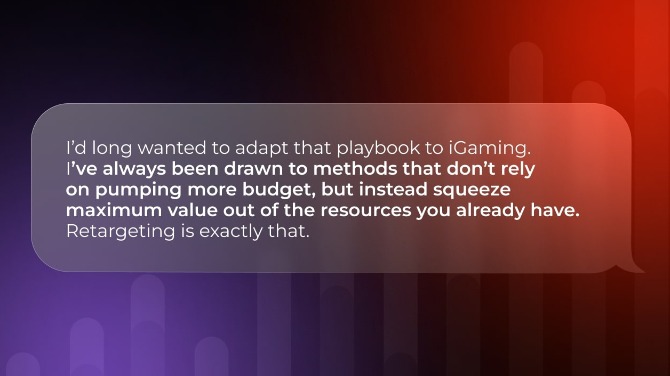
But in iGaming, it’s trickier: traffic sources are fragmented, setups unstable, and you’re forced to collect audiences piece by piece. For a long time, it felt impossible to build it at a systemic level.
The turning point came when new tools hit the market, and PIN-UP Partners developed analytics sharp enough to measure efficiency down to the decimal. Suddenly, the numbers made it crystal clear: retargeting in iGaming could become one of the most profitable player-return channels out there.
Here’s what we changed at PIN-UP Partners:
- Built an efficiency measurement system by integrating product analytics into Tableau.
- Created over 10,000 audience segments tailored to different behaviors and scenarios.
- Aligned arbitrage, media buying, and product teams into one effort.
Then, we automated the whole machine to the point where one specialist runs it today. Retargeting transformed from a chaotic, labor-heavy experiment into a predictable, scalable retention channel. A/B tests in one GEO showed the redesign boosted GGR by +30%. On top of that, ROI consistently beats most acquisition channels.
With unified processes, automation, and laser-precise analytics, PIN-UP Partners now know exactly which segments perform best — and how they scale when volume ramps up. That’s how retargeting went from “nice idea, but messy” to a real profit driver.
The Takeaway
A team redesign isn’t about buzzwords — it’s about making business processes meaningful. My advice is to always ask yourself the hard questions: Why are we here? What are we trying to achieve? Who owns what? If you keep answering them honestly and regularly, your team’s results will improve, and so will your profit.

If you skip redesign, your team will just grow by inertia. You’ll end up with a pile of people, endless reports, and shiny regulations, but no profit growth. Treat team redesign as a constant process, and those coveted multipliers, the real “X’s”, will follow.



Gambling Insider delivers the latest industry news, in-depth features, and operator reviews that you can trust. Our team combines rigorous editorial standards with decades of specialized expertise to ensure accuracy and fairness. We are committed to delivering clear, impartial, and dependable coverage across the global gambling sector.